
 Bitten or stung?
 All animals
 Pick a continent
 Africa
 Asia
 Europe
 South America
 Australia & Oceania
 Antarctica
 Pacific Ocean
 Atlantic Ocean
 Indian Ocean
 Arctic Ocean
 Mediterranean Sea
 Red Sea
 Caribbean Sea
 Coral Sea
 South China Sea
 Philippine Sea
 Andaman Sea
 North Sea
 Timor & Arafura Sea
 Bay of Bengal
 Gulf of California
 Games
 Venom battle
 Animal race
 Field notebook
 Venom TOP lists
 Stay safe
 Surprise me

Rinkhals
 Sprays or spits
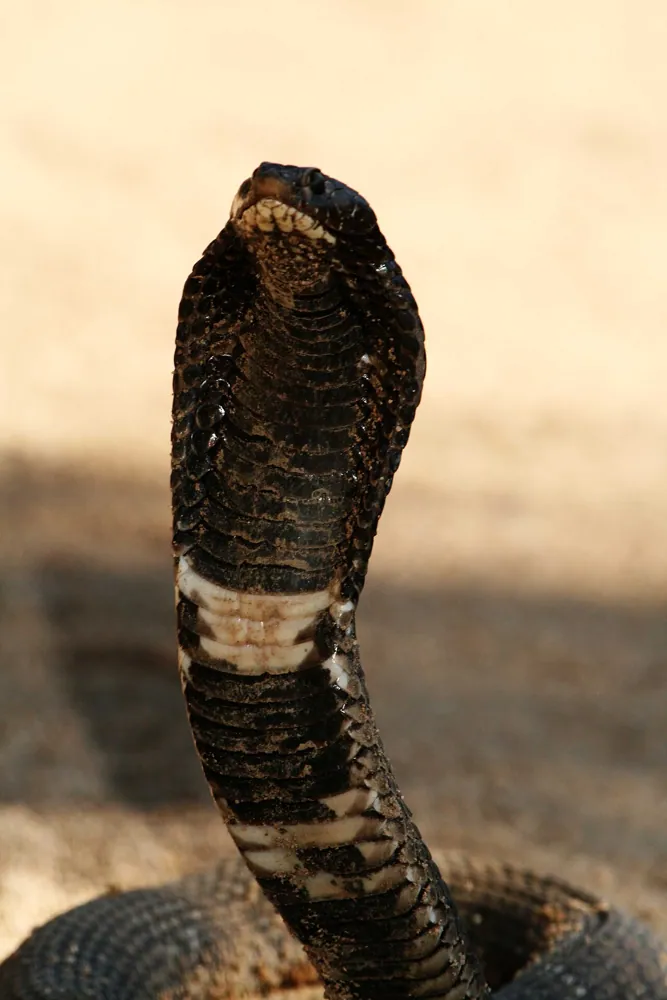
The rinkhals is a venomous snake that lives in southern Africa. It is often called the ring-necked spitting cobra, but it is not a true cobra. It is known for spitting venom at threats rather than relying on its bite.1
 How to recognise it
- Its belly is dark, with one or two light-coloured crossbands on the throat.1
- Its usual total length, including the tail, is 90 to 110 cm.1
- Colour varies. Some individuals are mostly black, while others are striped.1
- When distressed, it spreads its hood to show a striped neck.1
- Its dorsal scales are keeled, which means they have a ridge down the middle.1
Often confused with: It closely resembles true cobras, which belong to the genus Naja. Its keeled dorsal scales and the lack of solid teeth on the maxilla (upper jaw bone) set it apart, and these differences are why it is placed in its own genus, Hemachatus.1
Venom power
It sprays or spits a stinging liquid at attackers.
What does its venom do?
Its venom is neurotoxic, meaning it attacks the nerves, and partially cytotoxic, meaning it destroys body tissue. A bite causes great pain and can lead to necrosis (death of tissue). General symptoms include drowsiness, nausea, vomiting, violent abdominal pain, cramps and vertigo, and local swelling and bruising occur in about a quarter of cases.1
How dangerous is it to people?
Danger to people: SeriousA bite or venom in the eyes needs a doctor. Deaths are very rare.Bites are rare, because the snake relies on other defences first. Most bites happen when people try to handle it. No fatality from a rinkhals bite has been recorded in over 40 years.1
 Good news: doctors have a medicine (antivenom) or a treatment for this.1
What does it do when it is scared?
When threatened, it spreads its hood, hisses and lunges while spitting venom accurately up to 3 m, usually aiming at the face and eyes. If other defences fail, it may bite, and it can also roll over with its mouth open and tongue out.1
 If it bites or spits
Always call your emergency number first (for example 112 in Europe, 911 in North America, 000 in Australia).
- If venom gets into the eyes, rinse them at once with lots of clean water for at least 10 minutes, without rubbing, and see a doctor. For a bite, keep the person calm and still, do not cut, suck or use a tight band, and call the emergency number to get to hospital. Polyvalent antivenom works for rinkhals bites.1
- Keep the person still and calm, remove rings and tight things, and get to a hospital fast: antivenom is the treatment. Be ready to give rescue breaths or CPR if breathing gets weak or stops.
- If venom was spat into the eyes, rinse them with lots of clean water straight away.
This is general first aid guidance, not medical advice. Based on the first aid guidelines of the World Health Organization and the Australian Resuscitation Council. Facts come from public sources and may contain mistakes. When in doubt, always get medical help. First aid basics
 Stay safe
- Never touch, catch or tease a wild animal, even a small one, and even if it looks asleep or dead.
- Give it space. If you meet one, stay calm, step back slowly and let it go its own way.
- If one bites you or spits venom in your eyes: stay calm, keep still, call your emergency number (for example 112 in Europe, 911 in North America, 000 in Australia) or get to a hospital fast. Remember what it looked like, a photo helps.
It is not out to get you. It uses its venom to catch food or to protect itself, and it would much rather hide. More about staying safe
Where in the world?
How big is it?
How long is it?
 as long as 2 house cats nose to tail
 as long as 6 bananas end to end
 could cover 100 metres in 52 seconds (the fastest human needs 9.6)
How big is Rinkhals compared to you?
Just maths in your browser. Nothing is saved or sent anywhere.
How fast is it?


Facts
When threatened, it can play dead by rolling onto its back with its mouth open and tongue out. This behaviour, called thanatosis, is also seen in some other snakes.1
It can spit venom accurately at targets up to 3 m away and has good control over its venom glands.1
Unlike true cobras, which lay eggs, it gives birth to live young.1
It is not a true cobra. It belongs to its own genus, Hemachatus.1
Myth buster
Myth: The rinkhals is a true cobra.
Truth: It bears a great resemblance to true cobras, but it belongs to the genus Hemachatus rather than Naja, so it is not a true cobra.1
For venom experts
- Scientific name
- Hemachatus haemachatus
- Group
- Cobras, mambas & kraits
- Also called
- Ringhals, Ring-necked spitting cobra, Common rinkhals1
- Family
- Elapidae2
- Order
- Squamata
- Continents
- Africa
- Babies
- It gives birth to live young rather than laying eggs. A litter usually has around 20 to 30 young, though some females give birth to over 60, typically in late summer (December to March in the southern hemisphere).1
- Danger to people
- 3 / 5: Serious3
Where the facts come from
- Rinkhals (Wikipedia (CC BY-SA 4.0))
- Hemachatus haemachatus (iNaturalist): names and classification.
- Venom Wiki: the danger level, the typical size and the speed guess are our own. See how we work them out: How we rate danger.
Every fact on this page has a number that points to its source. If we got something wrong, sorry, we are animal fans, not a science journal. Tell us at [email protected] and we will fix it.
Get the Venom Wiki app
Every creature, every picture and the games in your pocket, even without internet.


 Support Venom Wiki Venom Wiki is a one-man project: free, with no ads and no cookies. A small tip helps keep it online.Feed the scorpion
 Black mamba
 Egyptian cobra
 Cape cobra
 Eastern green mamba
 Jameson's mamba
 Western green mamba
 Deathstalker
 Puff adder
 Boomslang
 Fat-tailed scorpion
 Gaboon viper
 Western honey bee
