
 Afrika
 Asien
Asien Europa
 Südamerika
 Australien & Ozeanien
 Antarktis
 Pazifischer Ozean
 Atlantischer Ozean
 Indischer Ozean
 Nordpolarmeer
 Mittelmeer
 Rotes Meer
 Karibisches Meer
 Korallenmeer
 Südchinesisches Meer
 Philippinensee
 Andamanensee
 Nordsee
 Timorsee & Arafurasee
 Golf von Bengalen
 Golf von Kalifornien
Eastern yellowjacket
 Stiche
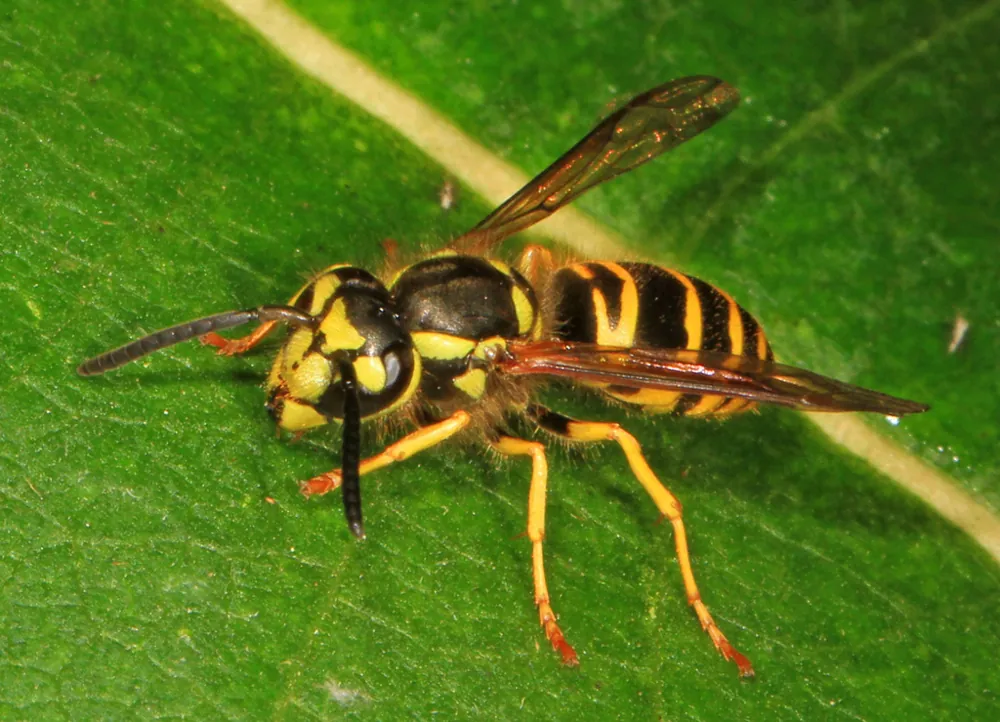
The eastern yellowjacket is a black and yellow wasp that lives in eastern North America. It builds paper nests, many of them underground, and lives in large family groups called colonies. People often meet it around recreational areas and buildings, and it can give a painful sting if its nest is threatened.1
 So erkennst du es
- Black and yellow lines on the head, thorax and abdomen1
- Length of about 12.7 to 15.9 mm1
- Spots on the head, which give the species its scientific name1
- Queens have one flared black line nearest the thorax, followed by thinner black lines, with two black dots between each line1
Oft verwechselt mit: It can be told apart from other wasp species by its smaller size and its abdominal pattern. Other yellowjacket species are also black and yellow, and in most areas where it lives, this is the most common yellowjacket species.1
Giftkraft
Das Gift kommt durch einen Stachel heraus.
Was macht sein Gift, wenn es beißt oder sticht?
Its sting is painful. Wasps, bees, ants and sawflies (the order Hymenoptera) are the leading cause of anaphylaxis in humans, a severe allergic reaction. These reactions are usually triggered by proteins in the venom. Peptides called vespulakinins were first found in this species and are insecticidal, meaning they kill insects.1
Wie gefährlich ist es für Menschen?
Gefahr für Menschen: SchmerzhaftEs kann richtig wehtun, ist aber fast nie gefährlich.It is known to inflict painful stings and defends its nest aggressively. Its nests are often treated as a pest because they are found so often in recreational and residential areas.1
Was macht es, wenn es Angst hat?
When threatened, workers release an alarm pheromone that calls others to attack. Wasps near the nest entrance circle in a zigzag pattern and fly straight at the target.1
 Wenn es sticht
- Kratz den Bienenstachel heraus und kühl die Stelle.
- Wenn die Person Atemnot hat, Gesicht oder Hals anschwellen oder ihr schwindlig wird, ist das ein allergischer Notfall: Ruf deine Notrufnummer an und benutze ihren Adrenalin-Autoinjektor, wenn sie einen hat.
Ruf immer zuerst deine Notrufnummer an (112, 000, 911). Das sind allgemeine Erste-Hilfe-Hinweise, keine ärztliche Beratung. Erste-Hilfe-Grundlagen
 Bleib sicher
- Fass ein wildes Tier niemals an, fang es nicht und ärgere es nicht, auch kein kleines, und auch nicht, wenn es schlafend aussieht oder tot.
- Halte Abstand. Wenn du einem begegnest, bleib ruhig, geh langsam zurück und lass es seiner Wege gehen.
- Wenn dich eines sticht: Bleib ruhig, halt still, ruf deine Notrufnummer an (112, 000, 911) oder fahr schnell in ein Krankenhaus. Merk dir, wie es aussah, ein Foto hilft.
Es hat es nicht auf dich abgesehen. Es benutzt sein Gift, um Futter zu fangen oder sich zu schützen, und versteckt sich viel lieber. Mehr über Sicherheit
Wo auf der Welt?
Wie groß ist es?
Wie lang ist es?
Wie schwer ist es?
 kürzer als dein kleiner Finger
 so leicht, dass du es auf deiner Hand nicht spüren würdest
 könnte in 16 Sekunden über ein ganzes Fußballfeld fliegen
Wie groß ist Eastern yellowjacket im Vergleich zu DIR?
Nur Rechnen in deinem Browser. Nichts wird gespeichert oder irgendwohin geschickt.
Wie schnell ist es?


Fakten
A large nest can have 10,000 to 15,000 cells, and about a third of them are queen cells.1
The nest envelope is made from chewed, decaying wood mixed with saliva, which makes it fragile.1
The species is a host for a social parasite, Vespula squamosa, which can take over its nests.1
Males gather in groups around prominent trees and bushes, where they patrol and wait for queens.1
Queens can mate with several males, and both queens and males can mate more than once.1
Für Giftexperten
- Wissenschaftlicher Name
- Vespula maculifrons
- Gruppe
- Bienen, Wespen & Hornissen
- Familie
- Vespidae2
- Ordnung
- Hymenoptera
- Kontinente
- Nordamerika
- Babys
- A queen founds a new colony in spring by laying eggs in the first cells. The eggs hatch into workers, which then build and enlarge the nest.1
- Gefahr für Menschen
- 2 / 5: Schmerzhaft3
Woher die Fakten kommen
- Eastern yellowjacket (Wikipedia (CC BY-SA 4.0))
- Vespula maculifrons (iNaturalist): Namen und Klassifikation.
- Venom Wiki: die Gefahrenstufe, die typische Größe und die geschätzte Geschwindigkeit sind von uns. So berechnen wir sie: So bewerten wir die Gefahr.
Jeder Fakt auf dieser Seite hat eine Nummer, die auf seine Quelle zeigt. Wenn wir etwas falsch haben: Entschuldigung, wir sind Tierfans, keine Fachzeitschrift. Schreib uns an [email protected] und wir korrigieren es.
 Der Skorpion hat Hunger! Venom Wiki ist ein Ein-Mann-Projekt: kostenlos, ohne Werbung und ohne Tracker. Ein kleines Trinkgeld hilft, es online zu halten.Füttere den Skorpion
Mehr aus derselben Gruppe: Bienen, Wespen & Hornissen
 Tarantula hawkBienen, Wespen & HornissenTut nur weh
 Executioner waspBienen, Wespen & HornissenBraucht einen Arzt
 Warrior waspBienen, Wespen & HornissenBraucht einen Arzt
 Bald-faced hornetBienen, Wespen & HornissenTut nur weh
 Cow killer velvet antBienen, Wespen & HornissenTut nur weh
 Eastern cicada killerBienen, Wespen & HornissenHarmlos
 Terciopelo
 Eastern coral snake
 Eastern diamondback rattlesnake
 Eyelash viper
 Timber rattlesnake
 Western diamondback rattlesnake