
 Afrika
 Asien
Asien Europa
 Südamerika
 Australien & Ozeanien
 Antarktis
 Pazifischer Ozean
 Atlantischer Ozean
 Indischer Ozean
 Nordpolarmeer
 Mittelmeer
 Rotes Meer
 Karibisches Meer
 Korallenmeer
 Südchinesisches Meer
 Philippinensee
 Andamanensee
 Nordsee
 Timorsee & Arafurasee
 Golf von Bengalen
 Golf von Kalifornien
Southern yellowjacket
 Stiche
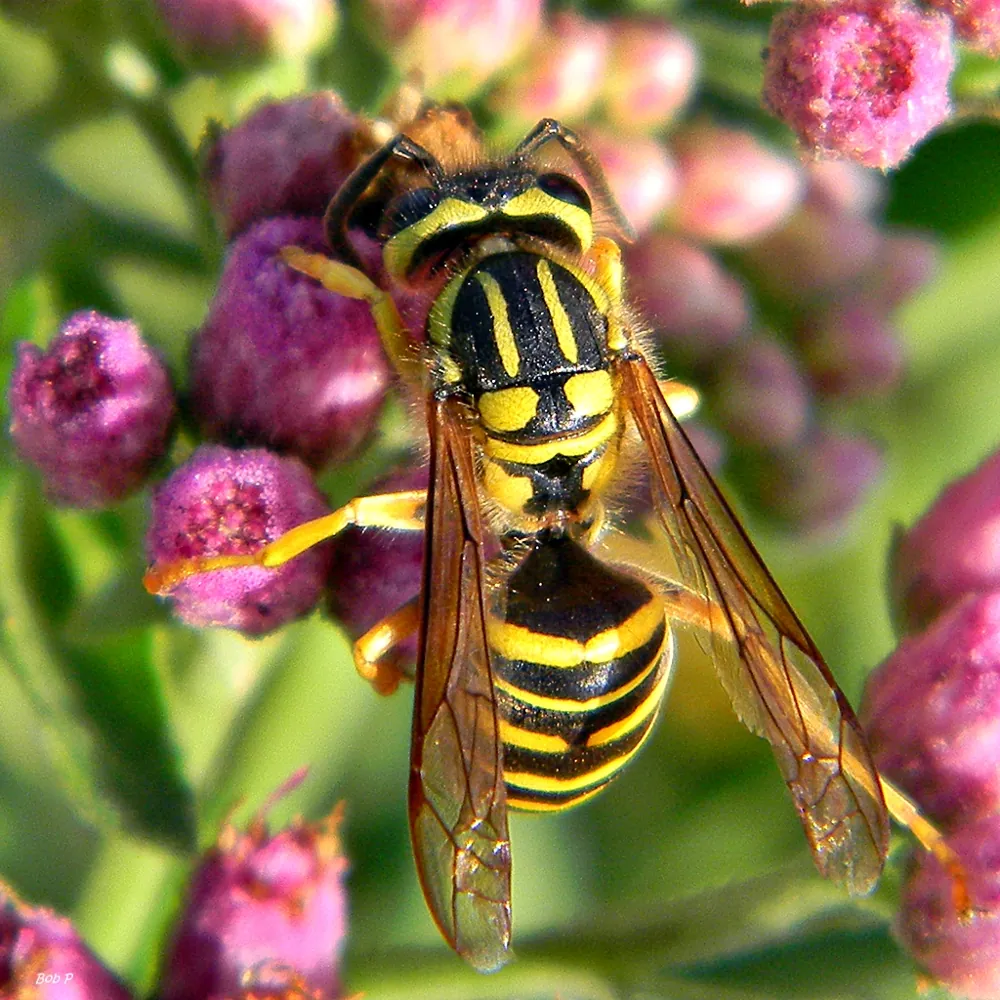
The southern yellowjacket is a social wasp with black and yellow stripes and an orange queen. It lives in eastern North America and further south into Central America. Its nests are often in yards, parks and by roads, so people meet it often, and its stings are painful.1



 So erkennst du es
- Black body with yellow striping over the whole body1
- Clear wings and a hairless body1
- About 1.3 cm long1
- The queen is larger than the males and workers and is more orange in colour1
- Has two stripes on its scuta1
Oft verwechselt mit: Its two stripes on the scuta are shared with V. sulphurea. The queen looks different from the workers and males, so check the colour and size of the wasp you see.1
Giftkraft
Das Gift kommt durch einen Stachel heraus.
Was macht sein Gift, wenn es beißt oder sticht?
Its stings are venomous, and the venom causes pain. Workers can sting several times in one attack.1
Wie gefährlich ist es für Menschen?
Gefahr für Menschen: SchmerzhaftEs kann richtig wehtun, ist aber fast nie gefährlich.The species is considered a pest because its nests are close to people and can be large. Close contact with people commonly leads to multiple, painful stings. Disturbing a nest can result in several stings.1
Was macht es, wenn es Angst hat?
Workers release alarm pheromones that signal the rest of the colony to attack whatever threatens the nest. Their stings are typically used in defence of the colony.1
 Wenn es sticht
- Kratz den Bienenstachel heraus und kühl die Stelle.
- Wenn die Person Atemnot hat, Gesicht oder Hals anschwellen oder ihr schwindlig wird, ist das ein allergischer Notfall: Ruf deine Notrufnummer an und benutze ihren Adrenalin-Autoinjektor, wenn sie einen hat.
Ruf immer zuerst deine Notrufnummer an (112, 000, 911). Das sind allgemeine Erste-Hilfe-Hinweise, keine ärztliche Beratung. Erste-Hilfe-Grundlagen
 Bleib sicher
- Fass ein wildes Tier niemals an, fang es nicht und ärgere es nicht, auch kein kleines, und auch nicht, wenn es schlafend aussieht oder tot.
- Halte Abstand. Wenn du einem begegnest, bleib ruhig, geh langsam zurück und lass es seiner Wege gehen.
- Wenn dich eines sticht: Bleib ruhig, halt still, ruf deine Notrufnummer an (112, 000, 911) oder fahr schnell in ein Krankenhaus. Merk dir, wie es aussah, ein Foto hilft.
Es hat es nicht auf dich abgesehen. Es benutzt sein Gift, um Futter zu fangen oder sich zu schützen, und versteckt sich viel lieber. Mehr über Sicherheit
Wo auf der Welt?
Wie groß ist es?
Wie lang ist es?
 so klein, dass es auf deinen Fingernagel passt
 könnte in 16 Sekunden über ein ganzes Fußballfeld fliegen
Wie groß ist Southern yellowjacket im Vergleich zu DIR?
Nur Rechnen in deinem Browser. Nichts wird gespeichert oder irgendwohin geschickt.
Wie schnell ist es?


Fakten
Most southern yellowjackets are social parasites: they build their nests around the nests of another species.1
About 85% of colonies start when a queen takes over a small nest of the eastern yellowjacket, V. maculifrons, and only about 15% are founded independently.1
Some nests are very large. One of the biggest reported was in a pine tree and the dirt beneath it, and it had over 50 combs in the trunk alone.1
In Florida and other southern coastal areas, some nests survive the winter and last for several years.1
Workers and queens use pheromones to communicate, with alarm signals for attacks and a different pheromone that attracts males to the queen.1
Woher die Fakten kommen
- Vespula squamosa (Wikipedia (CC BY-SA 4.0))
- Vespula squamosa (iNaturalist): Namen und Klassifikation.
- Venom Wiki: die Gefahrenstufe, die typische Größe und die geschätzte Geschwindigkeit sind von uns. So berechnen wir sie: So bewerten wir die Gefahr.
Jeder Fakt auf dieser Seite hat eine Nummer, die auf seine Quelle zeigt. Wenn wir etwas falsch haben: Entschuldigung, wir sind Tierfans, keine Fachzeitschrift. Schreib uns an [email protected] und wir korrigieren es.
 Der Skorpion hat Hunger! Venom Wiki ist ein Ein-Mann-Projekt: kostenlos, ohne Werbung und ohne Tracker. Ein kleines Trinkgeld hilft, es online zu halten.Füttere den Skorpion
Mehr aus derselben Gruppe: Bienen, Wespen & Hornissen
 Tarantula hawkBienen, Wespen & HornissenTut nur weh
 Executioner waspBienen, Wespen & HornissenBraucht einen Arzt
 Warrior waspBienen, Wespen & HornissenBraucht einen Arzt
 Bald-faced hornetBienen, Wespen & HornissenTut nur weh
 Cow killer velvet antBienen, Wespen & HornissenTut nur weh
 Eastern cicada killerBienen, Wespen & HornissenHarmlos
 Terciopelo
 Eastern coral snake
 Eastern diamondback rattlesnake
 Eyelash viper
 Timber rattlesnake
 Western diamondback rattlesnake
_(7225863346).jpg)