
 África
 Asia
Asia Europa
 Sudamérica
 Australia y Oceanía
 Antártida
 Océano Pacífico
 Océano Atlántico
 Océano Índico
 Océano Ártico
 Mar Mediterráneo
 Mar Rojo
 Mar Caribe
 Mar del Coral
 Mar de China Meridional
 Mar de Filipinas
 Mar de Andamán
 Mar del Norte
 Mar de Timor y de Arafura
 Golfo de Bengala
 Golfo de California
American toad
 Veneno en la piel
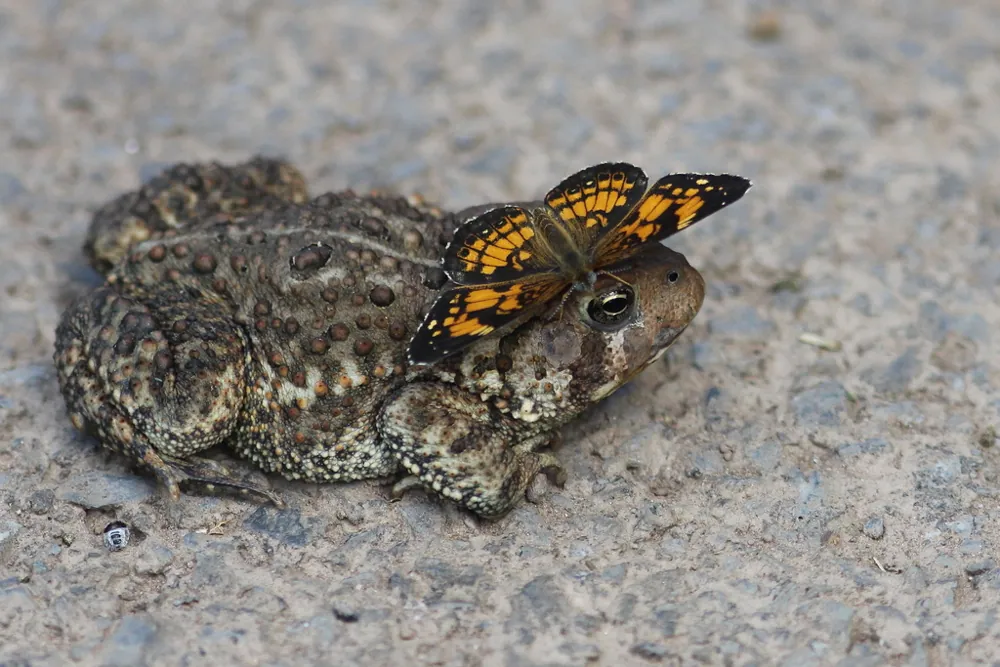
The American toad is a common toad found across the eastern half of Canada and the United States. It lives in forests, grasslands and gardens, and it breeds in shallow ponds and pools. It matters because it eats many insects and other small creatures, and its skin releases a substance that can irritate eyes and harm small animals such as dogs.1
 Cómo reconocerlo
- Adults are usually 5 to 9 cm long.1
- Skin colour varies from yellow to brown to black, and can be solid or speckled. It changes with habitat colours, humidity, stress and temperature.1
- Spots on the back contain only one or two warts, and the lower legs have enlarged warts.1
- The parotoid glands are the same colour as the surrounding skin.1
- Breeding males give a high trill lasting 6 to 30 seconds that sounds like a ringing telephone.1
Se confunde a menudo con: Fowler's toad, Woodhouse's toad, the Canadian toad, the southern toad and the Gulf Coast toad can look similar. Fowler's toad never has a spotted belly, and its cranial crests touch the parotoid glands. The American toad's crests almost never touch the glands. The Canadian toad's crests join to form a raised bump, which the American toad's do not. The southern toad's crests form two distinct knobs.1
Poder tóxico
Su piel es venenosa. Es peligroso tocarlo, lamerlo o comerlo.
¿Qué hace su toxina?
The American toad does not inject venom. Its parotoid glands secrete bufotoxin, a poisonous substance that makes the toad unpalatable to predators. It is a mild poison compared with other poisonous toads and frogs, but it can irritate human eyes and mucous membranes and is dangerous to smaller animals such as dogs when swallowed.1
¿Qué peligro tiene para las personas?
Peligro para las personas: LeveComo una picadura de abeja o menos. Prácticamente inofensivo para las personas.Bufotoxin is a mild poison. It can irritate human eyes and mucous membranes, and it is dangerous to smaller animals, such as dogs, if they swallow it.1
¿Qué hace cuando se asusta?
When threatened, the toad releases bufotoxin from its parotoid glands, which makes it unpleasant to eat.1
 Si alguien lo tocó o se lo comió
- Si alguien tocó uno: lávale bien las manos y que no se toque los ojos ni la boca. Si un niño o una mascota lo lamió o se lo comió: llama al centro de toxicología o a emergencias.
Llama siempre primero a tu número de emergencias (112, 000, 911). Esto son pautas generales de primeros auxilios, no consejo médico. Primeros auxilios básicos
 Mantente a salvo
- Nunca toques, atrapes ni molestes a un animal salvaje, aunque sea pequeño y aunque parezca dormido o muerto.
- Déjale espacio. Si te encuentras uno, mantén la calma, retrocede despacio y deja que siga su camino.
- Si lo tocaste o te lo comiste: no te frotes los ojos ni la boca, lávate las manos y busca ayuda médica.
No va a por ti. Su veneno solo está ahí para que nadie se lo coma. Más sobre cómo protegerte
¿En qué parte del mundo?
¿Qué tamaño tiene?
¿Cuánto mide?
 mide como 3 piezas de construcción de juguete en fila
 podría recorrer 100 metros en 180 segundos (el humano más rápido necesita 9,6)
¿Qué tamaño tiene American toad comparado contigo?
Solo cálculos en tu navegador. No se guarda ni se envía nada a ningún sitio.
¿Qué velocidad alcanza?


Datos
Some American toads have lived for over 30 years, and one female was reported to be living healthily into her late 30s.1
Toads avoid mating with their siblings. Males' calls seem to help females recognise their close relatives.1
Toad tadpoles produce toxic chemicals in their skin that discourage some predators. Most fish learn quickly to avoid eating them.1
Their skin colour can change with their surroundings, humidity, stress and temperature.1
Tadpoles swim in very shallow water, often among thick grass, and gather in schools during the day to reduce predation.1
Toadlets often leave the water together in large groups and migrate to shaded forest areas near where they were bred.1
Para expertos en veneno
- Nombre científico
- Anaxyrus americanus
- Grupo
- Ranas venenosas, sapos y tritones
- Familia
- Bufonidae2
- Orden
- Anura
- Continentes
- Norteamérica
- Crías
- Females lay two long ropes containing 2,000 to 20,000 small black eggs, each 1 to 2 mm across, surrounded by jelly. The eggs hatch into tadpoles in 3 to 12 days.1
- Esperanza de vida
- unos 30 años1
- Peligro para las personas
- 1 / 5: Leve3
De dónde salen los datos
- American toad (Wikipedia (CC BY-SA 4.0))
- Anaxyrus americanus (iNaturalist): nombres y clasificación.
- Venom Wiki: el nivel de peligro, el tamaño típico y la velocidad estimada son nuestros. Mira cómo los calculamos: Cómo valoramos el peligro.
Cada dato de esta página tiene un número que lleva a su fuente. Si nos hemos equivocado en algo, perdón, somos fans de los animales, no una revista científica. Escríbenos a [email protected] y lo arreglamos.
 ¡El escorpión tiene hambre! Venom Wiki es un proyecto de una sola persona: gratis, sin anuncios y sin rastreadores. Una pequeña propina ayuda a mantenerlo en línea.Alimenta al escorpión
Más del mismo grupo: Ranas venenosas, sapos y tritones
 Cane toadRanas venenosas, sapos y tritonesNecesita médicoNo tocar
 Strawberry poison-dart frogRanas venenosas, sapos y tritonesSolo dueleNo tocar
 California newtRanas venenosas, sapos y tritonesPuede matarNo tocar
 Rough-skinned newtRanas venenosas, sapos y tritonesPuede matarNo tocar
 Colorado River toadRanas venenosas, sapos y tritonesNecesita médicoNo tocar
 Panamanian golden frogRanas venenosas, sapos y tritonesNecesita médicoNo tocar
 Terciopelo
 Eastern coral snake
 Eastern diamondback rattlesnake
 Eyelash viper
 Timber rattlesnake
 Western diamondback rattlesnake