
 Afrika
 Asia
Asia Europa
 Hego Amerika
 Australia eta Ozeania
 Antartika
 Ozeano Barea
 Ozeano Atlantikoa
 Ozeano Indikoa
 Ozeano Artikoa
 Mediterraneo itsasoa
 Itsaso Gorria
 Karibe itsasoa
 Koralen itsasoa
 Hego Txinako itsasoa
 Filipinetako itsasoa
 Andaman itsasoa
 Ipar itsasoa
 Timor eta Arafura itsasoak
 Bengalako golkoa
 Kaliforniako golkoa
Bandy-bandy
 Koska
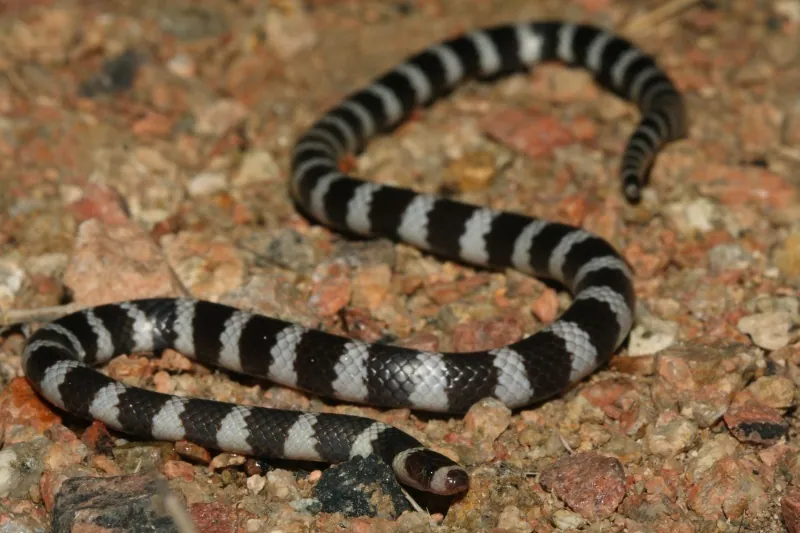
KoskaThe bandy-bandy is a small, glossy snake with bold black and white rings that go all the way round its body. It lives in Australia, mostly along the east coast. It is venomous, but its venom is weak and it is generally considered harmless to people.1

 Nola ezagutu
- Smooth, glossy scales1
- Sharply contrasting black and white rings that continue right around the body1
- A short tail with a blunt tip, unlike other elapid snakes1
- Usually 50 to 60 cm long including the tail1
Askotan honekin nahasten da: Other bandy-bandy species look similar and live in different regions. They are told apart by the presence of a pair of small scales on the head (internasals), the number of black bands on the body and tail, and the number of belly scales.1
Pozoi-ahalmena
Pozoia letaginetatik edo hortzetatik ateratzen da kosk egiten duenean.
Zer egiten du bere pozoiak?
Bandy-bandy venom is weak, and its effects are mostly limited to the area around the bite. Its mouth is small and it is not aggressive, so it rarely bites people.1
Zein arriskutsua da pertsonentzat?
Arriskua pertsonentzat: MingarriaBenetan min handia eman dezake, baina ia inoiz ez da larria.The bandy-bandy is generally considered harmless to people because of its small mouth and inoffensive nature.1
 Kosk egiten badu
- Presio-immobilizazioa: bildu benda elastiko sendo bat koskaren gainean eta gero gorputz-adar osoan gora, immobilizatu ferula batekin, eta eutsi pertsona guztiz geldi laguntza iritsi arte.
- Ez garbitu koska: ospitaleetan azalean geratutako pozoia azter dezakete antipozoi egokia aukeratzeko.
Deitu beti lehenik zure larrialdi-zenbakira (112, 000, 911). Lehen sorospenei buruzko orientabide orokorra da hau, ez mediku-aholkua. Lehen sorospenen oinarriak
 Egon seguru
- Ez ukitu, ez harrapatu eta ez zirikatu inoiz animalia basati bat, txikia izan arren, eta lo edo hilda dagoela badirudi ere.
- Utzi tartea. Bat aurkitzen baduzu, egon lasai, egin atzera poliki eta utzi bere bidetik joaten.
- Batek kosk egiten badizu: egon lasai, egon geldi, deitu zure larrialdi-zenbakira (112, 000, 911) edo joan ospitalera azkar. Gogoratu nolakoa zen, argazki batek laguntzen du.
Ez dabil zure atzetik. Pozoia janaria harrapatzeko edo bere burua babesteko erabiltzen du, eta askoz nahiago du ezkutatu. Seguru egoteari buruz gehiago
Munduko zein tokitan?
Zein handia da?
Zein luzea da?
 3 banana bata bestearen atzetik jarrita bezain luzea
 100 metro 58 segundotan egin litzake (gizakirik azkarrenak 9,6 behar ditu)
Zein handia da Bandy-bandy ZUREKIN alderatuta?
Matematika hutsa zure nabigatzailean. Ez da ezer gordetzen, ezta inora bidaltzen ere.
Zein azkarra da?


Datuak
Blind snakes can be bigger than the bandy-bandy that eats them. Bandy-bandies have been seen with prey sticking out of their mouths while they slowly digest it.1
Bandy-bandies can follow the chemical trail of a blind snake. In one study they followed trails for an average of 0.93 metres, and some followed a full 1.4-metre trail.1
Bandy-bandies are also called hoop snakes because of their striking rings.1
Females are much larger than males. In one study, the mean snout-vent length was 54.4 cm for females and 39.2 cm for males.1
Unlike other elapid snakes, the bandy-bandy has a blunt tail tip.1
Pozoi-adituentzat
- Izen zientifikoa
- Vermicella annulata
- Taldea
- Australiako sugeak
- Familia
- Elapidae2
- Ordena
- Squamata
- Kontinenteak
- Australia eta Ozeania
- Kumeak
- Bandy-bandies lay eggs (they are oviparous), usually in late summer, February to March. A clutch averages 7.7 eggs, and up to 13 have been recorded.1
- Arriskua pertsonentzat
- 2 / 5: Mingarria3
Datuak nondik datozen
- Bandy-bandy (Wikipedia (CC BY-SA 4.0))
- Vermicella annulata (iNaturalist): izenak eta sailkapena.
- Venom Wiki: arrisku-maila, ohiko tamaina eta abiadura-kalkulua geureak dira. Ikusi nola kalkulatzen ditugun: Nola baloratzen dugun arriskua.
Orrialde honetako datu bakoitzak zenbaki bat du, bere iturrira eramaten zaituena. Zerbait gaizki badugu, barkatu, animalien zaleak gara, ez zientzia-aldizkari bat. Esaiguzu [email protected] helbidean eta konponduko dugu.
 Eskorpioia gose da! Venom Wiki pertsona bakar baten proiektua da: doakoa, iragarkirik eta jarraitzailerik gabe. Eskupeko txiki batek sarean mantentzen laguntzen du.Elikatu eskorpioia
Talde bereko gehiago: Australiako sugeak
 Coastal taipan
 Common death adder
 Eastern brown snake
 Inland taipan
 Tiger snake
 Collett's snake
Hemen ere bizi da: Australia eta Ozeania
 Sydney funnel-web spiderTarantulak eta inbutu-sareko armiarmakHilgarria
 Redback spiderArmiarmakMedikua behar du
 Brown tree snakeAtzeko letagineko sugeakMin ematen du, besterik ez
 Hooded pitohuiBeste animalia toxiko batzukMin ematen du, besterik ezEz ukitu
 PlatypusUgaztun pozoitsuakMin ematen du, besterik ez
 Northern tree-dwelling funnel-web spiderTarantulak eta inbutu-sareko armiarmakHilgarria