
 Afrika
 Asia
Asia Europa
 Hego Amerika
 Australia eta Ozeania
 Antartika
 Ozeano Barea
 Ozeano Atlantikoa
 Ozeano Indikoa
 Ozeano Artikoa
 Mediterraneo itsasoa
 Itsaso Gorria
 Karibe itsasoa
 Koralen itsasoa
 Hego Txinako itsasoa
 Filipinetako itsasoa
 Andaman itsasoa
 Ipar itsasoa
 Timor eta Arafura itsasoak
 Bengalako golkoa
 Kaliforniako golkoa
Eastern diamondback rattlesnake
 Koska
KoskaThe eastern diamondback rattlesnake is a pit viper that lives in the southeastern United States. It is the largest rattlesnake species and one of the heaviest venomous snakes in the Americas. Its diamond-patterned back and loud rattle make it easy to recognise, and it is widely regarded as one of the most dangerous venomous snakes in North America.1



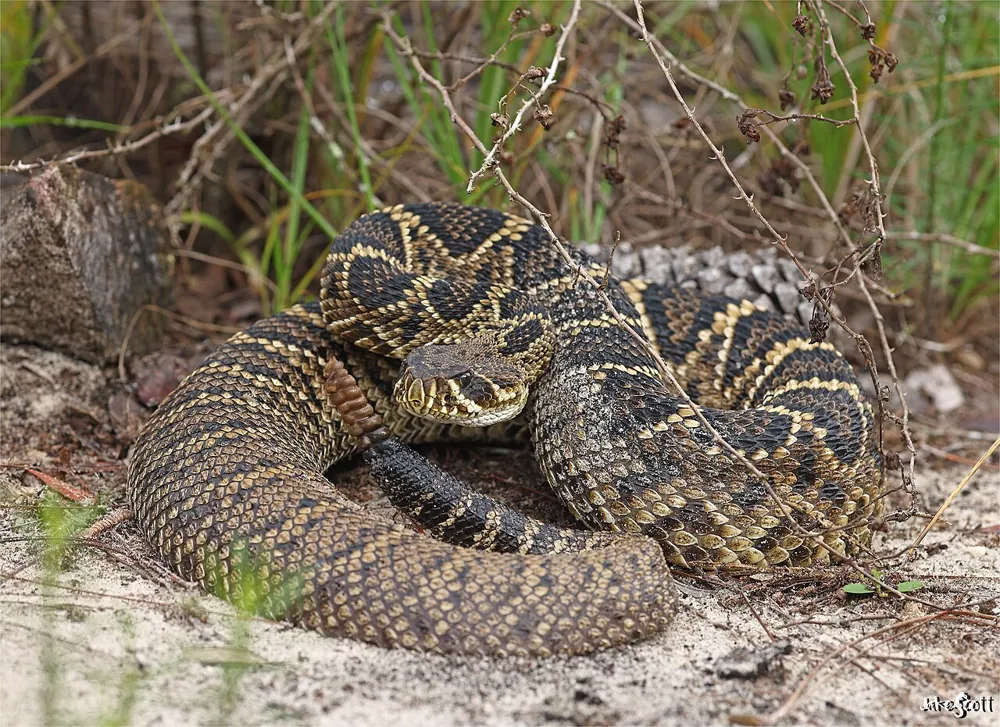
 Nola ezagutu
- Dark brown to black diamond-shaped blotches on a brownish, grey or olive background, each outlined with cream or yellowish scales1
- A dark stripe runs from behind each eye to the mouth corner, edged above and below by white or yellow stripes1
- A rattle of hollow segments at the tail tip, which break off and are replaced when the snake sheds1
- Five to ten bands around the tail, below the diamond pattern1
- A large, heavy body, with adults often around 1.1 to 1.7 m long1
Pozoi-ahalmena
Pozoia letaginetatik edo hortzetatik ateratzen da kosk egiten duenean.
Zer egiten du bere pozoiak?
Its venom contains more than 100 different toxins, and about 40 have been identified, making it one of the most studied snake venoms. The venom contains a thrombin-like enzyme called crotalase, which clots fibrinogen, a protein needed for blood clotting. The estimated human lethal dose is 100 to 150 mg.1
Zein arriskutsua da pertsonentzat?
Arriskua pertsonentzat: Oso arriskutsuaTratamendurik jasotzen ez duen pertsona bat hil dezake.It has a reputation as the most dangerous venomous snake in North America. It is not usually aggressive, but it is large and powerful. Reported mortality from untreated bites is 10 to 20% in some studies and 30% in another, and it is a major cause of fatal snakebites within its range.1
Zer egiten du beldurtzen denean?
When threatened, it raises the front half of its body in an S-shaped coil, rattles loudly, and can strike to at least a third of its body length.1
 Kosk egiten badu
- Eutsi pertsona geldi eta lasai, eduki koska jasotako gorputz-adarra bihotzaren mailan, kendu eraztunak eta gauza estuak, eta joan ospitalera azkar.
Deitu beti lehenik zure larrialdi-zenbakira (112, 000, 911). Lehen sorospenei buruzko orientabide orokorra da hau, ez mediku-aholkua. Lehen sorospenen oinarriak
 Egon seguru
- Ez ukitu, ez harrapatu eta ez zirikatu inoiz animalia basati bat, txikia izan arren, eta lo edo hilda dagoela badirudi ere.
- Utzi tartea. Bat aurkitzen baduzu, egon lasai, egin atzera poliki eta utzi bere bidetik joaten.
- Batek kosk egiten badizu: egon lasai, egon geldi, deitu zure larrialdi-zenbakira (112, 000, 911) edo joan ospitalera azkar. Gogoratu nolakoa zen, argazki batek laguntzen du.
Ez dabil zure atzetik. Pozoia janaria harrapatzeko edo bere burua babesteko erabiltzen du, eta askoz nahiago du ezkutatu. Seguru egoteari buruz gehiago
Munduko zein tokitan?
Zein handia da?
Zein luzea da?
Zein astuna da?
 5 etxeko katu muturretik buztanera jarrita bezain luzea
 13 banana bata bestearen atzetik jarrita bezain luzea
 100 metro 86 segundotan egin litzake (gizakirik azkarrenak 9,6 behar ditu)
Zein handia da Eastern diamondback rattlesnake ZUREKIN alderatuta?
Matematika hutsa zure nabigatzailean. Ez da ezer gordetzen, ezta inora bidaltzen ere.
Zein azkarra da?


Datuak
It is the largest rattlesnake species. One specimen shot in 1946 measured 2.4 m and weighed 15.4 kg.1
In proportion to its length, it has the longest fangs of any rattlesnake, with fangs of over 25 mm expected in a 2.4 m adult.1
It can strike its prey within a tenth of a second.1
It can swim well and has been seen crossing water sometimes miles from land.1
Although mainly ground-dwelling, it has been spotted up to 10 m above the ground in bushes and trees.1
Males are usually larger than females, which is a rare pattern called reverse sexual size dimorphism.1
Mito-hauslea
Mitoa: The eastern diamondback must rattle before it strikes.
Egia: It can strike while completely silent. Some individuals stay quiet even when approached closely.1
Pozoi-adituentzat
- Izen zientifikoa
- Crotalus adamanteus
- Taldea
- Kriskitin-sugeak
- Familia
- Viperidae2
- Ordena
- Squamata
- Kontinenteak
- Ipar Amerika
- Kumeak
- It gives birth to live young, between 4 and 28 at a time, usually from July to early October. The newborns are 30 to 36 cm long and look like adults, except they have a small button instead of a rattle.1
- Nola dagoen naturan
- Least Concern on the IUCN Red List (2001), but its population trend is down. It is under review for the US Endangered Species List, and it is considered endangered in North Carolina.1
- Arriskua pertsonentzat
- 4 / 5: Oso arriskutsua3
Datuak nondik datozen
- Eastern diamondback rattlesnake (Wikipedia (CC BY-SA 4.0))
- Crotalus adamanteus (iNaturalist): izenak eta sailkapena.
- Venom Wiki: arrisku-maila, ohiko tamaina eta abiadura-kalkulua geureak dira. Ikusi nola kalkulatzen ditugun: Nola baloratzen dugun arriskua.
Orrialde honetako datu bakoitzak zenbaki bat du, bere iturrira eramaten zaituena. Zerbait gaizki badugu, barkatu, animalien zaleak gara, ez zientzia-aldizkari bat. Esaiguzu [email protected] helbidean eta konponduko dugu.
 Eskorpioia gose da! Venom Wiki pertsona bakar baten proiektua da: doakoa, iragarkirik eta jarraitzailerik gabe. Eskupeko txiki batek sarean mantentzen laguntzen du.Elikatu eskorpioia
 Timber rattlesnake
 Western diamondback rattlesnake
 Sidewinder
 Mojave rattlesnake
 Aruba rattlesnake
 Black-tailed rattlesnake
 Terciopelo
 Eastern coral snake
 Eyelash viper
 Arizona bark scorpion
 Brown recluse
 Cane toad