
 Afrika
 Asia
Asia Europa
 Hego Amerika
 Australia eta Ozeania
 Antartika
 Ozeano Barea
 Ozeano Atlantikoa
 Ozeano Indikoa
 Ozeano Artikoa
 Mediterraneo itsasoa
 Itsaso Gorria
 Karibe itsasoa
 Koralen itsasoa
 Hego Txinako itsasoa
 Filipinetako itsasoa
 Andaman itsasoa
 Ipar itsasoa
 Timor eta Arafura itsasoak
 Bengalako golkoa
 Kaliforniako golkoa
Giant golden orb-weaver
 Koska
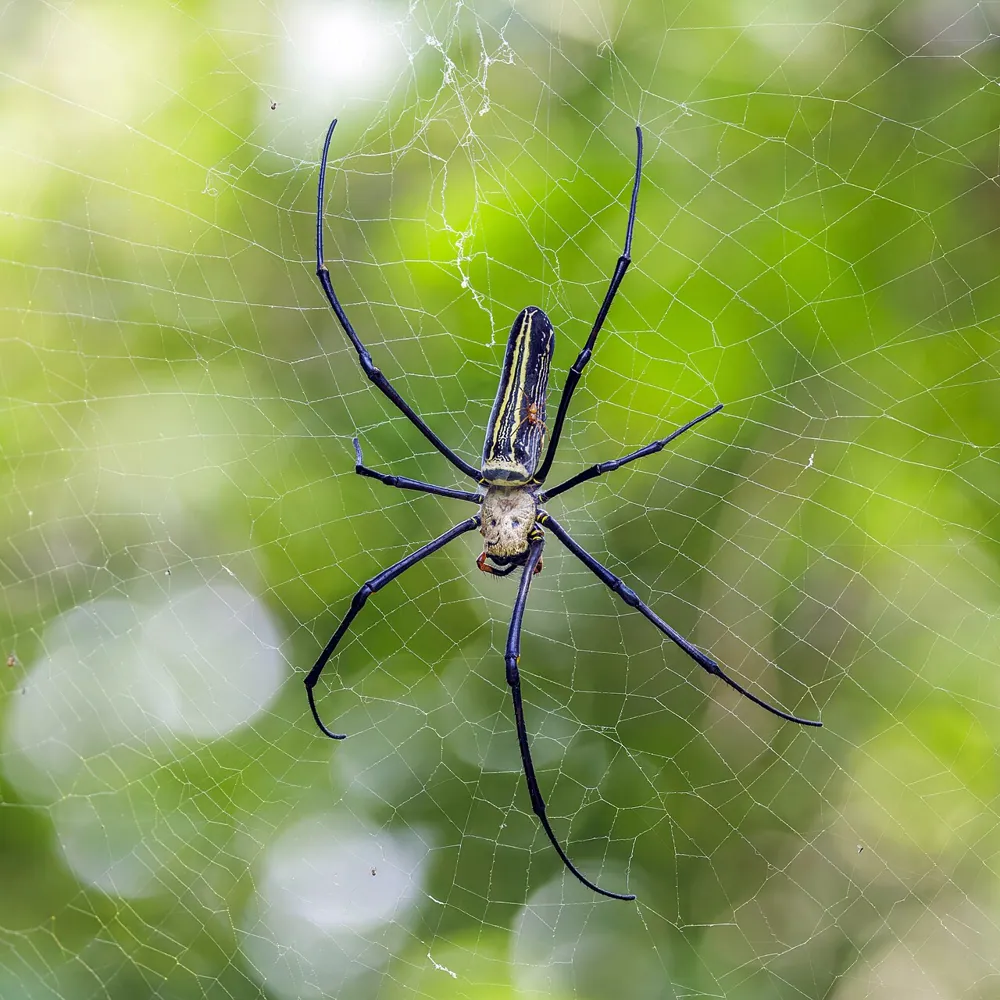
KoskaThe giant golden orb-weaver is a large spider found across East and Southeast Asia and in Oceania. Adult females have bodies up to 50 mm long, while the males are tiny by comparison. Its big, yellowish webs are often seen in forests and against buildings.1

 Nola ezagutu
- Adult females are very large, with a body length of 25 to 50 mm.1
- The abdomen is mostly dark yellow-brown with yellow stripes.1
- The legs are long and black and yellow.1
- Females have a horn-like bulge on the back of the body (tergum).1
- Males are tiny, measuring about 4 to 6 mm, with light brown legs.1
Askotan honekin nahasten da: Trichonephila clavata has no horn-like bulge on its back, which the giant golden orb-weaver does have. Nephila laurinae lacks the pair of yellow stripes at the back of the abdomen that this species has.1
Pozoi-ahalmena
Pozoia letaginetatik edo hortzetatik ateratzen da kosk egiten duenean.
Zein arriskutsua da pertsonentzat?
Arriskua pertsonentzat: ArinaErle-ziztada bat bezala edo gutxiago. Ia kaltegabea pertsonentzat. Kosk egiten badu
- Garbitu koska eta jarri izotz-poltsa bat gainean minerako. Lortu mediku-laguntza mina handia bada, zabaltzen bada edo pertsona gaizki sentitzen bada.
Deitu beti lehenik zure larrialdi-zenbakira (112, 000, 911). Lehen sorospenei buruzko orientabide orokorra da hau, ez mediku-aholkua. Lehen sorospenen oinarriak
 Egon seguru
- Ez ukitu, ez harrapatu eta ez zirikatu inoiz animalia basati bat, txikia izan arren, eta lo edo hilda dagoela badirudi ere.
- Utzi tartea. Bat aurkitzen baduzu, egon lasai, egin atzera poliki eta utzi bere bidetik joaten.
- Batek kosk egiten badizu: egon lasai, egon geldi, deitu zure larrialdi-zenbakira (112, 000, 911) edo joan ospitalera azkar. Gogoratu nolakoa zen, argazki batek laguntzen du.
Ez dabil zure atzetik. Pozoia janaria harrapatzeko edo bere burua babesteko erabiltzen du, eta askoz nahiago du ezkutatu. Seguru egoteari buruz gehiago
Munduko zein tokitan?
Zein handia da?
Zein luzea da?
 zure hatz txikia baino laburragoa
 100 metro 130 segundotan egin litzake (gizakirik azkarrenak 9,6 behar ditu)
Zein handia da Giant golden orb-weaver ZUREKIN alderatuta?
Matematika hutsa zure nabigatzailean. Ez da ezer gordetzen, ezta inora bidaltzen ere.
Zein azkarra da?


Datuak
Its silk is more robust than most human-made materials, which has drawn attention from materials scientists.1
Males can be 4 to 10 times smaller than the females, one of the biggest size differences among land animals.1
Adult females keep growing by moulting after they mature, which most spiders do not do.1
Females do not shed their genitals when they moult, so they can keep collecting sperm.1
When temperatures rise above 40 °C, it will abandon its web.1
Pozoi-adituentzat
- Izen zientifikoa
- Nephila pilipes
- Taldea
- Armiarmak
- Familia
- Nephilidae2
- Ordena
- Araneae
- Kontinenteak
- Asia, Australia eta Ozeania
- Kumeak
- Females do not hang egg sacs in the web. Instead they dig a pit, lay eggs in it and cover it with plant debris or soil. Adult females lay eggs continuously.1
- Arriskua pertsonentzat
- 1 / 5: Arina3
Datuak nondik datozen
- Nephila pilipes (Wikipedia (CC BY-SA 4.0))
- Nephila pilipes (iNaturalist): izenak eta sailkapena.
- Venom Wiki: arrisku-maila, ohiko tamaina eta abiadura-kalkulua geureak dira. Ikusi nola kalkulatzen ditugun: Nola baloratzen dugun arriskua.
Orrialde honetako datu bakoitzak zenbaki bat du, bere iturrira eramaten zaituena. Zerbait gaizki badugu, barkatu, animalien zaleak gara, ez zientzia-aldizkari bat. Esaiguzu [email protected] helbidean eta konponduko dugu.
 Eskorpioia gose da! Venom Wiki pertsona bakar baten proiektua da: doakoa, iragarkirik eta jarraitzailerik gabe. Eskupeko txiki batek sarean mantentzen laguntzen du.Elikatu eskorpioia
 Redback spider
 Katipo
 Mediterranean black widow
 Diving bell spider
 European yellow sac spider
 White-tailed spider
 Deathstalker
 Indian cobra
 Indian saw-scaled viper
 King cobra
 Puff adder
 Russell's viper
_female_and_male_Double_Haven.jpg)