
 Afrika
 Asia
Asia Europa
 Hego Amerika
 Australia eta Ozeania
 Antartika
 Ozeano Barea
 Ozeano Atlantikoa
 Ozeano Indikoa
 Ozeano Artikoa
 Mediterraneo itsasoa
 Itsaso Gorria
 Karibe itsasoa
 Koralen itsasoa
 Hego Txinako itsasoa
 Filipinetako itsasoa
 Andaman itsasoa
 Ipar itsasoa
 Timor eta Arafura itsasoak
 Bengalako golkoa
 Kaliforniako golkoa
Kokoe poison frog
 Pozoia azalean
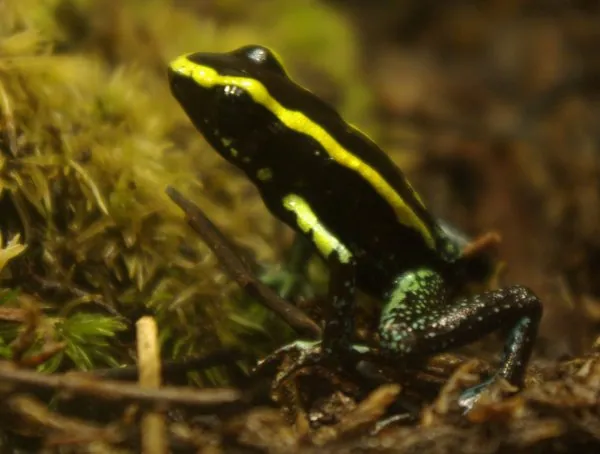
The Kokoe poison frog is a small, brightly striped frog that lives on the forest floor of western Colombia. It is one of the most poisonous frogs in the world. Its skin holds a toxin that can be deadly, so it should never be handled.1



 Nola ezagutu
- Black back, sometimes with orange patches.1
- Green, yellow, orange or brownish gold stripes along each side of the body.1
- Black belly with blue or green dots.1
- The smallest of the poison dart frogs in its genus, Phyllobates.1
- Two forms exist: a smaller form with large stripes and a larger form with small stripes.1
Pozoi-indarra
Bere azala toxikoa da. Arriskutsua da ukitzea, miazkatzea edo jatea.
Zer egiten du bere toxinak?
This frog is poisonous rather than venomous, because its toxin is held in its skin and does not come from a bite or sting. The toxin, batrachotoxin, is a steroidal alkaloid. It keeps the sodium channels in nerve and muscle cells permanently open, which stops the cells from resetting. The result is paralysis, and often death, as affected muscles stay locked in a contracted state.1
Zein arriskutsua da pertsonentzat?
Arriskua pertsonentzat: Oso arriskutsuaTratamendurik jasotzen ez duen pertsona bat hil dezake.Wild frogs are extremely deadly to humans, and the toxin can be fatal in doses as small as 100 μg. Frogs raised in captivity are generally non-toxic.1
Zer egiten du beldurtzen denean?
It releases its toxin from skin glands only when under stress.1
 Norbaitek ukitu edo jan badu
- Norbaitek bat ukitu badu: garbitu eskuak ondo eta ez ukitu begiak edo ahoa. Haur edo maskota batek bat miazkatu edo jan badu: deitu zure intoxikazio-zentrora edo larrialdi-zenbakira.
Deitu beti lehenik zure larrialdi-zenbakira (112, 000, 911). Lehen sorospenei buruzko orientabide orokorra da hau, ez mediku-aholkua. Lehen sorospenen oinarriak
 Egon seguru
- Ez ukitu, ez harrapatu eta ez zirikatu inoiz animalia basati bat, txikia izan arren, eta lo edo hilda dagoela badirudi ere.
- Utzi tartea. Bat aurkitzen baduzu, egon lasai, egin atzera poliki eta utzi bere bidetik joaten.
- Ukitu edo jan baduzu: ez igurtzi begiak edo ahoa, garbitu eskuak eta lortu mediku-laguntza.
Ez dabil zure atzetik. Pozoia ezerk jan ez dezan baino ez du. Seguru egoteari buruz gehiago
Munduko zein tokitan?
Zein handia da?
Zein luzea da?
 klip bat bezain luzea, gutxi gorabehera
 100 metro 100 segundotan egin litzake (gizakirik azkarrenak 9,6 behar ditu)
Zein handia da Kokoe poison frog ZUREKIN alderatuta?
Matematika hutsa zure nabigatzailean. Ez da ezer gordetzen, ezta inora bidaltzen ere.
Zein azkarra da?


Datuak
It is known as the third most poisonous frog in the world.1
Indigenous peoples of Colombia have used its poison on hunting darts.1
Unlike many other dart frogs, males do not wrestle. Rivals face off and call loudly until one backs down.1
Its mating calls are a loud, bird-like whirring twitter, which can last up to 45 seconds.1
Unlike other Phyllobates species, it does not breed in coconut shells. It lays its eggs in narrow tubes on the ground instead.1
Mito-hauslea
Mitoa: All poison frogs make their own poison.
Egia: These frogs probably do not make batrachotoxin themselves. They take it in from their diet of beetles, millipedes and flies, and from the leaf litter. That is why captive frogs are generally non-toxic.1
Pozoi-adituentzat
- Izen zientifikoa
- Phyllobates aurotaenia
- Taldea
- Igel toxikoak, apoak eta uhandreak
- Familia
- Dendrobatidae2
- Ordena
- Anura
- Kontinenteak
- Hego Amerika
- Kumeak
- The female lays a clutch of eggs in leaf litter, averaging 15 to 20. After the eggs hatch, the male carries the tadpoles to slow-flowing water.1
- Nola dagoen naturan
- Least Concern (IUCN), although its numbers and range are declining, mainly due to habitat loss1
- Arriskua pertsonentzat
- 4 / 5: Oso arriskutsua3
Datuak nondik datozen
- Phyllobates aurotaenia (Wikipedia (CC BY-SA 4.0))
- Phyllobates aurotaenia (iNaturalist): izenak eta sailkapena.
- Venom Wiki: arrisku-maila, ohiko tamaina eta abiadura-kalkulua geureak dira. Ikusi nola kalkulatzen ditugun: Nola baloratzen dugun arriskua.
Orrialde honetako datu bakoitzak zenbaki bat du, bere iturrira eramaten zaituena. Zerbait gaizki badugu, barkatu, animalien zaleak gara, ez zientzia-aldizkari bat. Esaiguzu [email protected] helbidean eta konponduko dugu.
 Eskorpioia gose da! Venom Wiki pertsona bakar baten proiektua da: doakoa, iragarkirik eta jarraitzailerik gabe. Eskupeko txiki batek sarean mantentzen laguntzen du.Elikatu eskorpioia
Talde bereko gehiago: Igel toxikoak, apoak eta uhandreak
 Golden poison frogIgel toxikoak, apoak eta uhandreakHilgarriaEz ukitu
 Cane toadIgel toxikoak, apoak eta uhandreakMedikua behar duEz ukitu
 Dyeing poison dart frogIgel toxikoak, apoak eta uhandreakMin ematen du, besterik ezEz ukitu
 Black-legged poison frogIgel toxikoak, apoak eta uhandreakHil dezakeEz ukitu
 Bruno's casque-headed frogIgel toxikoak, apoak eta uhandreakMedikua behar duEz ukitu
 Harlequin poison frogIgel toxikoak, apoak eta uhandreakMedikua behar duEz ukitu
 Terciopelo
 Brazilian wandering spider
 Eyelash viper
 Golden lancehead
 South American bushmaster
 Peruvian giant centipede