
 Afrika
 Asia
Asia Europa
 Hego Amerika
 Australia eta Ozeania
 Antartika
 Ozeano Barea
 Ozeano Atlantikoa
 Ozeano Indikoa
 Ozeano Artikoa
 Mediterraneo itsasoa
 Itsaso Gorria
 Karibe itsasoa
 Koralen itsasoa
 Hego Txinako itsasoa
 Filipinetako itsasoa
 Andaman itsasoa
 Ipar itsasoa
 Timor eta Arafura itsasoak
 Bengalako golkoa
 Kaliforniako golkoa
Redtail coral snake
 Koska
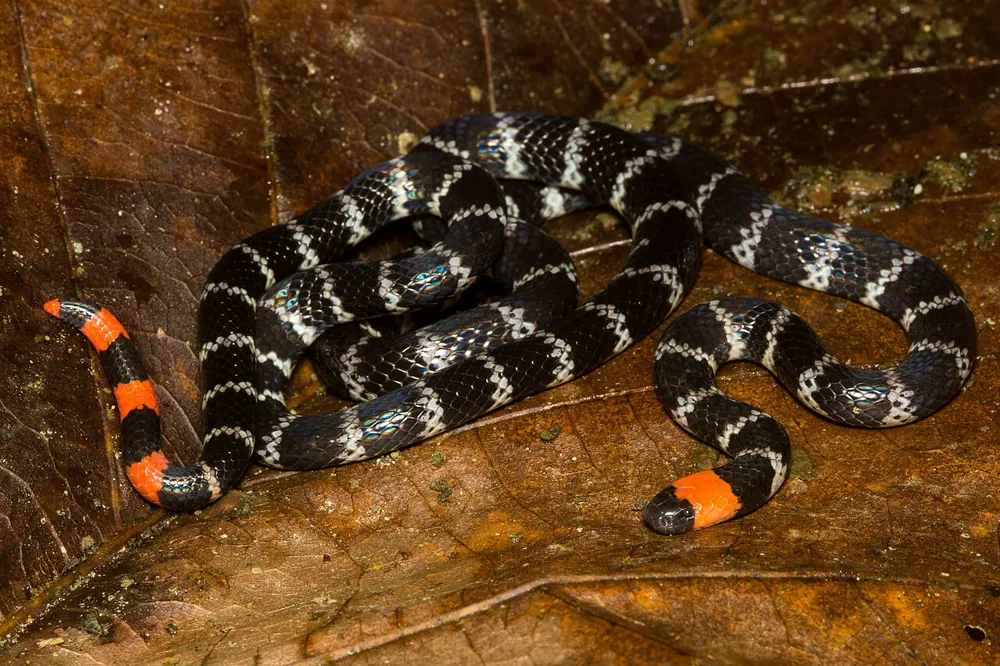
KoskaThe red-tailed coral snake is a small venomous snake from Central and northern South America. It is common in farming areas of Colombia, so people living there may meet it. Its venom attacks the nerves and muscles, which makes it one of the more dangerous snakes in its region.1



 Nola ezagutu
- Has a cylindrical body and quite small eyes with a rounded head.1
- Black body rings, numbering from 34 to 84, are separated by narrow yellow or white rings.1
- The second ring on the head and 3 or 4 of the tail rings are red.1
- Can reach a total length of 140.6 cm, including the tail.1
- Mostly active at dusk and at night.1
Pozoi-ahalmena
Pozoia letaginetatik edo hortzetatik ateratzen da kosk egiten duenean.
Zer egiten du bere pozoiak?
Its venom is neurotoxic, which means it attacks the nerves. It blocks the signals that tell muscles to contract, which can lead to muscle weakness and paralysis. Local pain and tingling can appear within minutes of a bite. In severe cases, nerve symptoms such as drooping eyelids, slurred speech, drowsiness and weakness in the limbs can develop within 30 minutes to 1 to 2 hours, and breathing can stop.1
Zein arriskutsua da pertsonentzat?
Arriskua pertsonentzat: Oso arriskutsuaTratamendurik jasotzen ez duen pertsona bat hil dezake.Its venom is potentially deadly. Scientists milked an average of 7 mg of dry venom from this snake, which is more than the estimated lethal dose for an adult human of 4 to 6 mg.1
 Kosk egiten badu
- Eutsi pertsona geldi eta lasai eta joan ospitalera azkar, koska txikia dirudien arren: sintomak ordu batzuk geroago has daitezke.
Deitu beti lehenik zure larrialdi-zenbakira (112, 000, 911). Lehen sorospenei buruzko orientabide orokorra da hau, ez mediku-aholkua. Lehen sorospenen oinarriak
 Egon seguru
- Ez ukitu, ez harrapatu eta ez zirikatu inoiz animalia basati bat, txikia izan arren, eta lo edo hilda dagoela badirudi ere.
- Utzi tartea. Bat aurkitzen baduzu, egon lasai, egin atzera poliki eta utzi bere bidetik joaten.
- Batek kosk egiten badizu: egon lasai, egon geldi, deitu zure larrialdi-zenbakira (112, 000, 911) edo joan ospitalera azkar. Gogoratu nolakoa zen, argazki batek laguntzen du.
Ez dabil zure atzetik. Pozoia janaria harrapatzeko edo bere burua babesteko erabiltzen du, eta askoz nahiago du ezkutatu. Seguru egoteari buruz gehiago
Munduko zein tokitan?
Zein handia da?
Zein luzea da?
 3 etxeko katu muturretik buztanera jarrita bezain luzea
 8 banana bata bestearen atzetik jarrita bezain luzea
 100 metro 71 segundotan egin litzake (gizakirik azkarrenak 9,6 behar ditu)
Zein handia da Redtail coral snake ZUREKIN alderatuta?
Matematika hutsa zure nabigatzailean. Ez da ezer gordetzen, ezta inora bidaltzen ere.
Zein azkarra da?


Datuak
It has between 34 and 84 black body rings, so no two snakes look exactly the same in ring count.1
Its venom is about 60% three-finger toxins, about 30% phospholipase A2, and about 10% other toxins.1
In dry spells it may shelter several centimetres underground, and in heavy rain it comes to the surface or into thick leaf litter.1
The most abundant toxin in its venom is called mipartoxin-I.1
Datuak nondik datozen
- Micrurus mipartitus (Wikipedia (CC BY-SA 4.0))
- Micrurus mipartitus (iNaturalist): izenak eta sailkapena.
- Venom Wiki: arrisku-maila, ohiko tamaina eta abiadura-kalkulua geureak dira. Ikusi nola kalkulatzen ditugun: Nola baloratzen dugun arriskua.
Orrialde honetako datu bakoitzak zenbaki bat du, bere iturrira eramaten zaituena. Zerbait gaizki badugu, barkatu, animalien zaleak gara, ez zientzia-aldizkari bat. Esaiguzu [email protected] helbidean eta konponduko dugu.
 Eskorpioia gose da! Venom Wiki pertsona bakar baten proiektua da: doakoa, iragarkirik eta jarraitzailerik gabe. Eskupeko txiki batek sarean mantentzen laguntzen du.Elikatu eskorpioia
 Eastern coral snake
 Central American coral snake
 Texas coral snake
 Sonoran coral snake
 Allen's coral snake
 Amazonian coral snake
 Terciopelo
 Eastern diamondback rattlesnake
 Eyelash viper
 Timber rattlesnake
 Western diamondback rattlesnake
 Arizona bark scorpion