
 Afirik
 Aazi
Aazi Orop
Orop Amerik Sud
 Ostarali e Oseyani
 Antarktik
 Geeci Pasifik
 Geeci Atlantik
 Geeci Enndo
 Geeci Arktik
 Geeci Mediteraane
 Geeci Boɗeewi
 Geeci Karayib
 Geeci Korayl
 Geeci Siin Sud
 Geeci Filipiin
 Geeci Andaman
 Geeci Nord
 Geeci Timor e Arafura
 Gulf Bengal
 Gulf Kaliforni
Lehmann's poison frog
 Tooke nder nguru mumNo ñaama: ƁuuɓuuliTookeejo ɓanndu, wanaa naatnoowo tooke
Lehmann's poison frog is a small, brightly marked frog that lives only in a small part of western Colombia. Its skin produces strong toxins, and its bright colours warn predators to leave it alone. It is critically endangered, so it matters for conservation as well as for safety.1


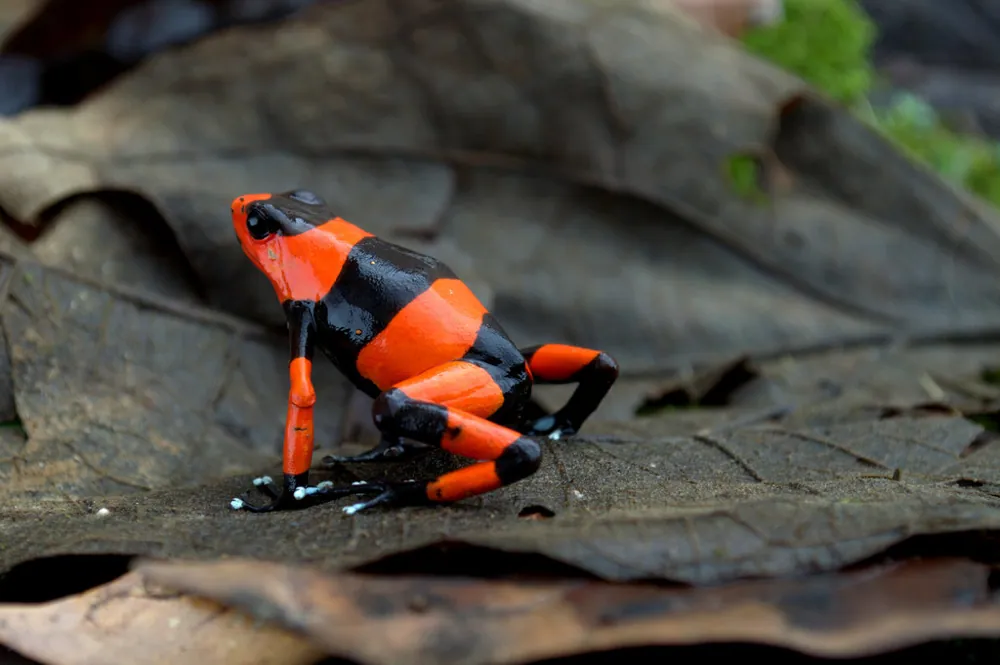
 Hono anndirtee ngal
- Black or dark brown background with two bright, broad bands of colour round the body1
- Coloured bands on the arms and legs, and on the belly1
- Red, orange or yellow colour forms; each frog has its own unique pattern1
- Males have silver-tipped toes1
- Adults measure 31 to 36 mm from snout to vent1
No jiibondiree e: The harlequin poison frog (Oophaga histrionicus) looks very similar and can interbreed with it. Scientists still debate whether Lehmann's poison frog is a separate species. The main difference is that Lehmann's frog lacks histrionicotoxins, a type of toxin found in the harlequin frog. Males also have calls that differ between northern and southern populations.1
Doole tooke
Nguru mum ko tooke. No musiiba meemugol ngal, meemugol ngal e ɗemngal walla ñaamugol ngal.
Ko honɗun tooke ɓanndu mum waɗata?
It is not venomous. Its skin produces toxins, including alkaloids such as pumiliotoxins, that can be very poisonous. Frogs bred in captivity are not poisonous, because their diet lacks the chemicals needed to make the toxins.1
Hono musiiba mum heewiri e yimɓe?
Musiiba e yimɓe: Musiiba mawɗoSi neɗɗo meemii walla ñaamii ngal, yahu ka doktoro. Maayde no famɗi sanne.The skin toxins can be very poisonous to predators, and some native tribes of Colombia used them to coat their darts. Frogs in captivity are not poisonous.1
Ko honɗun ngal waɗata si ngal hulii?
Its bright, vivid colours act as a warning to predators that it is inedible.1
 Si neɗɗo meemii walla ñaamii ngal
- Si neɗɗo meemii gooto e majji: loot juuɗe ɗen no moƴƴi, wota meem gite walla hunuko. Si paykun walla kullal suudu meemii gooto e ɗemngal walla ñaamii gooto: noddu centre antipoison walla nimero ballal.
Adii fow noddu nimero ballal (112, 000, 911). Ɗum ko anndinal ballal adiingal, wanaa saaraangal doktoro. Ko adii nder ballal adiingal
 Reen hoore maa
- Wota a meem, wota a nanngu, wota a jalnu kullal ladde haa abada, hay si ko tokooso, hay si no yi'ee no ɗaanii walla maayii.
- Accu ngal nokku. Si a fotti e ngal, deeƴu, ruttu ɓaawo seeɗa seeɗa, accu ngal yaha laawol mum.
- Si a meemii walla a ñaamii ngal: wota a moomtu gite maa walla hunuko maa, loot juuɗe maa, heɓu ballal doktoro.
Ngal faalaaka gaañugol ma. Tooke mum woodi tun ngam wota huunde ñaam ngal. Ko ɓeydi fii reenugol hoore maa
Hoto nder aduna?
Hono mawniri?
Hono juutiri?
 juuti no ñippirde kayitaaje
 no waawi taccugol meeteruuji 100 nder segonde 97 (neɗɗo ɓurɗo yaawugol sokli 9,6)
Hono Lehmann's poison frog mawniri, si fooɗondiraama e AN?
Ko limoore tun nder navigateur maa. Alaa ko danndetee walla ko neldetee ka nokku woo.
Hono yaawiri?


Humpito
In the wild, this frog is toxic, but frogs kept in captivity lose their toxicity because the toxins come from their diet.1
Tadpoles in the same pool may eat each other, so the male carries them to separate water pools.1
The male is the one who guards the eggs and carries the tadpoles on his back for two to four weeks.1
Its skin toxins are being studied for possible medicinal uses.1
Its bright colours are a warning, a strategy called aposematism.1
Bonnoowo fenaandeeji
Fenaande: Lehmann's poison frog is always poisonous.
Goonga: Wild frogs are toxic, but frogs bred in captivity are not, because their diet lacks the chemicals needed to make the poison.1
Ngam ganduɓe tooke
- Innde ganndal
- Oophaga lehmanni
- Fedde
- Paaɓe tooke, krapooji e tritonuuji
- Ɓesngu
- Dendrobatidae2
- Ordre
- Anura
- Leyɗe mawɗe
- Amerik Sud
- Ɓiɓɓe tokosɓe
- The female lays a small number of large eggs on leaves about 1.2 metres above the forest floor. The male fertilises them, keeps them moist, then carries the tadpoles on his back to small water pools such as tree hollows and bromeliad rosettes.1
- Hono ngal woniri nder ladde
- Critically endangered (IUCN); listed on CITES Appendix II1
- Musiiba e yimɓe
- 3 / 5: Musiiba mawɗo3
Ɗo humpitooji ɗin iwri
- Lehmann's poison frog (Wikipedia (CC BY-SA 4.0))
- Oophaga lehmanni (iNaturalist): inɗe e ŋoordingol (classification).
- Venom Wiki: tolno musiiba, mawnugol aadaajo e miijo yaawugol ko amen. Ndaar no min ƴeewtirta ɗum: Hono min tolnirta musiiba.
Kala humpito nder ngoo hello no jogii limoore hollirnde iwdi mum. Si min juumii, yaafo, min ko yiɗɓe kulle, wanaa jaaynde ganndal. Haalan min e [email protected], min feewnitan.
 Yaare nden no weelaa! Venom Wiki ko golle neɗɗo gooto: ko yoɓetaake, alaa piiblisite, alaa reweteeɓe. Kopporde tokooso no walla heddingol ɗum e enternet.Ñaamnu yaare nden
Ko ɓeydi e fedde wootere: Paaɓe tooke, krapooji e tritonuuji
 Faaɓru tooke kaŋŋePaaɓe tooke, krapooji e tritonuujiWaroowoWota a meem
 Cane toadPaaɓe tooke, krapooji e tritonuujiNo sokli doktoroWota a meem
 Dyeing poison dart frogPaaɓe tooke, krapooji e tritonuujiNo muusi tunWota a meem
 Black-legged poison frogPaaɓe tooke, krapooji e tritonuujiNo waawi warugolWota a meem
 Bruno's casque-headed frogPaaɓe tooke, krapooji e tritonuujiNo sokli doktoroWota a meem
 Harlequin poison frogPaaɓe tooke, krapooji e tritonuujiNo sokli doktoroWota a meem
 Terciopelo
 Brazilian wandering spider
 Eyelash viper
 Golden lancehead
 South American bushmaster
 Peruvian giant centipede