
 Afirik
 Asiya
Asiya Turai
Turai Amerik Worgo
 Australiya e Oseaniya
 Antarktika
 Baharu Pasifik
 Baharu Atlantik
 Baharu Indiya
 Baharu Arktik
 Baharu Mediterane
 Baharu Boɗeeru
 Baharu Karibiya
 Baharu Koral
 Baharu Ciina Worgo
 Baharu Filipin
 Baharu Andaman
 Baharu Rewo
 Baharu Timor e Arafura
 Baharu Bengal
 Baharu Kaliforniya
Chinese black earth tiger tarantula
 Ina ŋata
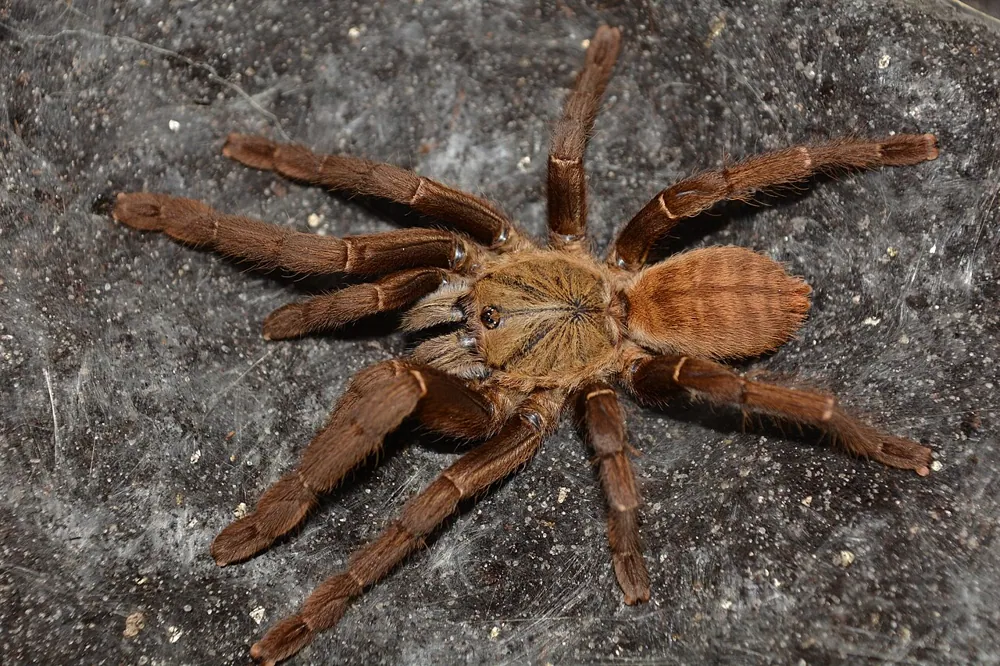
The Chinese black earth tiger tarantula is a large, dark spider that lives in burrows on the island of Hainan, off southern China. It is one of several spiders from China and Vietnam known as the Chinese bird spider. Scientists study its venom because it is considered highly venomous.1

 No anndirto nde
- Dark black-brown body1
- Abdomen (rear body) is dark brown with six black stripes running across it and a black stripe down the centre of the upper surface1
- Carapace (upper front body) is black-brown, and the underside of the front body is red-brown1
- Females are about 60 mm long (body plus chelicerae, the fang-bearing mouthparts), with longer legs than males1
- Males are smaller, about 34 mm long, but have legs of a similar length to the female's1
Ina jiiɓindiree e: It resembles Cyriopagopus schmidti. The Chinese black earth tiger tarantula can be told apart by its dark black-brown body and by the longer thorns on the forward-facing side of the maxillae (the mouthparts that hold the fangs).1
Doole tooke
Tooke ina yalta e ñiiƴe mum si nde ŋatii.
Hol ko tooke mum (ŋatol walla fiɗol) waɗata?
Its venom is a complex neurotoxin, meaning it attacks the nervous system. It contains many compounds that block neurotransmitters, the chemical messengers that carry signals between nerves, including neurotoxic peptides called hainantoxins. The effects of its bite on humans are not well documented.1
Hol no nde woni bone e yimɓe?
Bone e yimɓe: Bone mawɗoŊatol ina haani doktaa. Maayde ina woodi seeɗa sanne.The effects of its bite on people are not well documented. In laboratory tests, its venom is often lethal to mice and rats in small doses, so it is generally regarded as a highly venomous species.1
Hol ko nde waɗata si nde hulii?
It stays hidden in its silk-lined burrow during the day, and its silk alarm lines radiate from the burrow mouth.1
 Si nde ŋatii
- Lootu ŋatol ngol, ɓuuɓnu ngol. Heɓu ballal doktaa si muusu ina tiiɗi walla neɗɗo oo ɓanndu mum welaani.
Sahaa fof, noddu lamba ballal yaawngal (112, 000, 911) ko adii. Ɗum ko ballal arano kuuɓal, wonaa wasiyya doktaa. Aslu ballal arano
 Reen hoore maa
- Taa memu, taa nanngu, taa aaɓnu dabbaare ladde abada, hay pamaro, hay si ina wayi no ɗaanii walla maayii.
- Accu nde nokku. Si a fottii e gooto, deeƴu, ruttu caggal seeɗa seeɗa, accu nde yaha laawol mum.
- Si gooto e majji ŋatii ma: deeƴu, taa dillu, noddu lamba ballal yaawngal (112, 000, 911) walla yah asibiti law. Siftor no nde wayri, foto ina walla.
Nde ɗaɓɓaaki ma. Nde huutora tooke mum ngam nanngude ñaamdu walla reende hoore mum, nde ɓuri yiɗde suuɗaade. Ɓeydu anndude no reentorto
Hol to e aduna?
Hol no nde mawni?
Hol no nde juuti?
 juuti no bulok fijo 2 jokkondiraaɗi
 ina waawi dogde meeter 100 nder sakan 200 (neɗɗo ɓurɗo yaawde ina haani 9,6)
Hol no Chinese black earth tiger tarantula mawni, fottindaade e AAN?
Hiisa tan nder browser maa. Alaa ko mooftetee walla ko neletee.
Hol no nde yaawi?


Anndal
Although the effects of its bite on humans are poorly recorded, its venom is often lethal to laboratory mice and rats in small doses.1
Its venom contains neurotoxic peptides called hainantoxins, which block the chemical signals that nerves use to communicate.1
It lives on very steep, south-facing mountain slopes, at angles of 75 to 85 degrees.1
Despite the male being much smaller than the female, his legs are nearly as long as hers.1
Ɗo anndal iwi
- Cyriopagopus hainanus (Wikipedia (CC BY-SA 4.0))
- Cyriopagopus hainanus (iNaturalist): inɗe e tolnugol.
- Venom Wiki: darja bone, mawnude woowaaɗo e miijo yaawre ko amen. Ndaar no min hiisirta ɗum: No min betiri bone.
Kala anndal e ngoo hello ina jogii limre hollirnde iwdi mum. Si min juumii, accu min, min yiɗɓe dabbaaji, wonaa jaridaa ganndal. Wiy min e [email protected] min feewnitay.
 Yaare nden ina heege! Venom Wiki ko golle neɗɗo gooto: meere, tawa tallaaji alaa, trackers alaa. Ballal pamarngal ina walla heddinde ɗum e internet.Ñaamnu yaare nden
Goɗɗi e fedde wootere: Tarantula e funnel-web
 Gooty sapphire tarantulaTarantula e funnel-webIna haani doktaa
 Indian ornamental tarantulaTarantula e funnel-webIna haani doktaa
 Cobalt blue tarantulaTarantula e funnel-webIna muusa tan
 Chinese bird spiderTarantula e funnel-webIna haani doktaa
 Fringed ornamental tarantulaTarantula e funnel-webIna haani doktaa
 Japanese funnel-web spiderTarantula e funnel-webIna haani doktaa
 Yaare deathstalker
 Cobra Indiya
 Viper kiifi kaasa Indiya
 King cobra
 Puff adder
 Mboddi Russell