
 Afirik
 Asiya
Asiya Turai
Turai Amerik Worgo
 Australiya e Oseaniya
 Antarktika
 Baharu Pasifik
 Baharu Atlantik
 Baharu Indiya
 Baharu Arktik
 Baharu Mediterane
 Baharu Boɗeeru
 Baharu Karibiya
 Baharu Koral
 Baharu Ciina Worgo
 Baharu Filipin
 Baharu Andaman
 Baharu Rewo
 Baharu Timor e Arafura
 Baharu Bengal
 Baharu Kaliforniya
Flamboyant cuttlefish
 Tooke si ñaamaamaIna ñaama: TeewuTooke memde walla ñaamde, wonaa tooke ŋatol walla fiɗol
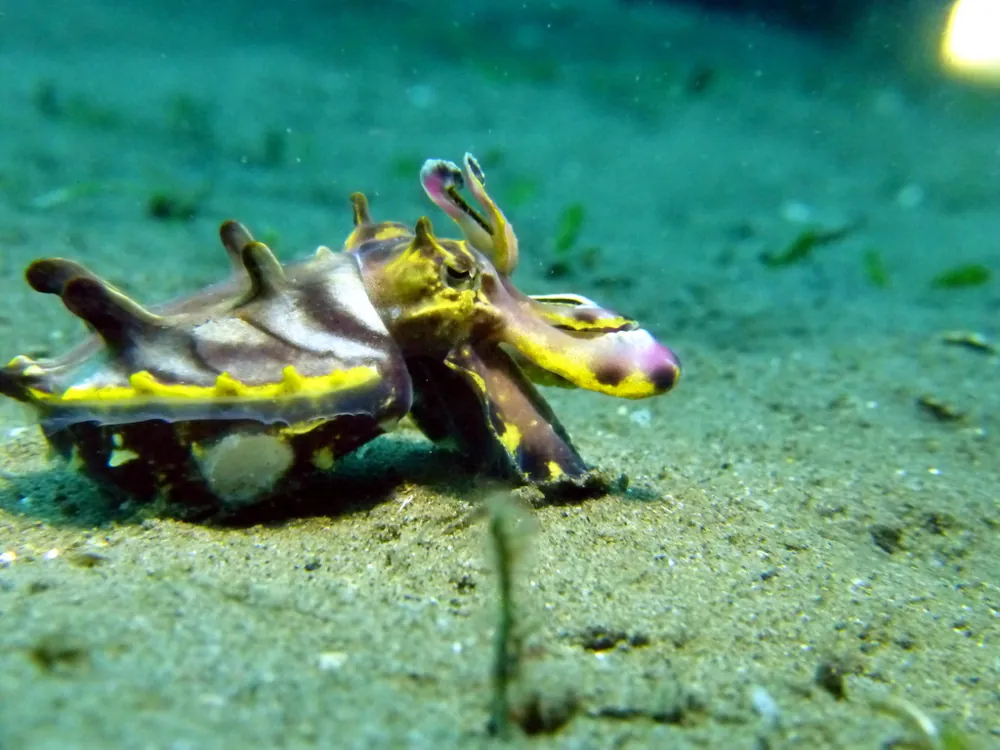
The flamboyant cuttlefish is a small sea creature that can change its colours and patterns in a flash. It lives in shallow tropical waters around northern Australia, New Guinea, the Philippines, Indonesia and Malaysia. It is special because its flesh is poisonous to eat, and it walks along the sea floor instead of swimming.1


 No anndirto nde
- Has a very broad, oval body (mantle) and small, flat, fin-like flaps on the back1
- Broad, blade-like arms with four rows of suckers1
- Normal base colour is dark brown1
- When disturbed, it quickly turns black, dark brown and white, with yellow patches around the body, arms and eyes1
- Arm tips often flash bright red as a warning1
Doole tooke
Ina bone tan si huunde ñaamii nde.
Hol no nde woni bone e yimɓe?
Bone e yimɓe: Ina muusaIna waawi muusude sanne, kono ɓadii abada wonaa bone mawɗo.Its muscle tissue is highly toxic, so eating it can be dangerous.1
Hol ko nde waɗata si nde hulii?
When disturbed or attacked, it changes colour to a dark, high-contrast pattern and shows bright red arm tips to warn off predators. It also walks along the sea floor while waving the wide membranes on its arms.1
 Si neɗɗo memii nde walla ñaamii nde
- Ɗigginde e daranɗinde (pressure immobilisation): haɓɓu bandeeji elastik ɗigginiiɗo dow ŋatol, refti haɓɓu koyngal walla junngo ngal fof haa dow, haɓɓu leggal tiiɗngal (splint) e mum, ngam neɗɗo oo wona ɗoon tawa dillaani fey haa ballal arta.
- Blue-ringed octopus walla cone snail ina waawi haɗde neɗɗo foofde tawa o fini tawon: noddu ballal, wonu hebbinaaɗo hokkude mo fooftaare e hunnduko (rescue breaths) haa yimɓe ambulans ngarta ɓe jogitoo mo.
Sahaa fof, noddu lamba ballal yaawngal (112, 000, 911) ko adii. Ɗum ko ballal arano kuuɓal, wonaa wasiyya doktaa. Aslu ballal arano
 Reen hoore maa
- Taa memu, taa nanngu, taa aaɓnu dabbaare ladde abada, hay pamaro, hay si ina wayi no ɗaanii walla maayii.
- Accu nde nokku. Si a fottii e gooto, deeƴu, ruttu caggal seeɗa seeɗa, accu nde yaha laawol mum.
- Si a memii nde walla a ñaamii nde: taa momtu gite maa walla hunnduko maa, lootu juuɗe maa, heɓu ballal doktaa.
Nde ɗaɓɓaaki ma. Tooke mum ina woodi tan ngam taa huunde ñaama nde. Ɓeydu anndude no reentorto
Hol to e aduna?
Hol no nde mawni?
Hol no nde juuti?
 juuti no bulok fijo 2,5 jokkondiraaɗi
 ina waawi lumbaade njuuteendi pisin mawɗo (50 m) nder sakan 12
Hol no Flamboyant cuttlefish mawni, fottindaade e AAN?
Hiisa tan nder browser maa. Alaa ko mooftetee walla ko neletee.
Hol no nde yaawi?

Anndal
A toxicology report found its muscle tissue highly toxic, making it only the third cephalopod known to be poisonous.1
It is one of the only cuttlefish known to walk on the sea floor. This is because its cuttlebone lacks an outer cone, the part most other cuttlefish use to float.1
A female once laid about a dozen eggs inside an overturned half coconut husk, which kept them safe from fish.1
Its toxin has been compared with that of the blue-ringed octopus, but the strength of that link is disputed.1
Feññinoowo goonga
Fenaande: Its bright arm display means it is a dangerous, deadly poisonous animal.
Goonga: The display is thought to warn predators that its flesh is poisonous. However, significant amounts of toxin have not yet been isolated from this species, and preliminary tests found only trace amounts of tetrodotoxin.1
Ngam ganduɓe tooke
- Innde ganndal
- Metasepia pfefferi
- Fedde
- Cone snail e octopus
- Besngu
- Sepiidae2
- Tolno
- Sepiida
- Nahiyaaji
- Baharu Indiya, Baharu Pasifik, Baharu Koral, Baharu Filipin, Baharu Timor e Arafura, Baharuuji mawɗi
- Ɓikkoy
- Eggs are laid one at a time in crevices or on ledges in coral, rock or wood. Hatchlings look like adults and can copy the same camouflage patterns. They receive no care from their parents.1
- Bone e yimɓe
- 2 / 5: Ina muusa3
Ɗo anndal iwi
- Ascarosepion pfefferi (Wikipedia (CC BY-SA 4.0))
- Metasepia pfefferi (iNaturalist): inɗe e tolnugol.
- Venom Wiki: darja bone, mawnude woowaaɗo e miijo yaawre ko amen. Ndaar no min hiisirta ɗum: No min betiri bone.
Kala anndal e ngoo hello ina jogii limre hollirnde iwdi mum. Si min juumii, accu min, min yiɗɓe dabbaaji, wonaa jaridaa ganndal. Wiy min e [email protected] min feewnitay.
 Yaare nden ina heege! Venom Wiki ko golle neɗɗo gooto: meere, tawa tallaaji alaa, trackers alaa. Ballal pamarngal ina walla heddinde ɗum e internet.Ñaamnu yaare nden
Goɗɗi e fedde wootere: Cone snail e octopus
 Geography cone
 Greater blue-ringed octopus
 Southern blue-ringed octopus
 Blue sea dragon
 Common octopus
 Giant Pacific octopus
Ina wona kadi e: Baharu Indiya
 Australian box jellyfishJellyfish e fiɗooji baharuWarooɗoTaa memu
 Hawksbill sea turtleDabbaaji goɗɗi tooke memde walla ñaamdeIna waawi warde
 Irukandji jellyfishJellyfish e fiɗooji baharuIna waawi wardeTaa memu
 Reef stonefishLiddi tookeIna waawi wardeTaa memu
 Crown-of-thorns starfishSea urchin, sea star e gilɗi baharuIna haani doktaaTaa memu
 Portuguese man o' warJellyfish e fiɗooji baharuIna haani doktaaTaa memu