
 Afirik
 Asiya
Asiya Turai
Turai Amerik Worgo
 Australiya e Oseaniya
 Antarktika
 Baharu Pasifik
 Baharu Atlantik
 Baharu Indiya
 Baharu Arktik
 Baharu Mediterane
 Baharu Boɗeeru
 Baharu Karibiya
 Baharu Koral
 Baharu Ciina Worgo
 Baharu Filipin
 Baharu Andaman
 Baharu Rewo
 Baharu Timor e Arafura
 Baharu Bengal
 Baharu Kaliforniya
Giant Caribbean sea anemone
 Tentacle fiɗooji
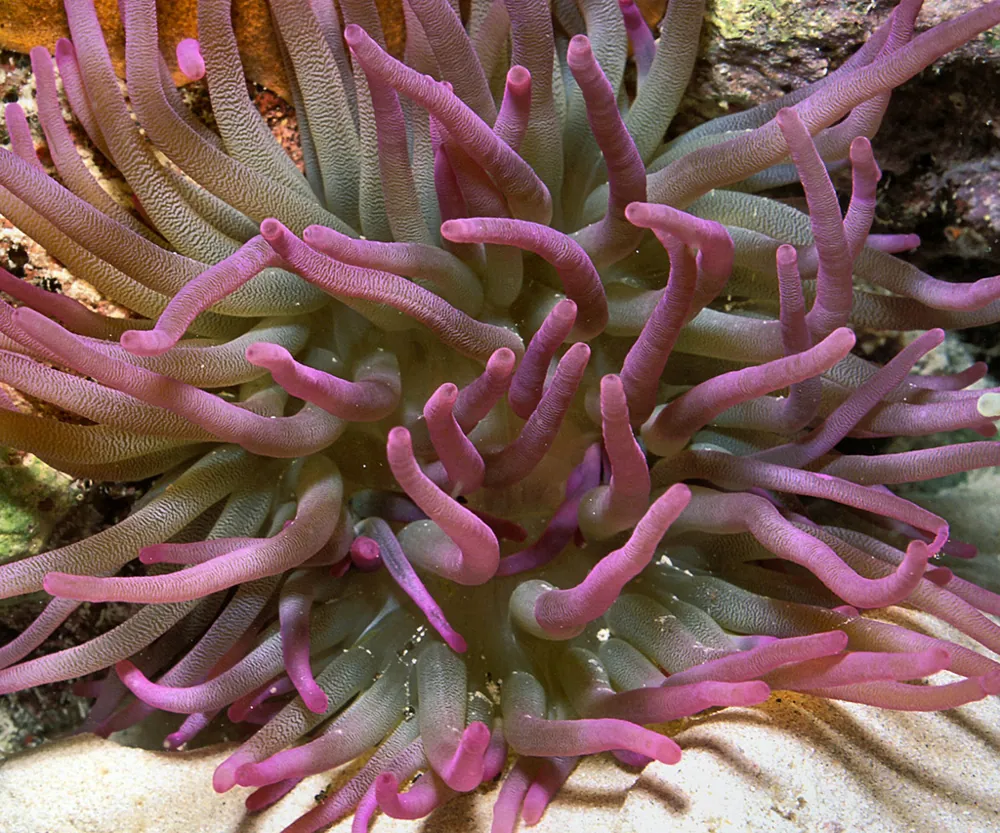
The giant Caribbean sea anemone is a large, colourful sea animal that looks like a soft, flower-shaped blob on the seabed. It lives in shallow reefs and calm inshore waters in the Caribbean and western Atlantic. Its sting is strong enough to stun the fish and shrimp it eats.1



 No anndirto nde
- Grows about 15 cm high and 30 cm wide, with a disc up to about 40 cm across1
- Body can be white, light blue, pink, orange, pale red or light brown1
- More than 100 tentacles surround the mouth1
- Tentacle tips may be purple or rose-coloured, or may be paler than the body1
- Grows singly or in loose groups, never as colonies1
Doole tooke
Ujunaaje selluuji pamari fiɗooji ina fiɗa si huunde memii ɗi.
Hol ko tooke mum (ŋatol walla fiɗol) waɗata?
Its stinging cells (nematocysts) at the tentacle tips contain a toxin called CgNa. When the stinging cells fire, they impale the attacker and release the toxin, which causes extreme pain and paralysis.1
Hol no nde woni bone e yimɓe?
Bone e yimɓe: HoyɗoNo fiɗol nyaaku walla ɓuri famɗude. Ɓadii alaa bone e yimɓe.Hol ko nde waɗata si nde hulii?
When threatened it shrinks by pulling its tentacles into its body and forcing out most of the water, which reduces the surface a predator can attack.1
 Si nde fiɗii
- Yaltu e ndiyam, ittu kala tentacle (e kaddule juuɗe walla wudere).
- Ngam box jellyfish leyɗe tulɓe: loow vinegar dow fiɗe ɗe, ko famɗi fof sakan 30, noddu ballal, wonu hebbinaaɗo waɗde CPR. Ngam bluebottle e ɓurɗi ɗuuɗde: lootu e ndiyam baharu, refti ndiyam wulɗam ngam muusu.
Sahaa fof, noddu lamba ballal yaawngal (112, 000, 911) ko adii. Ɗum ko ballal arano kuuɓal, wonaa wasiyya doktaa. Aslu ballal arano
 Reen hoore maa
- Taa memu, taa nanngu, taa aaɓnu dabbaare ladde abada, hay pamaro, hay si ina wayi no ɗaanii walla maayii.
- Accu nde nokku. Si a fottii e gooto, deeƴu, ruttu caggal seeɗa seeɗa, accu nde yaha laawol mum.
- Si gooto e majji fiɗii ma: deeƴu, taa dillu, noddu lamba ballal yaawngal (112, 000, 911) walla yah asibiti law. Siftor no nde wayri, foto ina walla.
Nde ɗaɓɓaaki ma. Nde huutora tooke mum ngam nanngude ñaamdu walla reende hoore mum, nde ɓuri yiɗde suuɗaade. Ɓeydu anndude no reentorto
Hol to e aduna?
Hol no nde mawni?
Hol no nde juuti?
 juuti no bulok fijo 5 jokkondiraaɗi
 ɓuri leeltude katantanwa ngesa
Hol no Giant Caribbean sea anemone mawni, fottindaade e AAN?
Hiisa tan nder browser maa. Alaa ko mooftetee walla ko neletee.
Hol no nde yaawi?

Anndal
Its nerve cells contain proteins that are molecularly similar to those in mammal nerve cells, which helps scientists study how nervous systems evolved.1
Fish and cleaner shrimp shelter among its tentacles, and it serves as a base station for fish cleaning.1
Although mostly stuck in place, it can crawl very slowly on its base, the pedal disc.1
Its larvae carry their own food in a yolk, so starvation is unlikely and they can drift far to spread out.1
Most individuals are either male or female, with a roughly equal ratio of the two sexes, though they occasionally have both.1
Ngam ganduɓe tooke
- Innde ganndal
- Condylactis gigantea
- Fedde
- Jellyfish e fiɗooji baharu
- Besngu
- Actiniidae2
- Tolno
- Actiniaria
- Nahiyaaji
- Baharu Atlantik, Baharu Karibiya, Baharu Meksiko, Baharuuji mawɗi
- Ɓikkoy
- Eggs and sperm are released into the water, where fertilisation happens. The fertilised egg becomes a larva that settles on the seabed and grows into an adult.1
- Bone e yimɓe
- 1 / 5: Hoyɗo3
Ɗo anndal iwi
- Condylactis gigantea (Wikipedia (CC BY-SA 4.0))
- Condylactis gigantea (iNaturalist): inɗe e tolnugol.
- Venom Wiki: darja bone, mawnude woowaaɗo e miijo yaawre ko amen. Ndaar no min hiisirta ɗum: No min betiri bone.
Kala anndal e ngoo hello ina jogii limre hollirnde iwdi mum. Si min juumii, accu min, min yiɗɓe dabbaaji, wonaa jaridaa ganndal. Wiy min e [email protected] min feewnitay.
 Yaare nden ina heege! Venom Wiki ko golle neɗɗo gooto: meere, tawa tallaaji alaa, trackers alaa. Ballal pamarngal ina walla heddinde ɗum e internet.Ñaamnu yaare nden
Goɗɗi e fedde wootere: Jellyfish e fiɗooji baharu
 Box jellyfish OstireliyaJellyfish e fiɗooji baharuWarooɗoTaa memu
 Irukandji jellyfishJellyfish e fiɗooji baharuIna waawi wardeTaa memu
 Portuguese man o' warJellyfish e fiɗooji baharuIna haani doktaaTaa memu
 Lion's mane jellyfishJellyfish e fiɗooji baharuIna muusa tanTaa memu
 Moon jellyfishJellyfish e fiɗooji baharuAlaa bone
 Common kingslayerJellyfish e fiɗooji baharuIna waawi wardeTaa memu
Ina wona kadi e: Baharu Atlantik
 Hawksbill sea turtleDabbaaji goɗɗi tooke memde walla ñaamdeIna waawi warde
 Blue sea dragonCone snail e octopusIna muusa tan
 Greenland sharkDabbaaji goɗɗi tooke memde walla ñaamdeIna muusa tan
 Common octopusCone snail e octopusAlaa bone
 Common stingrayLiddi tookeIna haani doktaa
 Greater weeverLiddi tookeIna haani doktaaTaa memu