
 Afrik
Afrik Aazi
Aazi Orop
Orop Amerik Worgo
 Ostaraali e Oseyaani
 Antarktik
 Geec Pasifik
 Geec Atlantik
 Geec Enndo
 Geec Arktik
 Geec Mediteraane
 Geec Boɗeejo
 Geec Karayib
 Geec Korayl
 Geec Siin Worgo
 Geec Filipiin
 Geec Andaman
 Geec Rewo
 Geec Timor e Arafura
 Gulf Bengal
 Gulf Kaliforni
European fire-bellied toad
 Tooke e nguru mum
The European fire-bellied toad is a medium-sized frog that lives in ponds and marshes across Central and Eastern Europe. It is famous for its bright red belly, which it shows off to warn predators that it is toxic. Its loud 'whoop' call is also distinctive.1



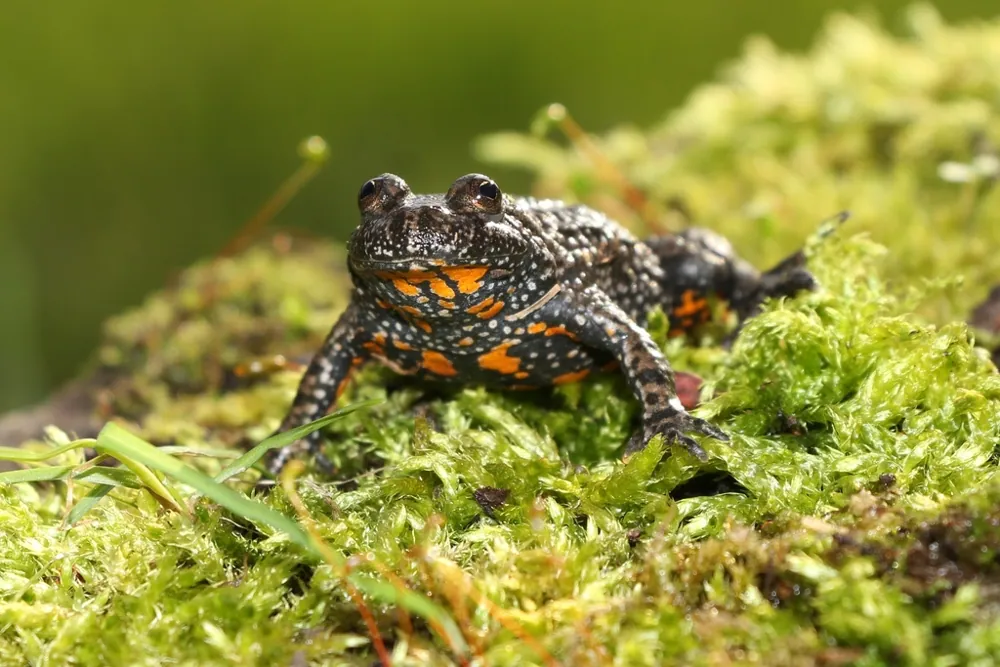
 No anndirte ngal
- Medium-sized frog, growing up to about 5.6 cm.1
- Back colour can be grey, brown or green, and is covered in warts.1
- Belly is red with thick black mottling.1
- When threatened, it lifts its arms, sometimes flipping over, to show its red belly.1
Ina heewi waylondireede e: The yellow-bellied toad (Bombina variegata) is closely related and the two can hybridise where they overlap. The yellow-bellied toad lives at higher elevations in ponds that dry up quickly, has longer legs and thicker skin, and cannot call as loudly.1
Doole tooke ɓanndu
Nguru mum ina jogii tooke. Ina bonna so meemaama, lakkaama walla ñaamaama.
Hol ko tooke ɓanndu mum waɗata?
The skin of this toad contains bombinins, which have antibacterial and antifungal effects. Its red belly warns predators that its skin is toxic.1
Hol no bone mum heewiri e yimɓe?
Bone e yimɓe: HoyɗoNo jukkugol ñaaki walla ko ɓuri famɗude. Ko ɓuri heewde alaa bone e yimɓe.Hol ko ngal waɗata so ina hula?
When threatened, it lifts its arms, sometimes flipping over, to expose its red belly and warn predators of its toxicity.1
 So neɗɗo meemii ngal walla ñaamii ngal
- So neɗɗo meemii gooto: loot juuɗe ɗee no moƴƴiri, wota a meem gite walla hunduko. So cukalel walla kullal galle lakkii walla ñaamii gooto: noddu centre antipoison walla nimero urgence.
Adii fof noddu nimero urgence (112, 000, 911). Ɗum ko anndinal ballal adiingal, wonaa saaraangal doktoor. Ko adii e ballal adiingal
 Reen hoore maa
- Wota a meem, wota a nanngu, wota a ñiŋŋu kullal ladde haa abada, hay so ngal ina famɗi, hay so ina nanndi e ɗaaniingal walla maayngal.
- Accu ngal nokku. So a fotti e ngal, deƴƴu, ruttu ɓaawo seeɗa seeɗa, accu ngal yaha laawol mum.
- So a meemii ngal walla a ñaamii ngal: wota a moomtu gite maa walla hunduko maa, loot juuɗe maa, heɓ ballal cafrol.
Ngal faalaaka gaañde ma. Tooke mum woni tan ngam wota huunde ñaam ngal. Ɓeydu anndude no reentortoo
Hol to e aduna?
Hol no mawniri?
Hol no juutiri?
 ɓuri hondu maa tokooso rabbaɗde
 ina waawi taƴde 100 meeteer e segonde 180 (neɗɗo ɓurɗo yaawde ina sokli 9,6)
Hol no European fire-bellied toad mawniri, so fooɗondiraama e AN?
Limgal tan e navigatoor maa. Alaa ko danndetee walla ko neldetee.
Hol no yaawiri?


Humpito
The antifungal effect of bombinins in the skin makes them promising for use in food packaging to slow spoilage.1
A population in Lorraine, France, lives more than 500 km from its natural range, probably because people moved them there on purpose.1
Dozens of ponds dug in Funen County, Denmark, helped increase the population about five-fold in a decade.1
The prokineticin family of compounds was first discovered in this species and the yellow-bellied toad.1
Ngam ganduɓe tooke
- Innde ganndal
- Bombina bombina
- Fedde
- Ñaari tooke, ñaari e newts
- Ɓesngu
- Bombinatoridae2
- Ordre
- Anura
- Leyɗe mawɗe
- Orop
- Ɓiɓɓe tokooso
- Females lay up to 15 to 40 eggs, depending on their size. Tadpoles hatch in about a week and develop for about a month before metamorphosing at about 3.8 cm.1
- Hol no ngal woniri e ladde
- Least Concern (IUCN), though it has suffered losses in parts of its range1
- Bone e yimɓe
- 1 / 5: Hoyɗo3
Ɗo humpito iwri
- European fire-bellied toad (Wikipedia (CC BY-SA 4.0))
- Bombina bombina (iNaturalist): inɗe e ceergal.
- Venom Wiki: tolno bone, mawnude heewnde e miijo yaawde ko amen. Yiy no men keɓirta ɗum: No men tolnirta bone.
Kala humpito e ngoo hello ina jogii limoore hollirnde iwdi mum. So men juumii, yaafo, men ko yiɗɓe kulle, wonaa jaaynde ganndal. Wiy men e [email protected], men feewnita.
 Yaare nden ina weelaa! Venom Wiki ko golle neɗɗo gooto: yoɓetaake, alaa ko jeeyetee, alaa rewɓe. Ndokkal seeɗa ina walla ngam heddude e enternet.Ñaam yaare nden
Goɗɗe e nder fedde wootere: Ñaari tooke, ñaari e newts
 Fire salamanderÑaari tooke, ñaari e newtsIna muusi tanWota a meem
 Common toadÑaari tooke, ñaari e newtsIna muusi tanWota a meem
 Iberian ribbed newtÑaari tooke, ñaari e newtsAlaa bone
 Natterjack toadÑaari tooke, ñaari e newtsAlaa bone
 Alpine salamanderÑaari tooke, ñaari e newtsAlaa bone
 European green toadÑaari tooke, ñaari e newtsAlaa bone
Ina wuuri kadi e: Orop
 Common European adderƁoɗɗi wipeerIna sokli doktoor
 Spanish flyKulle goɗɗe jogiiɗe tooke ɓannduIna sokli doktoorWota a meem
 Common waspÑaaki, ɗuggi e ɗuggi mawɗiIna muusi tan
 European hornetÑaaki, ɗuggi e ɗuggi mawɗiIna muusi tan
 Western honey beeÑaaki, ɗuggi e ɗuggi mawɗiIna muusi tan
 Blunt-nosed viperƁoɗɗi wipeerIna waawi warde