
 Afrik
Afrik Aazi
Aazi Orop
Orop Amerik Worgo
 Ostaraali e Oseyaani
 Antarktik
 Geec Pasifik
 Geec Atlantik
 Geec Enndo
 Geec Arktik
 Geec Mediteraane
 Geec Boɗeejo
 Geec Karayib
 Geec Korayl
 Geec Siin Worgo
 Geec Filipiin
 Geec Andaman
 Geec Rewo
 Geec Timor e Arafura
 Gulf Bengal
 Gulf Kaliforni
Long-spine porcupinefish
 Ina bonna so ñaamaamaIna ñaama: Seeɗa e kala huundeTooke ɓanndu, wonaa tooke ŋatgol
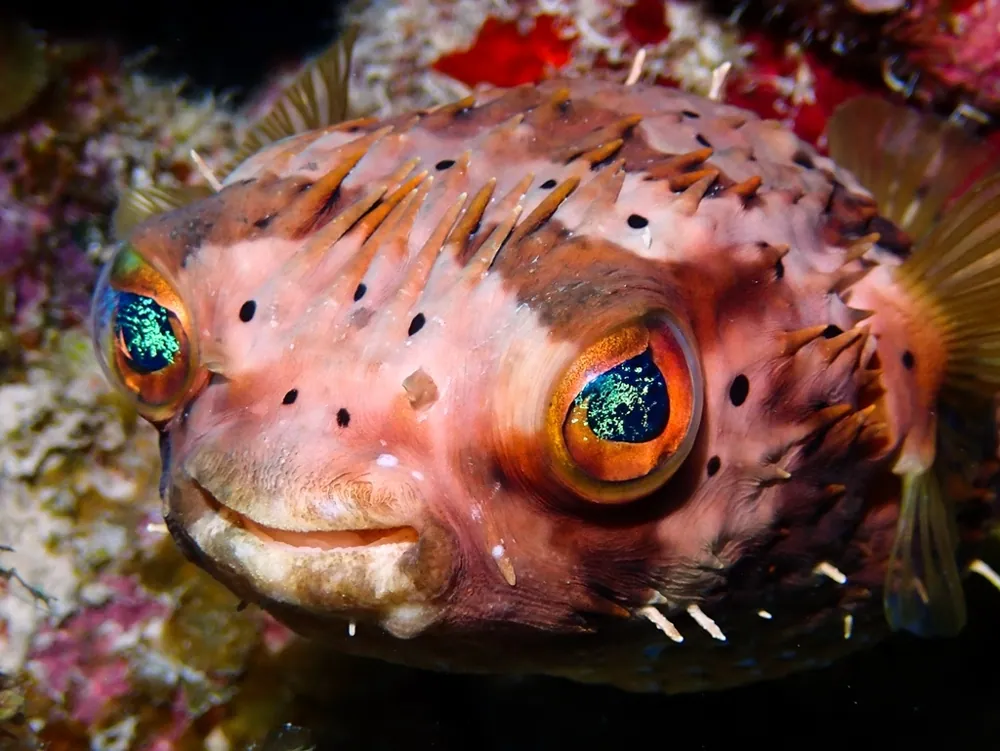
The long-spine porcupinefish is a marine fish covered in long, sharp spines. It lives in warm tropical and subtropical seas around the world, often over muddy seabeds or on reefs. Its beak-like jaws can crush hard prey such as sea urchins and shellfish.1



 No anndirte ngal
- Pale in colour, with large black blotches and smaller black spots. The spots become fewer as the fish gets older.1
- Many long spines, each with two roots, which can be raised or lowered. They are especially numerous on the head.1
- The teeth of the two jaws are fused into a parrot-like beak.1
- Adults can reach 50 cm in length.1
Ina heewi waylondireede e: The black-blotched porcupinefish (Diodon liturosus) is the only other fish it might be confused with. The long-spine porcupinefish has much longer spines.1
Doole tooke ɓanndu
Ina bonna tan so huunde ñaamii ngal.
Hol no bone mum heewiri e yimɓe?
Bone e yimɓe: Ina tiiɗiSo neɗɗo ñaamii ngal, yahu e doktoor. Maayde ina famɗi sanne. So neɗɗo meemii ngal walla ñaamii ngal
- So neɗɗo ñaamii ɗum walla ina jogii maandeeji caggal ñaamde ɗum: noddu nimero urgence walla centre antipoison ɗoo e sahaa oo.
Adii fof noddu nimero urgence (112, 000, 911). Ɗum ko anndinal ballal adiingal, wonaa saaraangal doktoor. Ko adii e ballal adiingal
 Reen hoore maa
- Wota a meem, wota a nanngu, wota a ñiŋŋu kullal ladde haa abada, hay so ngal ina famɗi, hay so ina nanndi e ɗaaniingal walla maayngal.
- Accu ngal nokku. So a fotti e ngal, deƴƴu, ruttu ɓaawo seeɗa seeɗa, accu ngal yaha laawol mum.
- So a meemii ngal walla a ñaamii ngal: wota a moomtu gite maa walla hunduko maa, loot juuɗe maa, heɓ ballal cafrol.
Ngal faalaaka gaañde ma. Tooke mum woni tan ngam wota huunde ñaam ngal. Ɓeydu anndude no reentortoo
Hol to e aduna?
Hol no mawniri?
Hol no juutiri?
 juutde no banaanaaji 3 sammondiraaɗi
 juutde no kaaɗe mahirɗe 16 ɗaɓɓondiraaɗe
 ina waawi yoowde juuteendi pisin mawɗo (50 m) e segonde 45
Hol no Long-spine porcupinefish mawniri, so fooɗondiraama e AN?
Limgal tan e navigatoor maa. Alaa ko danndetee walla ko neldetee.
Hol no yaawiri?
Humpito
Its jaws are fused into a beak that looks like a parrot's, and it uses it to crack open sea urchins and molluscs.1
Its spines have two roots and can be raised or lowered.1
The black spots on its pale body become fewer as it ages.1
Young fish are found in groups, and they stay in open water until they reach about 7 cm.1
Ngam ganduɓe tooke
- Innde ganndal
- Diodon holocanthus
- Fedde
- Kulle goɗɗe jogiiɗe tooke ɓanndu
- Ɓesngu
- Diodontidae2
- Ordre
- Tetraodontiformes
- Leyɗe mawɗe
- Geec Pasifik, Geec Atlantik, Geec Enndo, Geec Boɗeejo, Geec Karayib, Geec Korayl, Geec Filipiin, Geec Siin Worgo, Gulf Meksik, Geec Timor e Arafura, Gulf Bengal, Gulf Kaliforni, Geece mawɗe
- Ɓiɓɓe tokooso
- It spawns at the surface at dawn or dusk, in pairs or in groups of males with one female. The young stay pelagic (living in open water) until they are at least 7 cm long.1
- Bone e yimɓe
- 3 / 5: Ina tiiɗi3
Ɗo humpito iwri
- Long-spine porcupinefish (Wikipedia (CC BY-SA 4.0))
- Diodon holocanthus (iNaturalist): inɗe e ceergal.
- Venom Wiki: tolno bone, mawnude heewnde e miijo yaawde ko amen. Yiy no men keɓirta ɗum: No men tolnirta bone.
Kala humpito e ngoo hello ina jogii limoore hollirnde iwdi mum. So men juumii, yaafo, men ko yiɗɓe kulle, wonaa jaaynde ganndal. Wiy men e [email protected], men feewnita.
 Yaare nden ina weelaa! Venom Wiki ko golle neɗɗo gooto: yoɓetaake, alaa ko jeeyetee, alaa rewɓe. Ndokkal seeɗa ina walla ngam heddude e enternet.Ñaam yaare nden
Goɗɗe e nder fedde wootere: Kulle goɗɗe jogiiɗe tooke ɓanndu
 Liingu puffer SapoŋKulle goɗɗe jogiiɗe tooke ɓannduBareejo
 Hawksbill sea turtleKulle goɗɗe jogiiɗe tooke ɓannduIna waawi warde
 Greenland sharkKulle goɗɗe jogiiɗe tooke ɓannduIna muusi tan
 Silver-cheeked toadfishKulle goɗɗe jogiiɗe tooke ɓannduBareejo
 Blackspotted pufferKulle goɗɗe jogiiɗe tooke ɓannduIna waawi warde
 White-spotted pufferKulle goɗɗe jogiiɗe tooke ɓannduIna waawi warde
Ina wuuri kadi e: Geec Pasifik
 Meduus kaaɗe OstaraaliMeduusaaji e kulle geec jukkoojeBareejoWota a meem
 Kokiyaas kone jeografiKokiyaas kone e pulpuujiBareejo
 Pulp mawɗo koode bulaajeKokiyaas kone e pulpuujiBareejo
 Pulp koode bulaaje worgoKokiyaas kone e pulpuujiBareejo
 Irukandji jellyfishMeduusaaji e kulle geec jukkoojeIna waawi wardeWota a meem
 Reef stonefishLiƴƴi jogiiɗi tookeIna waawi wardeWota a meem