
 Afrik
Afrik Aazi
Aazi Orop
Orop Amerik Worgo
 Ostaraali e Oseyaani
 Antarktik
 Geec Pasifik
 Geec Atlantik
 Geec Enndo
 Geec Arktik
 Geec Mediteraane
 Geec Boɗeejo
 Geec Karayib
 Geec Korayl
 Geec Siin Worgo
 Geec Filipiin
 Geec Andaman
 Geec Rewo
 Geec Timor e Arafura
 Gulf Bengal
 Gulf Kaliforni
Longhorn cowfish
 Tooke e nguru mumIna ñaama: Seeɗa e kala huundeTooke ɓanndu, wonaa tooke ŋatgol
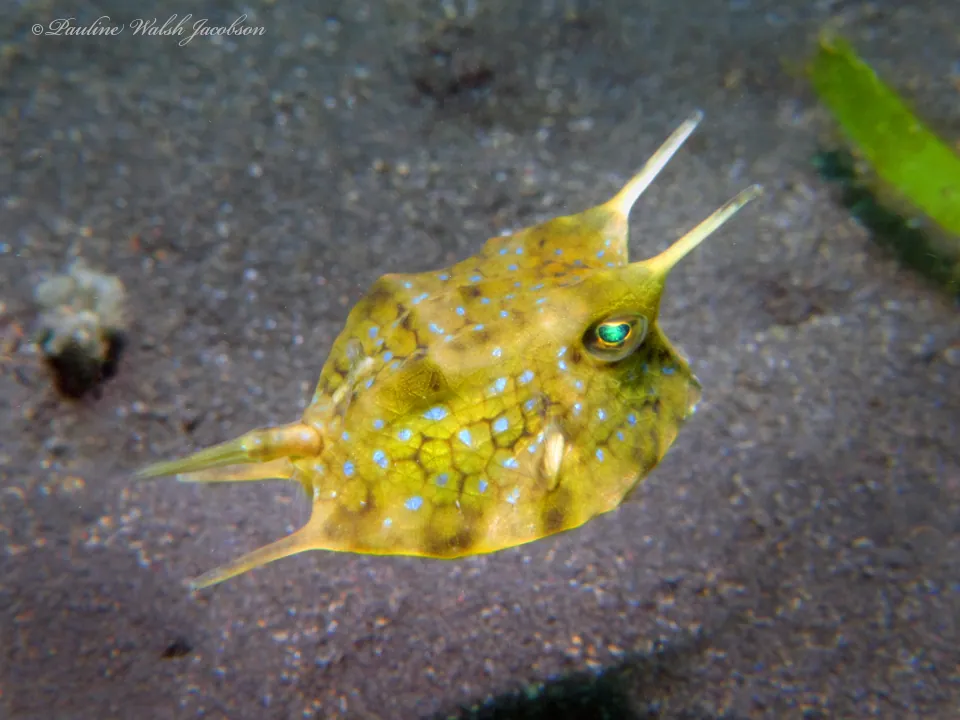
The longhorn cowfish is a small, boxy reef fish with two long horns above its eyes, like a cow's. It lives in warm waters across the Indo-Pacific, from the Red Sea to Japan and Australia. It is a slow swimmer that protects itself with a hard box-like body and a skin poison.1


 No anndirte ngal
- Two long horns stick out from the front of the head, above the large eyes1
- Its body is a solid, triangular, box-like shell made of fused plate-like scales, with the fins and tail sticking out1
- The base colour is yellow to olive, decorated with white or bluish spots1
- It has no gill cover, only a small slit or hole behind the head1
- It swims slowly with its fins, so it looks as if it is hovering1
Doole tooke ɓanndu
Nguru mum ina jogii tooke. Ina bonna so meemaama, lakkaama walla ñaamaama.
Hol ko tooke ɓanndu mum waɗata?
When it is severely stressed, it can release a toxin called pahutoxin from the mucus on its skin. This poison is toxic to other boxfish and has properties similar to sea cucumber toxins.1
Hol no bone mum heewiri e yimɓe?
Bone e yimɓe: HoyɗoNo jukkugol ñaaki walla ko ɓuri famɗude. Ko ɓuri heewde alaa bone e yimɓe.Hol ko ngal waɗata so ina hula?
Its hard box-like shell, its horns, which can be used to charge at predators, and its skin poison all protect it. If severely stressed, it may release its toxin.1
 So neɗɗo meemii ngal walla ñaamii ngal
- So neɗɗo ñaamii ɗum walla ina jogii maandeeji caggal ñaamde ɗum: noddu nimero urgence walla centre antipoison ɗoo e sahaa oo.
Adii fof noddu nimero urgence (112, 000, 911). Ɗum ko anndinal ballal adiingal, wonaa saaraangal doktoor. Ko adii e ballal adiingal
 Reen hoore maa
- Wota a meem, wota a nanngu, wota a ñiŋŋu kullal ladde haa abada, hay so ngal ina famɗi, hay so ina nanndi e ɗaaniingal walla maayngal.
- Accu ngal nokku. So a fotti e ngal, deƴƴu, ruttu ɓaawo seeɗa seeɗa, accu ngal yaha laawol mum.
- So a meemii ngal walla a ñaamii ngal: wota a moomtu gite maa walla hunduko maa, loot juuɗe maa, heɓ ballal cafrol.
Ngal faalaaka gaañde ma. Tooke mum woni tan ngam wota huunde ñaam ngal. Ɓeydu anndude no reentortoo
Hol to e aduna?
Hol no mawniri?
Hol no juutiri?
Hol no teddiri?
 juutde no banaanaaji 3 sammondiraaɗi
 juutde no kaaɗe mahirɗe 16 ɗaɓɓondiraaɗe
 ina waawi yoowde juuteendi pisin mawɗo (50 m) e segonde 45
Hol no Longhorn cowfish mawniri, so fooɗondiraama e AN?
Limgal tan e navigatoor maa. Alaa ko danndetee walla ko neldetee.
Hol no yaawiri?
Humpito
Its horns may have evolved to make it harder for predators to swallow it, and if damaged, they can grow back within a few months.1
It can make humming and clicking sounds using muscles connected to its swim bladder.1
It is slow and easy to catch by hand, and it makes a grunting noise when caught.1
On Pamban Island in India, a local belief says cows on the island turned into these fish when the land separated.1
It helps protect coral reefs by eating invertebrates that damage them, and it is also important to reef growth.1
Ngam ganduɓe tooke
- Innde ganndal
- Lactoria cornuta
- Fedde
- Kulle goɗɗe jogiiɗe tooke ɓanndu
- Ɓesngu
- Ostraciidae2
- Ordre
- Tetraodontiformes
- Leyɗe mawɗe
- Geec Pasifik, Geec Enndo, Geec Boɗeejo, Geec Korayl, Geec Filipiin, Geec Siin Worgo, Geec Timor e Arafura, Gulf Bengal, Geece mawɗe
- Ɓiɓɓe tokooso
- Females spawn in small groups, with one male and 3 to 4 females in each harem. The oval eggs hatch into larvae that quickly form the box-like armour.1
- Bone e yimɓe
- 1 / 5: Hoyɗo3
Ɗo humpito iwri
- Longhorn cowfish (Wikipedia (CC BY-SA 4.0))
- Lactoria cornuta (iNaturalist): inɗe e ceergal.
- Venom Wiki: tolno bone, mawnude heewnde e miijo yaawde ko amen. Yiy no men keɓirta ɗum: No men tolnirta bone.
Kala humpito e ngoo hello ina jogii limoore hollirnde iwdi mum. So men juumii, yaafo, men ko yiɗɓe kulle, wonaa jaaynde ganndal. Wiy men e [email protected], men feewnita.
 Yaare nden ina weelaa! Venom Wiki ko golle neɗɗo gooto: yoɓetaake, alaa ko jeeyetee, alaa rewɓe. Ndokkal seeɗa ina walla ngam heddude e enternet.Ñaam yaare nden
Goɗɗe e nder fedde wootere: Kulle goɗɗe jogiiɗe tooke ɓanndu
 Liingu puffer SapoŋKulle goɗɗe jogiiɗe tooke ɓannduBareejo
 Hawksbill sea turtleKulle goɗɗe jogiiɗe tooke ɓannduIna waawi warde
 Greenland sharkKulle goɗɗe jogiiɗe tooke ɓannduIna muusi tan
 Silver-cheeked toadfishKulle goɗɗe jogiiɗe tooke ɓannduBareejo
 Blackspotted pufferKulle goɗɗe jogiiɗe tooke ɓannduIna waawi warde
 White-spotted pufferKulle goɗɗe jogiiɗe tooke ɓannduIna waawi warde
Ina wuuri kadi e: Geec Pasifik
 Meduus kaaɗe OstaraaliMeduusaaji e kulle geec jukkoojeBareejoWota a meem
 Kokiyaas kone jeografiKokiyaas kone e pulpuujiBareejo
 Pulp mawɗo koode bulaajeKokiyaas kone e pulpuujiBareejo
 Pulp koode bulaaje worgoKokiyaas kone e pulpuujiBareejo
 Irukandji jellyfishMeduusaaji e kulle geec jukkoojeIna waawi wardeWota a meem
 Reef stonefishLiƴƴi jogiiɗi tookeIna waawi wardeWota a meem