
 África
 Asia
Asia Europa
 América do Sur
 Australia e Oceanía
 Antártida
 Océano Pacífico
 Océano Atlántico
 Océano Índico
 Océano Glacial Ártico
 Mar Mediterráneo
 Mar Vermello
 Mar Caribe
 Mar do Coral
 Mar da China Meridional
 Mar de Filipinas
 Mar de Andamán
 Mar do Norte
 Mar de Timor e de Arafura
 Golfo de Bengala
 Golfo de California
Black house spider
 Morde
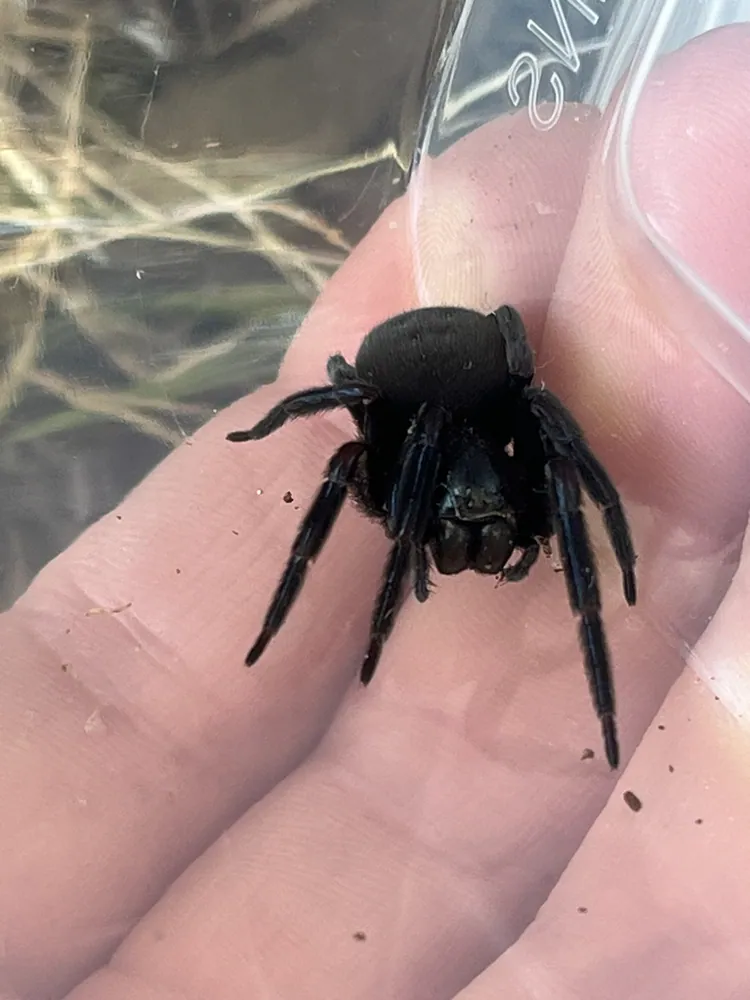
MordeThe black house spider is a dark, sturdy spider that lives across Australia. It was carried to New Zealand and Japan, and it often lives in homes, where it sits in a messy web in corners and near windows. It is venomous, but its bite is rarely a serious danger to people.1

 Como recoñecelo
- A dark, robust spider. Females have a body up to 18 mm long and a leg span of 30 mm.1
- Males are smaller, about 10 mm long, with longer legs in proportion to their body.1
- The body and legs are dark brown to black. The abdomen (rear part) is charcoal grey, with light markings that are sometimes faint, and it is covered in fine, velvety hair.1
- The web looks messy, with irregular sail-like sheets of silk and a funnel-shaped retreat, usually in the middle or corner of the web.1
Adoita confundirse con: The grey house spider (Badumna longinqua) is similar and has a similar range. It is slightly smaller, at about 14 mm, has a greyish top section (carapace) and black-brown legs. It is more often found outdoors.1
Poder da pezoña
A pezoña sae polos seus cairos ou dentes cando morde.
Que fai a súa pezoña?
The bite is venomous. It may be excruciatingly painful and cause local swelling. Nausea, vomiting, sweating and dizziness are occasionally recorded. In a few cases, skin lesions (arachnogenic necrosis, damage to the skin and tissue) have developed after several bites.1
Que perigoso é para as persoas?
Perigo para as persoas: DolorosoPode doer moito, pero case nunca é grave.Black house spiders are venomous but are not considered dangerous. They are timid, and bites from them are infrequent.1
 Se morde
- Lava a mordedura e ponlle unha bolsa de xeo para a dor. Busca axuda médica se a dor é forte, se se estende ou se a persoa se sente mal.
Chama sempre primeiro ao teu número de emerxencias (112, 000, 911). Isto son consellos xerais de primeiros auxilios, non consello médico. Primeiros auxilios básicos
 Mantente a salvo
- Nunca toques, collas nin molestes un animal salvaxe, aínda que sexa pequeno e aínda que pareza durmido ou morto.
- Déixalle espazo. Se atopas un, mantén a calma, recúa amodo e déixao ir polo seu camiño.
- Se un te morde: mantén a calma, non te movas, chama ao teu número de emerxencias (112, 000, 911) ou vai rápido a un hospital. Lembra como era, unha foto axuda.
Non vai a por ti. Usa a súa pezoña para cazar comida ou para defenderse, e prefire con moito agocharse. Máis sobre como estar a salvo
En que lugar do mundo?
Que tamaño ten?
Canto mide?
 máis curto ca o teu dedo meniño
Que tamaño ten Black house spider comparado CONTIGO?
Só son contas no teu navegador. Non se garda nin se envía nada a ningures.
Que rápido é?


Datos
A male plucks the female's web to attract her attention before he approaches to mate. They may stay together for several days and mate several times.1
The spider rarely moves its web, so old webs become messy, with dust and small objects stuck in them.1
At night, the spider repairs and adds to its web, often by laying new silk over the old.1
The female almost never leaves her web unless she is forced to.1
Predators include the white-tailed spider, as well as parasitic wasps and flies.1
Desmontamitos
Mito: Black house spiders are dangerous spiders.
Verdade: They are venomous, but they are not considered dangerous. They are timid, and their bites are infrequent.1
Para expertos en pezoñas
- Nome científico
- Badumna insignis
- Grupo
- Arañas
- Familia
- Desidae2
- Orde
- Araneae
- Continentes
- Australia e Oceanía
- Crías
- The female builds several white silk egg sacs inside the web retreat and stays with the eggs until they hatch. The young may leave or stay in the mother's web for some time.1
- Perigo para as persoas
- 2 / 5: Doloroso3
De onde veñen os datos
- Black house spider (Wikipedia (CC BY-SA 4.0))
- Badumna insignis (iNaturalist): nomes e clasificación.
- Venom Wiki: o nivel de perigo, o tamaño típico e a velocidade estimada son nosos. Mira como os calculamos: Como valoramos o perigo.
Cada dato desta páxina ten un número que leva á súa fonte. Se nos equivocamos nalgo, sentímolo, somos fans dos animais, non unha revista científica. Dínolo en [email protected] e arranxarémolo.
 O escorpión ten fame! Venom Wiki é un proxecto dunha soa persoa: gratis, sen anuncios e sen rastrexadores. Unha pequena propina axuda a mantelo en liña.Dálle de comer ao escorpión
 Redback spider
 Katipo
 White-tailed spider
 Peacock spider
 Badge huntsman spider
 Eastern white-tailed spider
 Coastal taipan
 Common death adder
 Eastern brown snake
 Inland taipan
 Sydney funnel-web spider
 Tiger snake