
 Afirka
 Asiya
Asiya Turai
Turai Kudancin Amurka
 Ostareliya da Oceania
 Antatika
 Tekun Pasifik
 Tekun Atlantika
 Tekun Indiya
 Tekun Arctic
 Bahar Rum
 Bahar Maliya
 Tekun Caribbean
 Tekun Coral
 Tekun Kudancin China
 Tekun Philippines
 Tekun Andaman
 Tekun Arewa
 Tekun Timor da Arafura
 Gaɓar Tekun Bengal
 Gaɓar Tekun California
Black long-spined urchin
 Ƙayoyi masu dafi
The black long-spined urchin is a sea urchin with very long, hollow spines. It lives on coral reefs, sand flats and seagrass beds across the Indo-Pacific, and it is one of the most widespread sea urchins in that region. Its spines can deliver a mild venom, so it is best to watch where you put your feet.1


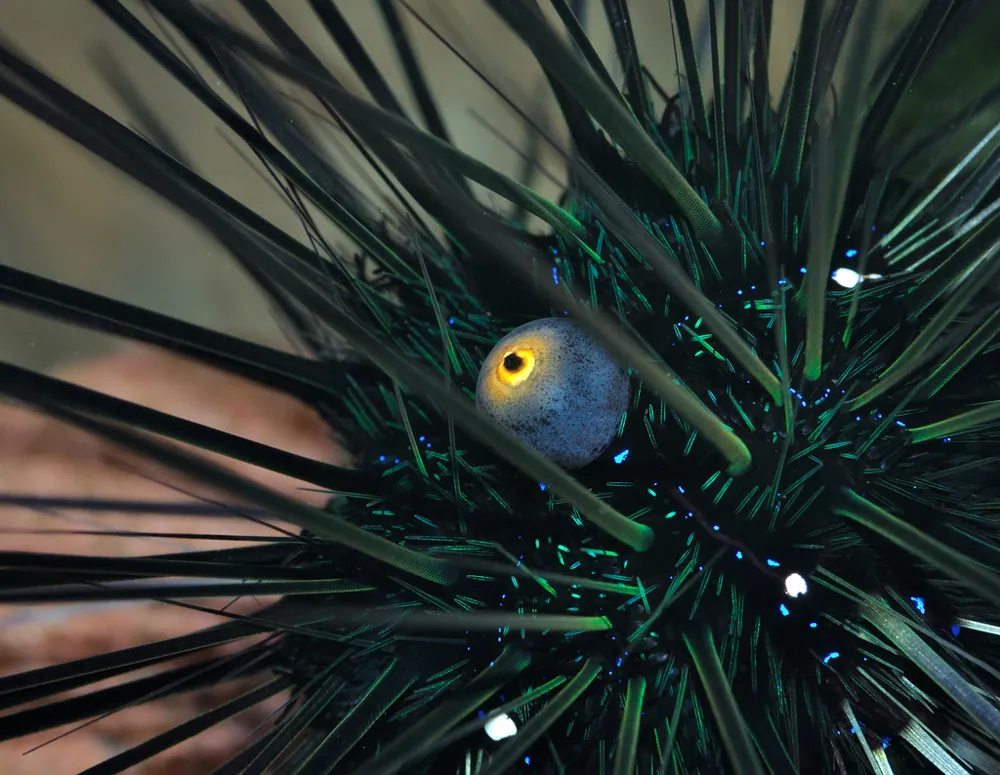
 Yadda za ka gane shi
- Black, near-spherical body (test) with extremely long, narrow, hollow spines, often black but sometimes brown-banded1
- Five white spots on the body, which separate it from other Diadema species1
- A bright orange ring around the periproctal cone (the 'anal cone'), which is often mistaken for an eye1
- Bluish spots on the genital plates and a line of blue spots along the body1
- Adults are no more than 70 mm across the body and about 40 mm high1
Ana yawan rikita shi da: Other Diadema species are similar in shape and spines, but they lack the five white spots that mark this species. Its orange ring and blue spots also help to tell it apart.1
Ƙarfin dafi
Ƙayoyi masu kaifi ne ke ɗauke da dafin. Taka shi ko kama shi yana ciwo.
Me dafinsa yake yi?
The spines are hollow and contain a mild venom. The toxin mostly causes swelling and pain, which spreads gradually over several hours. The venom is not fatal to humans. The spines themselves are a bigger problem, because they are brittle and needle-like, break off in flesh and are difficult to remove.1
Yaya haɗarinsa yake ga mutane?
Haɗari ga mutane: Mai raɗaɗiYana iya yin ciwo sosai, amma kusan bai taɓa zama mai tsanani ba.The venom is only mild, and the species is not considered a serious threat to humans. Stepping on it can cause painful stings.1
Me yake yi idan ya ji tsoro?
When threatened by a sudden impact or by spines snapping, it rapidly flips its body over and 'runs' on the tips of its longest spines.1
 Idan ƙayoyinsa suka soke ka
- Ka saka raunin cikin ruwan zafi, mai zafi iyakar yadda mutumin zai iya jurewa ba tare da ya ƙone ba, kuma ka nemi taimakon likita don cire ƙayoyin. Kada ka tona su da kanka.
Kullum ka fara kiran lambar gaggawa (112, 000, 911). Wannan jagorar agajin gaggawa ce ta gaba ɗaya, ba shawarar likita ba. Muhimman abubuwan agajin gaggawa
 Kiyaye lafiya
- Kada ka taɓa, kada ka kama, kada ka tsokani dabbar daji, ko da ƙarama ce, kuma ko da tana kama da tana barci ko ta mutu.
- Ka ba shi sarari. Idan ka haɗu da ɗaya, ka natsu, ka koma baya a hankali kuma ka bar shi ya bi hanyarsa.
- Idan ƙayoyinsa suka soke ka: ka natsu, ka zauna ba motsi, ka kira lambar gaggawarka (112, 000, 911) ko ka je asibiti da sauri. Ka tuna yadda yake, hoto yana taimakawa.
Ba ya neman cutar da kai. Yana amfani da dafinsa don kama abinci ko don kare kansa, kuma ya fi son ya ɓuya. Ƙarin bayani game da kiyaye lafiya
A ina a duniya?
Yaya girmansa yake?
Yaya tsawonsa yake?
Yaya nauyinsa yake?

 tsawon tubalan gini na wasa 2 a jere
 ya fi katantanwar lambu jinkiri
Yaya girman Black long-spined urchin yake idan aka kwatanta da KAI?
Lissafi ne kawai a cikin burauzarka. Ba a adana komai ko a aika ko'ina.
Yaya saurinsa yake?

Bayanai
It can move 760 mm in just 7 seconds by rolling and walking on the tips of its spines.1
It has no eye, but it has a diffuse light-sensing system that lets it detect light levels and the size and colour of objects.1
In 2006, living specimens were found off Turkey, making it the first invasive Erythrean sea urchin recorded in the Mediterranean.1
Goose barnacles of the genus Microlepas are known to live on it as parasites.1
It is considered one of the oldest living species in its genus, Diadema.1
Mai karya tatsuniya
Tatsuniya: Black long-spined urchins are deadly and their stings can kill people.
Gaskiya: Their venom is mild and is not fatal to humans. The main problems are pain, swelling and spines that break off in the skin.1
Don ƙwararru a kan dafi
- Sunan kimiyya
- Diadema setosum
- Rukuni
- Sea urchins, kifin tauraro da tsutsotsi
- Iyali
- Diadematidae2
- Tsari
- Diadematoida
- Nahiyoyi
- Tekun Indiya, Tekun Pasifik, Bahar Maliya, Tekun Coral, Tekun Philippines, Tekun Arabiya da Mashigin Farisa, Tekun Timor da Arafura, Gaɓar Tekun Bengal, Tekuna
- Jarirai
- It is a broadcast spawner, releasing eggs and sperm into the water. Spawning happens seasonally or year-round depending on the location, and in some places it follows the full moon.1
- Haɗari ga mutane
- 2 / 5: Mai raɗaɗi3
Inda bayanan suka fito
- Diadema setosum (Wikipedia (CC BY-SA 4.0))
- Diadema setosum (iNaturalist): sunaye da rarrabuwa.
- Venom Wiki: matakin haɗari, girman al'ada da ƙiyasin sauri namu ne. Ga yadda muke lissafa su: Yadda muke auna haɗari.
Kowane bayani a wannan shafi yana da lamba da ke nuna tushensa. Idan mun yi kuskure, ka yi haƙuri, mu masoya dabbobi ne, ba mujallar kimiyya ba. Ka gaya mana a [email protected] kuma za mu gyara.
 Kunama tana jin yunwa! Venom Wiki aikin mutum ɗaya ne: kyauta, ba talla kuma ba masu bin diddigi. Ɗan ƙaramin kyauta yana taimakawa wajen ci gaba da kasancewarsa a intanet.Ciyar da kunama
Ƙari daga rukuni ɗaya: Sea urchins, kifin tauraro da tsutsotsi
 Crown-of-thorns starfishSea urchins, kifin tauraro da tsutsotsiYana buƙatar likitaKada ka taɓa
 Flower urchinSea urchins, kifin tauraro da tsutsotsiNa iya kisa
 Fire urchinSea urchins, kifin tauraro da tsutsotsiYana buƙatar likitaKada ka taɓa
 Bearded firewormSea urchins, kifin tauraro da tsutsotsiCiwo kawaiKada ka taɓa
 BloodwormSea urchins, kifin tauraro da tsutsotsiCiwo kawai
 Bobbit wormSea urchins, kifin tauraro da tsutsotsiCiwo kawai
Yana kuma zaune a: Tekun Indiya
 Australian box jellyfishJellyfish da masu harbi na tekuMai kisaKada ka taɓa
 Geography coneKatantanwar cone da octopusMai kisa
 Greater blue-ringed octopusKatantanwar cone da octopusMai kisa
 Southern blue-ringed octopusKatantanwar cone da octopusMai kisa
 Hawksbill sea turtleSauran dabbobi masu gubaNa iya kisa
 Irukandji jellyfishJellyfish da masu harbi na tekuNa iya kisaKada ka taɓa