
 Afirka
 Asiya
Asiya Turai
Turai Kudancin Amurka
 Ostareliya da Oceania
 Antatika
 Tekun Pasifik
 Tekun Atlantika
 Tekun Indiya
 Tekun Arctic
 Bahar Rum
 Bahar Maliya
 Tekun Caribbean
 Tekun Coral
 Tekun Kudancin China
 Tekun Philippines
 Tekun Andaman
 Tekun Arewa
 Tekun Timor da Arafura
 Gaɓar Tekun Bengal
 Gaɓar Tekun California
Greater blue-ringed octopus
 Cizo
CizoThe greater blue-ringed octopus is a small sea creature that lives in the warm shallow waters of the Indo-West Pacific, including around Australia. It is one of the most venomous marine animals in the world, so knowing what it looks like matters.1



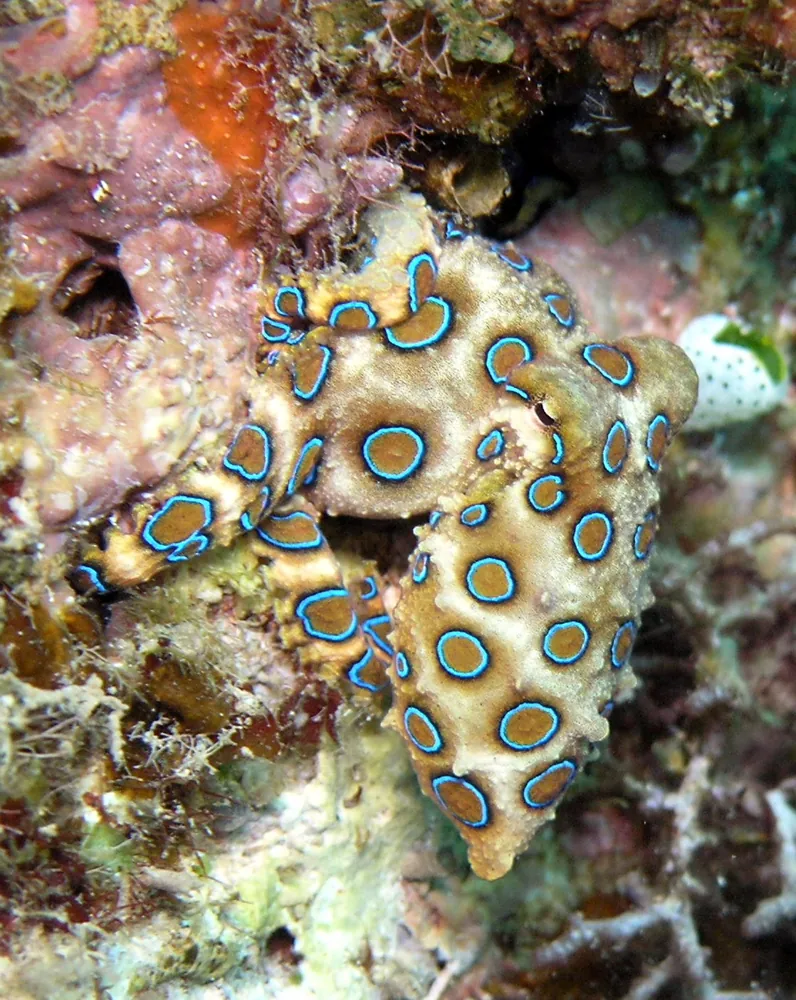
 Yadda za ka gane shi
- A small octopus, up to 10 cm with its arms included, weighing about 80 grams on average.1
- Electric blue rings, about 7 to 8 mm across, roughly 60 of them, spread over its whole skin.1
- The rings flash iridescent blue as a warning signal, each flash lasting about a third of a second.1
- Its body colour varies from yellow ochre to light brown, or whitish when inactive.1
- Blue lines run through its eyes.1
Ƙarfin dafi
Dafi yana fitowa ta haƙoransa na dafi ko haƙoransa idan ya ciza.
Me dafinsa yake yi?
Its venom contains tetrodotoxin (TTX), a powerful neurotoxin, which is a poison that attacks the nerves. It paralyses the muscles needed for movement, and in people it can lead to death through respiratory paralysis, which means the breathing muscles stop working. Symptoms include tingling and numbness of the face and lips, sweating, severe headaches, dizziness, speech problems, weakness and vomiting. Symptoms can appear between 15 minutes and four hours after a bite, and the victim stays conscious throughout.1
Yaya haɗarinsa yake ga mutane?
Haɗari ga mutane: Mai kisaƊaya daga cikin dabbobi mafi haɗari a duniya.The bite is capable of being fatal to humans. The bite is painless, so a person may not notice it. Children are more sensitive to the toxin. Death can occur between 20 minutes and 24 hours after symptoms begin.1
Me yake yi idan ya ji tsoro?
It flashes its blue rings as a warning to predators, and it uses its venom to defend itself.1
 Idan ya ciji
- Ɗaurin matsi don hana motsi: ka naɗe bandeji mai roba (elastic) da ƙarfi a kan wurin cizon sannan ka ci gaba da naɗewa har dukan gaɓar, ka ɗaure ta da katako (splint), kuma ka sa mutumin ya zauna ba motsi kwata-kwata har taimako ya iso.
- Octopus mai zobba shuɗi ko katantanwar cone na iya hana mutum numfashi alhali yana cikin hayyacinsa: ka kira taimako kuma ka shirya ba da numfashin ceto (hura iska a bakinsa) har sai motar asibiti ta karɓe shi.
Kullum ka fara kiran lambar gaggawa (112, 000, 911). Wannan jagorar agajin gaggawa ce ta gaba ɗaya, ba shawarar likita ba. Muhimman abubuwan agajin gaggawa
 Kiyaye lafiya
- Kada ka taɓa, kada ka kama, kada ka tsokani dabbar daji, ko da ƙarama ce, kuma ko da tana kama da tana barci ko ta mutu.
- Ka ba shi sarari. Idan ka haɗu da ɗaya, ka natsu, ka koma baya a hankali kuma ka bar shi ya bi hanyarsa.
- Idan ɗaya ya ciji ka: ka natsu, ka zauna ba motsi, ka kira lambar gaggawarka (112, 000, 911) ko ka je asibiti da sauri. Ka tuna yadda yake, hoto yana taimakawa.
Ba ya neman cutar da kai. Yana amfani da dafinsa don kama abinci ko don kare kansa, kuma ya fi son ya ɓuya. Ƙarin bayani game da kiyaye lafiya
A ina a duniya?
Yaya girmansa yake?
Yaya tsawonsa yake?
 tsawon tubalan gini na wasa 3 a jere
 zai iya yin iyo tsawon babban tafkin iyo (mita 50) cikin daƙiƙa 7.2
Yaya girman Greater blue-ringed octopus yake idan aka kwatanta da KAI?
Lissafi ne kawai a cikin burauzarka. Ba a adana komai ko a aika ko'ina.
Yaya saurinsa yake?


Bayanai
The greater blue-ringed octopus is one of the most venomous marine animals in the world, despite being small.1
Its venom contains tetrodotoxin, the same toxin found in pufferfish.1
There is no known antidote or antitoxin for tetrodotoxin, and the toxin does not break down when heated or boiled.1
Its blue rings are a warning signal to predators, showing that it is highly venomous.1
Males die after mating, and females die after guarding their eggs because they refuse to eat.1
Mai karya tatsuniya
Tatsuniya: A small octopus is harmless.
Gaskiya: Despite its small size, its bite can be deadly to humans.1
Don ƙwararru a kan dafi
- Sunan kimiyya
- Hapalochlaena lunulata
- Rukuni
- Katantanwar cone da octopus
- Iyali
- Octopodidae2
- Tsari
- Octopoda
- Nahiyoyi
- Tekun Indiya, Tekun Pasifik, Tekun Coral, Tekun Philippines, Tekun Timor da Arafura, Tekuna
- Jarirai
- The female lays 50 to 100 eggs, which she carries under her arms for about a month. The young hatch as tiny planktonic paralarvae, about the size of a pea.1
- Tsawon rai
- kusan shekaru 21
- Haɗari ga mutane
- 5 / 5: Mai kisa3
Inda bayanan suka fito
- Greater blue-ringed octopus (Wikipedia (CC BY-SA 4.0))
- Hapalochlaena lunulata (iNaturalist): sunaye da rarrabuwa.
- Venom Wiki: matakin haɗari, girman al'ada da ƙiyasin sauri namu ne. Ga yadda muke lissafa su: Yadda muke auna haɗari.
Kowane bayani a wannan shafi yana da lamba da ke nuna tushensa. Idan mun yi kuskure, ka yi haƙuri, mu masoya dabbobi ne, ba mujallar kimiyya ba. Ka gaya mana a [email protected] kuma za mu gyara.
 Kunama tana jin yunwa! Venom Wiki aikin mutum ɗaya ne: kyauta, ba talla kuma ba masu bin diddigi. Ɗan ƙaramin kyauta yana taimakawa wajen ci gaba da kasancewarsa a intanet.Ciyar da kunama
Ƙari daga rukuni ɗaya: Katantanwar cone da octopus
 Geography coneKatantanwar cone da octopusMai kisa
 Southern blue-ringed octopusKatantanwar cone da octopusMai kisa
 Blue sea dragonKatantanwar cone da octopusCiwo kawai
 Common octopusKatantanwar cone da octopusMarar lahani
 Giant Pacific octopusKatantanwar cone da octopusMarar lahani
 Blue-lined octopusKatantanwar cone da octopusMai kisa
Yana kuma zaune a: Tekun Indiya
 Australian box jellyfishJellyfish da masu harbi na tekuMai kisaKada ka taɓa
 Hawksbill sea turtleSauran dabbobi masu gubaNa iya kisa
 Irukandji jellyfishJellyfish da masu harbi na tekuNa iya kisaKada ka taɓa
 Reef stonefishKifaye masu dafiNa iya kisaKada ka taɓa
 Crown-of-thorns starfishSea urchins, kifin tauraro da tsutsotsiYana buƙatar likitaKada ka taɓa
 Portuguese man o' warJellyfish da masu harbi na tekuYana buƙatar likitaKada ka taɓa