
 Afirka
 Asiya
Asiya Turai
Turai Kudancin Amurka
 Ostareliya da Oceania
 Antatika
 Tekun Pasifik
 Tekun Atlantika
 Tekun Indiya
 Tekun Arctic
 Bahar Rum
 Bahar Maliya
 Tekun Caribbean
 Tekun Coral
 Tekun Kudancin China
 Tekun Philippines
 Tekun Andaman
 Tekun Arewa
 Tekun Timor da Arafura
 Gaɓar Tekun Bengal
 Gaɓar Tekun California
Harlequin poison frog
 Guba a fatarsa
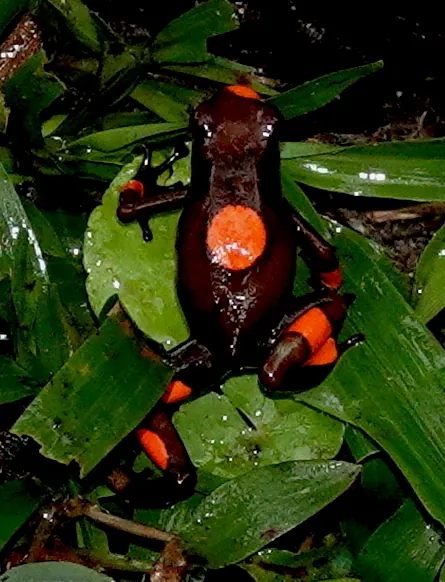
The harlequin poison frog is a small, brightly marked frog that lives on the forest floor of western Colombia. Its skin carries strong toxins, so it is one of the poison dart frogs that should never be handled. It is now critically endangered because its rainforest home is being destroyed.1

 Yadda za ka gane shi
- Background colour ranges from light to dark brown.1
- Usually has a vivid, bright spot on its back.1
- Small, with an average snout-to-vent length of about 3.3 cm.1
- Active on the forest floor, feeding on the ground after sunrise and hiding under leaf litter or on fallen logs by 16:00.1
Ana yawan rikita shi da: Some frogs that were once classed as this species were separated into new species in 2018: Oophaga anchicayensis, Oophaga andresi and Oophaga solanensis.1
Ƙarfin guba
Fatarsa tana da guba. Yana da haɗari a taɓa shi, a lasa shi ko a ci shi.
Me gubarsa take yi?
The frog produces histrionicotoxins, which are cardiotoxins, meaning they affect the heart. These compounds act as potent blockers of nicotinic acetylcholine receptors, the sites that receive nerve signals at muscle and nerve junctions. They also affect sodium and potassium channels, though much less strongly.1
Yaya haɗarinsa yake ga mutane?
Haɗari ga mutane: Mai tsananiIdan wani ya taɓa shi ko ya ci shi, a je wurin likita. Mutuwa ba kasafai take faruwa ba.The frog's toxins can be dangerous. Wild-caught frogs may be toxic and dangerous to handle, and they often have a much higher fatality rate in captivity.1
 Idan wani ya taɓa shi ko ya ci shi
- Idan wani ya taɓa ɗaya: a wanke hannaye sosai kuma kada a taɓa idanu ko baki. Idan yaro ko dabbar gida ya lasa ko ya ci ɗaya: ka kira cibiyar guba ko lambar gaggawa.
Kullum ka fara kiran lambar gaggawa (112, 000, 911). Wannan jagorar agajin gaggawa ce ta gaba ɗaya, ba shawarar likita ba. Muhimman abubuwan agajin gaggawa
 Kiyaye lafiya
- Kada ka taɓa, kada ka kama, kada ka tsokani dabbar daji, ko da ƙarama ce, kuma ko da tana kama da tana barci ko ta mutu.
- Ka ba shi sarari. Idan ka haɗu da ɗaya, ka natsu, ka koma baya a hankali kuma ka bar shi ya bi hanyarsa.
- Idan ka taɓa shi ko ka ci shi: kada ka goge idanunka ko bakinka, ka wanke hannayenka kuma ka nemi taimakon likita.
Ba ya neman cutar da kai. Gubarsa tana nan ne kawai don kada wani abu ya cinye shi. Ƙarin bayani game da kiyaye lafiya
Yaya girmansa yake?
Yaya tsawonsa yake?
 kusan tsawon kilif ɗin takarda
 zai iya gudun mita 100 cikin daƙiƙa 97 (mutum mafi sauri yana buƙatar 9,6)
Yaya girman Harlequin poison frog yake idan aka kwatanta da KAI?
Lissafi ne kawai a cikin burauzarka. Ba a adana komai ko a aika ko'ina.
Yaya saurinsa yake?


Bayanai
The tadpoles cannot feed on their own. They are obligate egg-feeders and will starve without the unfertilised eggs their mother provides.1
A parent carries the tadpoles to tiny water pools, often found in the axil of a bromeliad plant, where they develop.1
Histrionicotoxins are hard to make in a lab. Synthesising them has been the subject of many different attempts.1
Harlequin poison frogs are among the most difficult poison dart frogs to raise in captivity.1
Adults are active on the ground during the day and retreat to refuge by mid-afternoon.1
Don ƙwararru a kan dafi
- Sunan kimiyya
- Oophaga histrionica
- Rukuni
- Kwaɗi masu guba, toad da newt
- Iyali
- Dendrobatidae2
- Tsari
- Anura
- Nahiyoyi
- Kudancin Amurka
- Jarirai
- The female lays eggs among leaf litter. A parent carries the newly hatched tadpoles to a small water pool, often in a bromeliad, and the mother later lays unfertilised eggs for the tadpoles to eat.1
- Yadda yake a cikin daji
- Critically Endangered1
- Haɗari ga mutane
- 3 / 5: Mai tsanani3
Inda bayanan suka fito
- Harlequin poison frog (Wikipedia (CC BY-SA 4.0))
- Oophaga histrionica (iNaturalist): sunaye da rarrabuwa.
- Venom Wiki: matakin haɗari, girman al'ada da ƙiyasin sauri namu ne. Ga yadda muke lissafa su: Yadda muke auna haɗari.
Kowane bayani a wannan shafi yana da lamba da ke nuna tushensa. Idan mun yi kuskure, ka yi haƙuri, mu masoya dabbobi ne, ba mujallar kimiyya ba. Ka gaya mana a [email protected] kuma za mu gyara.
 Kunama tana jin yunwa! Venom Wiki aikin mutum ɗaya ne: kyauta, ba talla kuma ba masu bin diddigi. Ɗan ƙaramin kyauta yana taimakawa wajen ci gaba da kasancewarsa a intanet.Ciyar da kunama
Ƙari daga rukuni ɗaya: Kwaɗi masu guba, toad da newt
 Golden poison frogKwaɗi masu guba, toad da newtMai kisaKada ka taɓa
 Cane toadKwaɗi masu guba, toad da newtYana buƙatar likitaKada ka taɓa
 Dyeing poison dart frogKwaɗi masu guba, toad da newtCiwo kawaiKada ka taɓa
 Black-legged poison frogKwaɗi masu guba, toad da newtNa iya kisaKada ka taɓa
 Bruno's casque-headed frogKwaɗi masu guba, toad da newtYana buƙatar likitaKada ka taɓa
 Giant leaf frogKwaɗi masu guba, toad da newtCiwo kawaiKada ka taɓa
 Terciopelo
 Brazilian wandering spider
 Eyelash viper
 Golden lancehead
 South American bushmaster
 Peruvian giant centipede