
 Afirika
 Asiya
Asiya Bulaaya
 Amerika ey'Obukiikaddyo
 Awusitureeliya ne Oseyaniya
 Antakitika
 Oseyani ya Pasifiki
 Oseyani ya Atlantiki
 Oseyani y'e Buyindi
 Oseyani ya Arakitiki
 Ennyanja ya Mediterenia
 Ennyanja Emmyufu
 Ennyanja ya Karibiyani
 Ennyanja ya Korali
 Ennyanja ya China ey'Obukiikaddyo
 Ennyanja ya Bufilipino
 Ennyanja ya Andaman
 Ennyanja ey'Obukiikakkono (North Sea)
 Ennyanja ya Timor ne Arafura
 Ekikono kya Bengal
 Ekikono kya Kalifoniya
Brown banded cobra
 Kiruma
The brown banded cobra is a medium-sized venomous snake found in Southeast Asia. Until 2022 scientists thought it was part of the monocled cobra's species, but genetic studies showed it is its own species. It is an aggressive snake and was a major cause of snakebites in one part of southwestern China.1



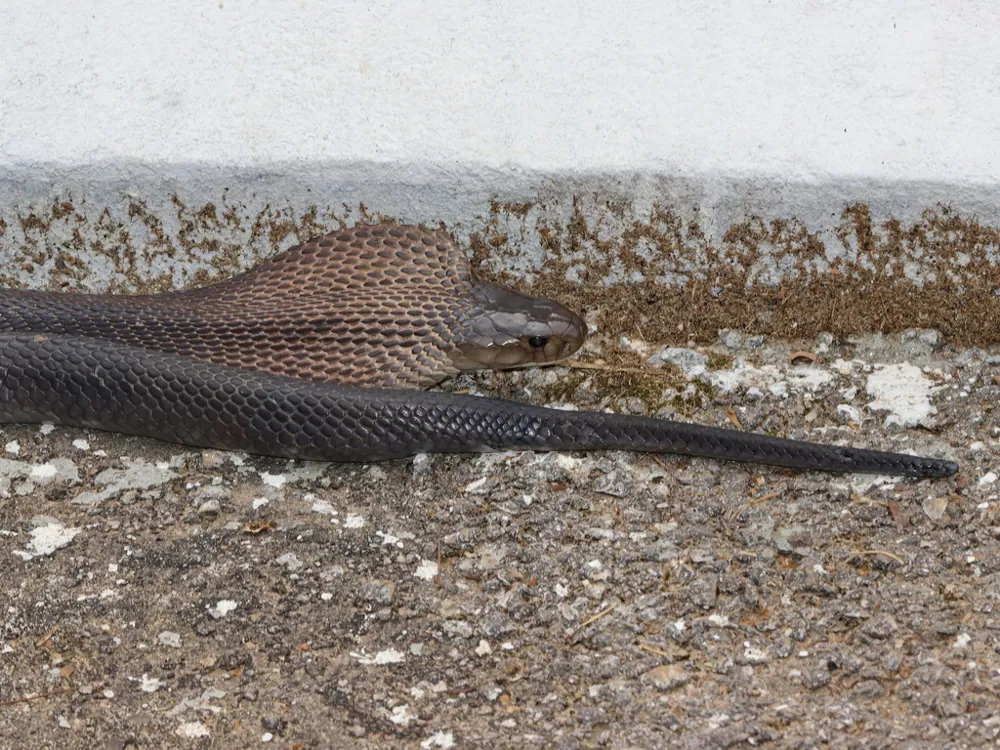
 Engeri y'okukitegeera
- A medium-sized cobra, with adult body length of 69 to 137 cm1
- Brown body, with shades that vary along its length1
- Juveniles and smaller snakes are darker on the back and belly than large adults1
- Narrow crossbands on the middle to hind parts of the back scales1
- The underside of the tail is buff with dark fringes1
- Its hood usually has a single eye-like marking1
Kitera okutabulwa ne: It resembles the monocled cobra (Naja kaouthia), which has a similar hood marking. The brown banded cobra can be told apart by its regular narrow crossbands on the middle to hind back scales and the buff tail with dark fringes.1
Amaanyi g'obusagwa
Obusagwa buyita mu mannyo gaakyo amawanvu (fangs) oba mu mannyo amalala nga kiruma.
Obusagwa bwakyo bukola ki?
Not much is known about this species' venom. Its fangs are short and firm, like other cobras, but they are not adapted to spit venom.1
Kirina akabi kenkana wa eri abantu?
Akabi eri abantu: Kya kabi nnyoKisobola okutta omuntu atafunye bujjanjabi.It is an aggressive snake and was one of the most significant causes of snakebite in Xishuangbanna, Yunnan Province, from 2007 to 2014.1
 Bwe kiruma
- Omuntu muleke ateetambula era ateefu, ggyamu empeta n'ebintu ebinyweza, era omutwale mu ddwaliro mangu: eddagala eriwonya obusagwa (antivenom) bwe bujjanjabi.
Bulijjo sooka kuba ennamba y'ebigwa bitalaze (112, 000, 911). Buno bulagirizi bwa bujjanjabi obusooka obwa bulijjo, si kuwabula kwa musawo. Obujjanjabi obusooka obw'omusingi
 Weekuume
- Tokwatako, tokwata wadde okusoomooza ensolo ey'omu nsiko, ne bw'eba ntono, era ne bw'eba erabika nga yeebase oba nga efudde.
- Gireke n'ebbanga. Bw'osisinkana emu, beera mukkakkamu, dda emabega mpola era gireke egende mu kkubo lyayo.
- Bw'emu ekuluma: beera mukkakkamu, totambula, kuba ennamba y'ebigwa bitalaze (112, 000, 911) oba tuuka mu ddwaliro mangu. Jjukira bwe yali efaanana, ekifaananyi kiyamba.
Tekikunoonya. Kikozesa obusagwa bwakyo okukwata emmere oba okwekuuma, era kyandisinze kwekweka. Ebirala ku kwekuuma
Wa mu nsi?
Kinene kyenkana wa?
Kiwanvu kyenkana wa?
 kiwanvu nga kkapa ez'awaka 2,5 okuva ku nnyindo okutuuka ku mukira
 kiwanvu nga ndiizi 8 eziteekeddwa mu lunyiriri
 kyandisobodde okudduka mita 100 mu sikonda 49 (omuntu asinga embiro yeetaaga 9,6)
Brown banded cobra kinene kyenkana wa bw'ogeraageranya ne GGWE?
Kubala bwokka mu browser yo. Tewali kitterekebwa wadde okusindikibwa wonna.
Kidduka kyenkana wa?


Ebituufu
It has been reported entering homes in Yunnan Province to feed on chicks.1
Several individuals have been found living in abandoned termite nests during winter in Menglian County.1
Like other cobras, its fangs are short and firm, but they are not adapted to spray venom.1
It was considered part of the monocled cobra's species until genetic studies in 2022 showed it is a separate species.1
Ebituufu we biva
- Brown banded cobra (Wikipedia (CC BY-SA 4.0))
- Naja fuxi (iNaturalist): amannya n'ensengeka y'ebika.
- Venom Wiki: omutendera gw'akabi, obunene obwa bulijjo n'okuteebereza kw'embiro bibyaffe. Laba engeri gye tubibalamu: Engeri gye tupimamu akabi.
Buli kituufu ku lupapula luno kirina ennamba eraga we kyava. Bwe tuba tukoze ensobi, tusonyiwe, tuli bayagazi ba nsolo, so si magazini ya ssaayansi. Tubuulire ku [email protected] tujja kugitereeza.
 Enjaba erumwa enjala! Venom Wiki pulojekiti ya muntu omu: ya bwereere, tewali birango era tewali bikulondoola. Akasiimo akatono kayamba okugikuuma ku yintaneti.Liisa enjaba
 Indian cobra
 King cobra
 Caspian cobra
 Common krait
 Malayan krait
 Many-banded krait
 Deathstalker
 Indian saw-scaled viper
 Puff adder
 Essalambwa lya Russell
 Asian giant hornet
 Komodo dragon