
 Afirika
 Asiya
Asiya Bulaaya
 Amerika ey'Obukiikaddyo
 Awusitureeliya ne Oseyaniya
 Antakitika
 Oseyani ya Pasifiki
 Oseyani ya Atlantiki
 Oseyani y'e Buyindi
 Oseyani ya Arakitiki
 Ennyanja ya Mediterenia
 Ennyanja Emmyufu
 Ennyanja ya Karibiyani
 Ennyanja ya Korali
 Ennyanja ya China ey'Obukiikaddyo
 Ennyanja ya Bufilipino
 Ennyanja ya Andaman
 Ennyanja ey'Obukiikakkono (North Sea)
 Ennyanja ya Timor ne Arafura
 Ekikono kya Bengal
 Ekikono kya Kalifoniya
Hump-nosed viper
 Kiruma
The hump-nosed viper is a small, stout pit viper with an upturned snout that ends in a hump. It lives in India and Sri Lanka, in jungle and coffee plantations. It matters because its bite can cause serious harm, and for a long time it was wrongly thought to be harmless.1
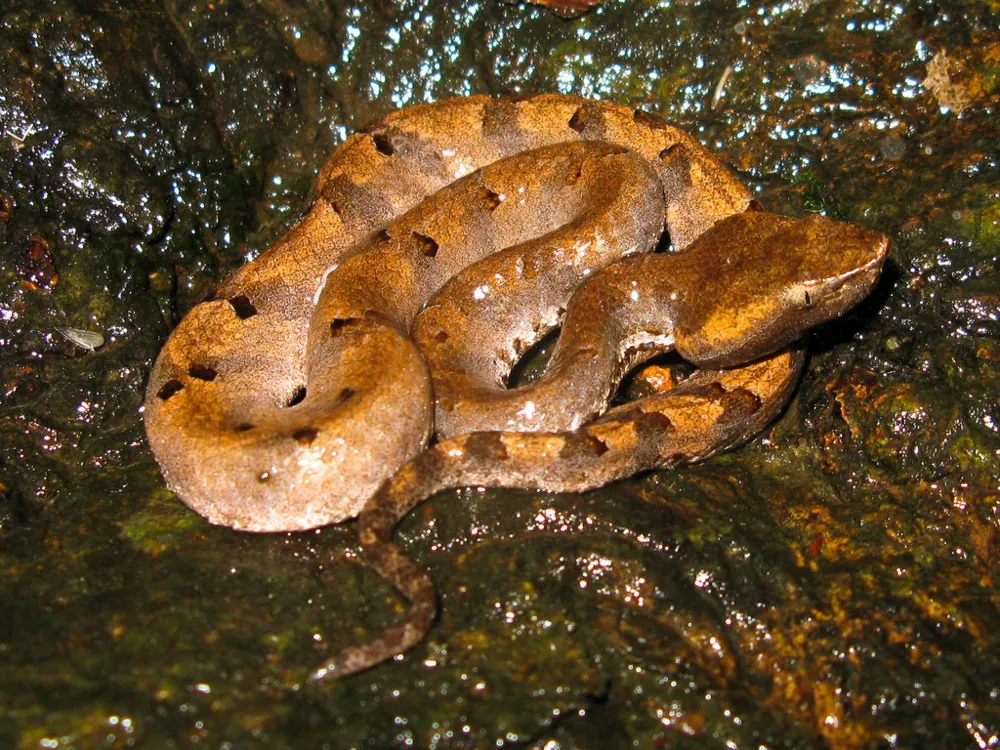
 Engeri y'okukitegeera
Amaanyi g'obusagwa
Obusagwa buyita mu mannyo gaakyo amawanvu (fangs) oba mu mannyo amalala nga kiruma.
Obusagwa bwakyo bukola ki?
Its venom causes coagulopathy, a problem with blood clotting, and acute renal failure, which is sudden kidney failure. If a bite is not treated within a few hours, it can be fatal to people.1
Kirina akabi kenkana wa eri abantu?
Akabi eri abantu: Kya kabi nnyoKisobola okutta omuntu atafunye bujjanjabi.Bites were once thought to be harmless, but they are now known to be serious. It is the snake that causes the highest number of recorded snake bites in Sri Lanka. It is now considered highly venomous and is one of the medically important venomous snakes in Sri Lanka and on the south-west coast of India.1
Kikola ki nga kitidde?
When annoyed it vibrates its tail, a warning behaviour it shares with other pit vipers such as rattlesnakes, and it can make fast strikes despite being a slow mover.1
 Bwe kiruma
- Bites need medical treatment within a few hours. An antivenom is being developed and tested in Sri Lanka.1
- Omuntu muleke ateetambula era ateefu, ekitundu ekirumiddwa kibeere ku buwanvu bw'omutima, ggyamu empeta n'ebintu ebinyweza, era omutwale mu ddwaliro mangu.
Bulijjo sooka kuba ennamba y'ebigwa bitalaze (112, 000, 911). Buno bulagirizi bwa bujjanjabi obusooka obwa bulijjo, si kuwabula kwa musawo. Obujjanjabi obusooka obw'omusingi
 Weekuume
- Tokwatako, tokwata wadde okusoomooza ensolo ey'omu nsiko, ne bw'eba ntono, era ne bw'eba erabika nga yeebase oba nga efudde.
- Gireke n'ebbanga. Bw'osisinkana emu, beera mukkakkamu, dda emabega mpola era gireke egende mu kkubo lyayo.
- Bw'emu ekuluma: beera mukkakkamu, totambula, kuba ennamba y'ebigwa bitalaze (112, 000, 911) oba tuuka mu ddwaliro mangu. Jjukira bwe yali efaanana, ekifaananyi kiyamba.
Tekikunoonya. Kikozesa obusagwa bwakyo okukwata emmere oba okwekuuma, era kyandisinze kwekweka. Ebirala ku kwekuuma
Wa mu nsi?
Kinene kyenkana wa?
Kiwanvu kyenkana wa?
 kiwanvu nga ndiizi 2,5 eziteekeddwa mu lunyiriri
 kiwanvu nga bbulooka 14 ez'okuzannyisa mu lunyiriri
 kyandisobodde okudduka mita 100 mu sikonda 110 (omuntu asinga embiro yeetaaga 9,6)
Hump-nosed viper kinene kyenkana wa bw'ogeraageranya ne GGWE?
Kubala bwokka mu browser yo. Tewali kitterekebwa wadde okusindikibwa wonna.
Kidduka kyenkana wa?


Ebituufu
For a long time its bites were thought to be harmless, but they are now known to cause serious complications.1
It causes more recorded snake bites in Sri Lanka than any other snake.1
It vibrates its tail when annoyed, a behaviour it shares with rattlesnakes.1
Although it is a slow mover, it can make fast strikes.1
Females give birth to live young, with broods of 4 to 17 newborns.1
Omumenyi w'enfumo
Enfumo: Its bites are harmless.
Amazima: Its bites can cause serious complications, including blood clotting problems and kidney failure, and can be fatal if not treated within a few hours.1
Ku bakugu mu busagwa
- Erinnya erya ssaayansi
- Hypnale hypnale
- Ekibinja
- Pit vipers (emisota egiwulira ebbugumu)
- Amaka
- Viperidae2
- Ensengeka
- Squamata
- Ssemazinga
- Asiya
- Abaana abawere
- It bears live young, usually from March through July. A brood ranges from 4 to 17 newborns, each about 13 to 14.5 cm long.1
- Akabi eri abantu
- 4 / 5: Kya kabi nnyo3
Ebituufu we biva
- Hypnale hypnale (Wikipedia (CC BY-SA 4.0))
- Hypnale hypnale (iNaturalist): amannya n'ensengeka y'ebika.
- Venom Wiki: omutendera gw'akabi, obunene obwa bulijjo n'okuteebereza kw'embiro bibyaffe. Laba engeri gye tubibalamu: Engeri gye tupimamu akabi.
Buli kituufu ku lupapula luno kirina ennamba eraga we kyava. Bwe tuba tukoze ensobi, tusonyiwe, tuli bayagazi ba nsolo, so si magazini ya ssaayansi. Tubuulire ku [email protected] tujja kugitereeza.
 Enjaba erumwa enjala! Venom Wiki pulojekiti ya muntu omu: ya bwereere, tewali birango era tewali bikulondoola. Akasiimo akatono kayamba okugikuuma ku yintaneti.Liisa enjaba
Ebirala okuva mu kibinja kye kimu: Pit vipers (emisota egiwulira ebbugumu)
 Brown spotted pit viperPit vipers (emisota egiwulira ebbugumu)Kisobola okutta
 HabuPit vipers (emisota egiwulira ebbugumu)Kisobola okutta
 Hundred-pace viperPit vipers (emisota egiwulira ebbugumu)Kisobola okutta
 Malayan pit viperPit vipers (emisota egiwulira ebbugumu)Kisobola okutta
 MamushiPit vipers (emisota egiwulira ebbugumu)Kisobola okutta
 Mangshan pit viperPit vipers (emisota egiwulira ebbugumu)Kisobola okutta
 Deathstalker
 Indian cobra
 Indian saw-scaled viper
 King cobra
 Puff adder
 Essalambwa lya Russell