
 Afirika
 Asiya
Asiya Bulaaya
 Amerika ey'Obukiikaddyo
 Awusitureeliya ne Oseyaniya
 Antakitika
 Oseyani ya Pasifiki
 Oseyani ya Atlantiki
 Oseyani y'e Buyindi
 Oseyani ya Arakitiki
 Ennyanja ya Mediterenia
 Ennyanja Emmyufu
 Ennyanja ya Karibiyani
 Ennyanja ya Korali
 Ennyanja ya China ey'Obukiikaddyo
 Ennyanja ya Bufilipino
 Ennyanja ya Andaman
 Ennyanja ey'Obukiikakkono (North Sea)
 Ennyanja ya Timor ne Arafura
 Ekikono kya Bengal
 Ekikono kya Kalifoniya
Hura centipede
 Kiruma
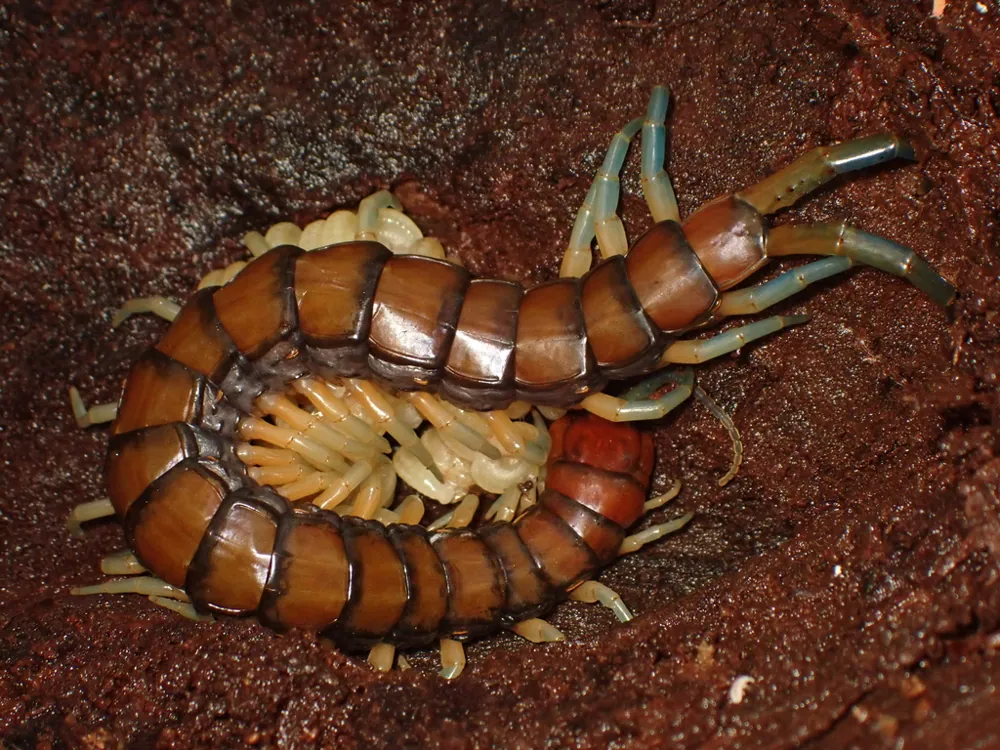
The hura, also called the giant centipede, is a centipede found in Australia and New Zealand. In New Zealand it can grow to over 20 centimetres, which makes it one of the largest centipedes there. It hunts small animals and can give a painful bite when threatened.1


 Engeri y'okukitegeera
- The head and first body plate are reddish-brown, and the other body plates are olive-brown.1
- It has large black forcipules, which are fang-like claws near the head.1
- Its legs are yellowish at the base and turn green towards the tip.1
- The last pair of legs has light blue tips.1
- In New Zealand it can exceed 20 cm long, but in Australia it usually reaches only about 3.9 cm.1
Amaanyi g'obusagwa
Obusagwa buyita mu mannyo gaakyo amawanvu (fangs) oba mu mannyo amalala nga kiruma.
Obusagwa bwakyo bukola ki?
The bite can cause swelling. In one recorded case it caused severe pain and vomiting.1
Kirina akabi kenkana wa eri abantu?
Akabi eri abantu: Kya bulumiKisobola okuluma ddala, naye kumpi tekiba kya kabi kinene.When threatened, it can inflict a painful bite.1
Kikola ki nga kitidde?
When threatened, it uses its forcipules to bite.1
 Bwe kiruma
- Naaza ekifo ekirumiddwa, kinyogoze oba kinnyike mu mazzi ag'ebbugumu olw'obulumi, era funa obuyambi bw'abasawo singa kyeyongera okuba ekibi.
Bulijjo sooka kuba ennamba y'ebigwa bitalaze (112, 000, 911). Buno bulagirizi bwa bujjanjabi obusooka obwa bulijjo, si kuwabula kwa musawo. Obujjanjabi obusooka obw'omusingi
 Weekuume
- Tokwatako, tokwata wadde okusoomooza ensolo ey'omu nsiko, ne bw'eba ntono, era ne bw'eba erabika nga yeebase oba nga efudde.
- Gireke n'ebbanga. Bw'osisinkana emu, beera mukkakkamu, dda emabega mpola era gireke egende mu kkubo lyayo.
- Bw'emu ekuluma: beera mukkakkamu, totambula, kuba ennamba y'ebigwa bitalaze (112, 000, 911) oba tuuka mu ddwaliro mangu. Jjukira bwe yali efaanana, ekifaananyi kiyamba.
Tekikunoonya. Kikozesa obusagwa bwakyo okukwata emmere oba okwekuuma, era kyandisinze kwekweka. Ebirala ku kwekuuma
Wa mu nsi?
Kinene kyenkana wa?
Kiwanvu kyenkana wa?
 kiwanvu nga bbulooka 6 ez'okuzannyisa mu lunyiriri
 kyandisobodde okudduka mita 100 mu sikonda 180 (omuntu asinga embiro yeetaaga 9,6)
Hura centipede kinene kyenkana wa bw'ogeraageranya ne GGWE?
Kubala bwokka mu browser yo. Tewali kitterekebwa wadde okusindikibwa wonna.
Kidduka kyenkana wa?


Ebituufu
In a study on the Three Kings Islands, researchers reportedly had to wrap their sleeping bags in tinfoil to warn them of the centipedes nearby.1
In New Zealand, introduced rats and European hedgehogs eat hura, so the centipedes are most common on islands without these pests.1
North Island brown kiwi are known to prey on hura.1
Its blood-like fluid, called haemolymph, has a high concentration of protein and is thought to be typical of more primitive arthropods.1
Ebituufu we biva
- Cormocephalus rubriceps (Wikipedia (CC BY-SA 4.0))
- Cormocephalus rubriceps (iNaturalist): amannya n'ensengeka y'ebika.
- Venom Wiki: omutendera gw'akabi, obunene obwa bulijjo n'okuteebereza kw'embiro bibyaffe. Laba engeri gye tubibalamu: Engeri gye tupimamu akabi.
Buli kituufu ku lupapula luno kirina ennamba eraga we kyava. Bwe tuba tukoze ensobi, tusonyiwe, tuli bayagazi ba nsolo, so si magazini ya ssaayansi. Tubuulire ku [email protected] tujja kugitereeza.
 Enjaba erumwa enjala! Venom Wiki pulojekiti ya muntu omu: ya bwereere, tewali birango era tewali bikulondoola. Akasiimo akatono kayamba okugikuuma ku yintaneti.Liisa enjaba
Ebirala okuva mu kibinja kye kimu: Ebiwuka eby'amagulu amangi (centipedes)
 Giant Australian centipedeEbiwuka eby'amagulu amangi (centipedes)Kiruma bwokka
 Orange-footed centipedeEbiwuka eby'amagulu amangi (centipedes)Kiruma bwokka
 Tanzanian blue ringleg centipedeEbiwuka eby'amagulu amangi (centipedes)Kiruma bwokka
 Peruvian giant centipedeEbiwuka eby'amagulu amangi (centipedes)Kyetaaga omusawo
 Chinese red-headed centipedeEbiwuka eby'amagulu amangi (centipedes)Kyetaaga omusawo
 Giant desert centipedeEbiwuka eby'amagulu amangi (centipedes)Kiruma bwokka
Era kibeera mu: Awusitureeliya ne Oseyaniya
 Coastal taipanEmisota gy'e AwusitureeliyaKitta
 Common death adderEmisota gy'e AwusitureeliyaKitta
 Eastern brown snakeEmisota gy'e AwusitureeliyaKitta
 Taipani ow'omu bitundu by'omundaEmisota gy'e AwusitureeliyaKitta
 Sydney funnel-web spiderTarantula ne funnel-webKitta
 Omusota tayigaEmisota gy'e AwusitureeliyaKitta