
 Afirika
 Asiya
Asiya Bulaaya
 Amerika ey'Obukiikaddyo
 Awusitureeliya ne Oseyaniya
 Antakitika
 Oseyani ya Pasifiki
 Oseyani ya Atlantiki
 Oseyani y'e Buyindi
 Oseyani ya Arakitiki
 Ennyanja ya Mediterenia
 Ennyanja Emmyufu
 Ennyanja ya Karibiyani
 Ennyanja ya Korali
 Ennyanja ya China ey'Obukiikaddyo
 Ennyanja ya Bufilipino
 Ennyanja ya Andaman
 Ennyanja ey'Obukiikakkono (North Sea)
 Ennyanja ya Timor ne Arafura
 Ekikono kya Bengal
 Ekikono kya Kalifoniya
King brown snake
 Kiruma
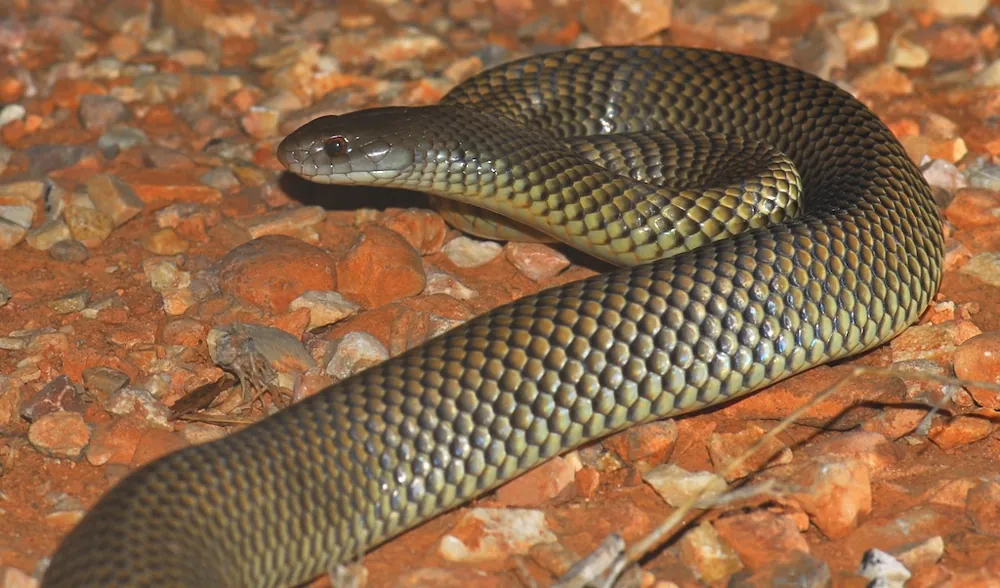
The king brown snake is a highly venomous snake and the largest land-dwelling venomous snake in Australia. It lives across northern, western and Central Australia. Its size and venom make it one of the most important snakes to recognise in the region.1



 Engeri y'okukitegeera
- A large, robust snake that can reach 2.0 to 2.5 m, with a maximum confirmed length of 3.3 m.1
- Colour varies by area: tan in the north, and darker brown to blackish in the south.1
- Scales are two-toned, giving the upper body a reticulated (net-like) pattern.1
- The belly is cream, white or salmon, and often has orange marks.1
- The head is slightly wider than the body, with small eyes that have red-brown irises and a dark tongue.1
Kitera okutabulwa ne: King brown snakes can be confused with brown snakes of the genus Pseudonaja, olive pythons, water pythons, spotted mulga snakes and coastal taipans. In eastern brown snakes, the temporolabial scale and last supralabial scale (scales above the mouth) are fused. In king brown snakes, they are separate.1
Amaanyi g'obusagwa
Obusagwa buyita mu mannyo gaakyo amawanvu (fangs) oba mu mannyo amalala nga kiruma.
Obusagwa bwakyo bukola ki?
The venom is not as potent as that of Australia's other dangerous snakes, but it can cause severe effects if delivered in large enough amounts. Its main effect is on striated (skeletal) muscle, which can cause paralysis through muscle damage. It also commonly affects blood clotting (coagulopathy).1
Kirina akabi kenkana wa eri abantu?
Akabi eri abantu: Kya kabi nnyoKisobola okutta omuntu atafunye bujjanjabi.Deaths from its bites have been recorded, with the most recent in 1969. Extensive pain and swelling often occur at the bite site, and necrosis (death of tissue) occurs rarely.1
 Amawulire amalungi: abasawo balina eddagala (antivenom) oba obujjanjabi ku kino.1
 Bwe kiruma
- Victims are treated with black snake (not brown snake) antivenom.1
- Okunyiga n'okunyweza ekitundu (pressure immobilisation): zinga bandeeji egolomoka ennywevu ku kifo ekirumiddwa, oluvannyuma ogende waggulu ku kitundu kyonna, kinyweze n'omuti (splint), era omuntu muleke ateetambulira ddala okutuusa obuyambi lwe butuuka.
- Tonaaza kifo ekirumiddwa: amalwaliro gasobola okukebera obusagwa obusigadde ku lususu okulonda eddagala eriwonya obusagwa (antivenom) erituufu.
Bulijjo sooka kuba ennamba y'ebigwa bitalaze (112, 000, 911). Buno bulagirizi bwa bujjanjabi obusooka obwa bulijjo, si kuwabula kwa musawo. Obujjanjabi obusooka obw'omusingi
 Weekuume
- Tokwatako, tokwata wadde okusoomooza ensolo ey'omu nsiko, ne bw'eba ntono, era ne bw'eba erabika nga yeebase oba nga efudde.
- Gireke n'ebbanga. Bw'osisinkana emu, beera mukkakkamu, dda emabega mpola era gireke egende mu kkubo lyayo.
- Bw'emu ekuluma: beera mukkakkamu, totambula, kuba ennamba y'ebigwa bitalaze (112, 000, 911) oba tuuka mu ddwaliro mangu. Jjukira bwe yali efaanana, ekifaananyi kiyamba.
Tekikunoonya. Kikozesa obusagwa bwakyo okukwata emmere oba okwekuuma, era kyandisinze kwekweka. Ebirala ku kwekuuma
Wa mu nsi?
Kinene kyenkana wa?
Kiwanvu kyenkana wa?
Kizitowa kyenkana wa?
 kiwanvu nga mbwa 3 okuva ku nnyindo okutuuka ku mukira
 kiwanvu nga ndiizi 18 eziteekeddwa mu lunyiriri
 kizitowa nga kkapa ey'awaka
 kyandisobodde okudduka mita 100 mu sikonda 41 (omuntu asinga embiro yeetaaga 9,6)
King brown snake kinene kyenkana wa bw'ogeraageranya ne GGWE?
Kubala bwokka mu browser yo. Tewali kitterekebwa wadde okusindikibwa wonna.
Kidduka kyenkana wa?


Ebituufu
Its name causes a real problem: its venom is not neutralised by brown snake antivenom, so the name has been criticised by medical researchers.1
It is the largest terrestrial venomous snake in Australia.1
In the Kaytetye language of Central Australia, it is called atetherr-ayne-wene, meaning "budgerigar-eater".1
Despite its common name, it belongs to the black snake genus Pseudechis and is only distantly related to true brown snakes.1
Males are around 20% larger than females.1
It has been reported to live up to 25 years in captivity.1
Omumenyi w'enfumo
Enfumo: Because it is called a brown snake, brown snake antivenom will treat its bite.
Amazima: Its venom is not neutralised by brown snake antivenom. Victims are treated with black snake antivenom.1
Ku bakugu mu busagwa
- Erinnya erya ssaayansi
- Pseudechis australis
- Ekibinja
- Emisota gy'e Awusitureeliya
- Amaka
- Elapidae2
- Ensengeka
- Squamata
- Ssemazinga
- Awusitureeliya ne Oseyaniya
- Abaana abawere
- King brown snakes lay eggs. A female produces a clutch of four to 19 eggs, usually around 10, which take 70 to 100 days to hatch.1
- Obuwangaazi
- nga emyaka 251
- Kiri kitya mu nsiko
- Least concern (IUCN), though its numbers may have declined with the spread of the cane toad.1
- Akabi eri abantu
- 4 / 5: Kya kabi nnyo3
Ebituufu we biva
- King brown snake (Wikipedia (CC BY-SA 4.0))
- Pseudechis australis (iNaturalist): amannya n'ensengeka y'ebika.
- Venom Wiki: omutendera gw'akabi, obunene obwa bulijjo n'okuteebereza kw'embiro bibyaffe. Laba engeri gye tubibalamu: Engeri gye tupimamu akabi.
Buli kituufu ku lupapula luno kirina ennamba eraga we kyava. Bwe tuba tukoze ensobi, tusonyiwe, tuli bayagazi ba nsolo, so si magazini ya ssaayansi. Tubuulire ku [email protected] tujja kugitereeza.
 Enjaba erumwa enjala! Venom Wiki pulojekiti ya muntu omu: ya bwereere, tewali birango era tewali bikulondoola. Akasiimo akatono kayamba okugikuuma ku yintaneti.Liisa enjaba
Ebirala okuva mu kibinja kye kimu: Emisota gy'e Awusitureeliya
 Coastal taipanEmisota gy'e AwusitureeliyaKitta
 Common death adderEmisota gy'e AwusitureeliyaKitta
 Eastern brown snakeEmisota gy'e AwusitureeliyaKitta
 Taipani ow'omu bitundu by'omundaEmisota gy'e AwusitureeliyaKitta
 Omusota tayigaEmisota gy'e AwusitureeliyaKitta
 Collett's snakeEmisota gy'e AwusitureeliyaKisobola okutta
Era kibeera mu: Awusitureeliya ne Oseyaniya
 Sydney funnel-web spiderTarantula ne funnel-webKitta
 Redback spiderNnabbubiKyetaaga omusawo
 Brown tree snakeEmisota egirina amannyo ag'obusagwa emabegaKiruma bwokka
 Hooded pitohuiEnsolo endala ez'obutwaKiruma bwokkaTokwatako
 PlatypusEbisolo ebiyonsa eby'obusagwaKiruma bwokka
 Northern tree-dwelling funnel-web spiderTarantula ne funnel-webKitta