
 Afirika
 Asiya
Asiya Bulaaya
 Amerika ey'Obukiikaddyo
 Awusitureeliya ne Oseyaniya
 Antakitika
 Oseyani ya Pasifiki
 Oseyani ya Atlantiki
 Oseyani y'e Buyindi
 Oseyani ya Arakitiki
 Ennyanja ya Mediterenia
 Ennyanja Emmyufu
 Ennyanja ya Karibiyani
 Ennyanja ya Korali
 Ennyanja ya China ey'Obukiikaddyo
 Ennyanja ya Bufilipino
 Ennyanja ya Andaman
 Ennyanja ey'Obukiikakkono (North Sea)
 Ennyanja ya Timor ne Arafura
 Ekikono kya Bengal
 Ekikono kya Kalifoniya
Lace monitor
 Kiruma
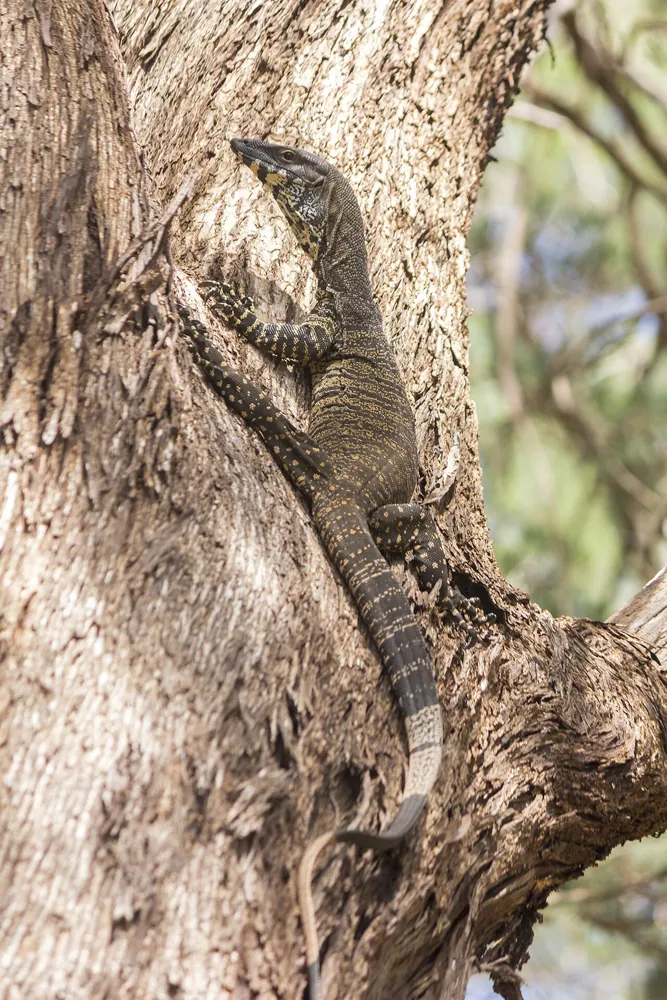
The lace monitor is a large lizard that lives in eastern Australia, and it can grow up to 2 metres long. It is a skilled climber that often lives in trees, and it is one of the country's biggest monitor lizards. It is also known as the tree goanna.1



 Engeri y'okukitegeera
- The main form is dark grey to dull bluish-black with scattered cream-coloured spots.1
- The head is black, and the snout has prominent black and yellow bands that extend under the chin and neck.1
- The tail has narrow black and cream bands that get wider towards the tip.1
- Bell's form has a yellow-brown or yellow base colour with fine black mottling and broad black or dark brown bands from the shoulders to the tail.1
- Juveniles have more defined banding, with five narrow black bands on the neck and eight on the body.1
Amaanyi g'obusagwa
Obusagwa buyita mu mannyo gaakyo amawanvu (fangs) oba mu mannyo amalala nga kiruma.
Obusagwa bwakyo bukola ki?
Lace monitors have venom glands, and their venom is similar to snake venom, but it is not strong enough to cause serious harm. A bite on the hand can cause swelling within minutes, localised disruption of blood clotting (the blood clots less well in that area), and shooting pain up to the elbow. This pain can often last for several hours.1
Kirina akabi kenkana wa eri abantu?
Akabi eri abantu: Kya bulumiKisobola okuluma ddala, naye kumpi tekiba kya kabi kinene.Its venom is not enough to cause serious harm. Scientists have cautioned that calling these lizards venomous overestimates the medical risk to bite victims.1
Kikola ki nga kitidde?
When disturbed, lace monitors retreat to a nearby tree.1
 Bwe kiruma
- Naaza ekiwundu, omuntu muleke ateefu era funa obuyambi bw'abasawo.
Bulijjo sooka kuba ennamba y'ebigwa bitalaze (112, 000, 911). Buno bulagirizi bwa bujjanjabi obusooka obwa bulijjo, si kuwabula kwa musawo. Obujjanjabi obusooka obw'omusingi
 Weekuume
- Tokwatako, tokwata wadde okusoomooza ensolo ey'omu nsiko, ne bw'eba ntono, era ne bw'eba erabika nga yeebase oba nga efudde.
- Gireke n'ebbanga. Bw'osisinkana emu, beera mukkakkamu, dda emabega mpola era gireke egende mu kkubo lyayo.
- Bw'emu ekuluma: beera mukkakkamu, totambula, kuba ennamba y'ebigwa bitalaze (112, 000, 911) oba tuuka mu ddwaliro mangu. Jjukira bwe yali efaanana, ekifaananyi kiyamba.
Tekikunoonya. Kikozesa obusagwa bwakyo okukwata emmere oba okwekuuma, era kyandisinze kwekweka. Ebirala ku kwekuuma
Wa mu nsi?
Kinene kyenkana wa?
Kiwanvu kyenkana wa?
Kizitowa kyenkana wa?
 kiwanvu nga kkapa ez'awaka 4 okuva ku nnyindo okutuuka ku mukira
 kiwanvu nga ndiizi 11 eziteekeddwa mu lunyiriri
 kyandisobodde okudduka mita 100 mu sikonda 22 (omuntu asinga embiro yeetaaga 9,6)
Lace monitor kinene kyenkana wa bw'ogeraageranya ne GGWE?
Kubala bwokka mu browser yo. Tewali kitterekebwa wadde okusindikibwa wonna.
Kidduka kyenkana wa?

Ebituufu
Populations near rubbish tips were thirty five times greater than in natural forest, and individuals were around twice as heavy.1
Lace monitors quickly learned to avoid cane toads after they had been poisoned by them.1
One lace monitor was recorded climbing a brick wall to find shelter during a thunderstorm.1
Its closest living relative is the Komodo dragon.1
Omumenyi w'enfumo
Enfumo: Bites from monitors were thought to be dangerous mainly because of infection from bacteria in their mouths.
Amazima: Researchers found in 2005 that the immediate effects of bites were more likely caused by venom.1
Ku bakugu mu busagwa
- Erinnya erya ssaayansi
- Varanus varius
- Ekibinja
- Eminya egy'obusagwa
- Amaka
- Varanidae2
- Ensengeka
- Squamata
- Ssemazinga
- Awusitureeliya ne Oseyaniya
- Abaana abawere
- Females lay an average of eight eggs, and up to 12, in active termite nests on the ground or in trees. The eggs hatch 6 to 7 months later.1
- Obuwangaazi
- nga emyaka 201
- Kiri kitya mu nsiko
- Least Concern1
- Akabi eri abantu
- 2 / 5: Kya bulumi3
Ebituufu we biva
- Lace monitor (Wikipedia (CC BY-SA 4.0))
- Varanus varius (iNaturalist): amannya n'ensengeka y'ebika.
- Venom Wiki: omutendera gw'akabi, obunene obwa bulijjo n'okuteebereza kw'embiro bibyaffe. Laba engeri gye tubibalamu: Engeri gye tupimamu akabi.
Buli kituufu ku lupapula luno kirina ennamba eraga we kyava. Bwe tuba tukoze ensobi, tusonyiwe, tuli bayagazi ba nsolo, so si magazini ya ssaayansi. Tubuulire ku [email protected] tujja kugitereeza.
 Enjaba erumwa enjala! Venom Wiki pulojekiti ya muntu omu: ya bwereere, tewali birango era tewali bikulondoola. Akasiimo akatono kayamba okugikuuma ku yintaneti.Liisa enjaba
Ebirala okuva mu kibinja kye kimu: Eminya egy'obusagwa
 Perentie
 Spiny-tailed monitor
 Yellow-spotted monitor
 Mitchell's water monitor
 Komodo dragon
 Gila monster
,_photographed_in_the_Kindra_State_Forest.jpg)
Era kibeera mu: Awusitureeliya ne Oseyaniya
 Coastal taipanEmisota gy'e AwusitureeliyaKitta
 Common death adderEmisota gy'e AwusitureeliyaKitta
 Eastern brown snakeEmisota gy'e AwusitureeliyaKitta
 Taipani ow'omu bitundu by'omundaEmisota gy'e AwusitureeliyaKitta
 Sydney funnel-web spiderTarantula ne funnel-webKitta
 Omusota tayigaEmisota gy'e AwusitureeliyaKitta