
 Afirika
 Asiya
Asiya Bulaaya
 Amerika ey'Obukiikaddyo
 Awusitureeliya ne Oseyaniya
 Antakitika
 Oseyani ya Pasifiki
 Oseyani ya Atlantiki
 Oseyani y'e Buyindi
 Oseyani ya Arakitiki
 Ennyanja ya Mediterenia
 Ennyanja Emmyufu
 Ennyanja ya Karibiyani
 Ennyanja ya Korali
 Ennyanja ya China ey'Obukiikaddyo
 Ennyanja ya Bufilipino
 Ennyanja ya Andaman
 Ennyanja ey'Obukiikakkono (North Sea)
 Ennyanja ya Timor ne Arafura
 Ekikono kya Bengal
 Ekikono kya Kalifoniya
Pygmy copperhead
 Kiruma
The pygmy copperhead is a small, venomous snake found only in South Australia, mainly on Kangaroo Island and in the Fleurieu Peninsula and Mount Lofty Ranges. It is the smallest of the Australian copperheads. Its venom is dangerous, so prompt medical treatment matters.1


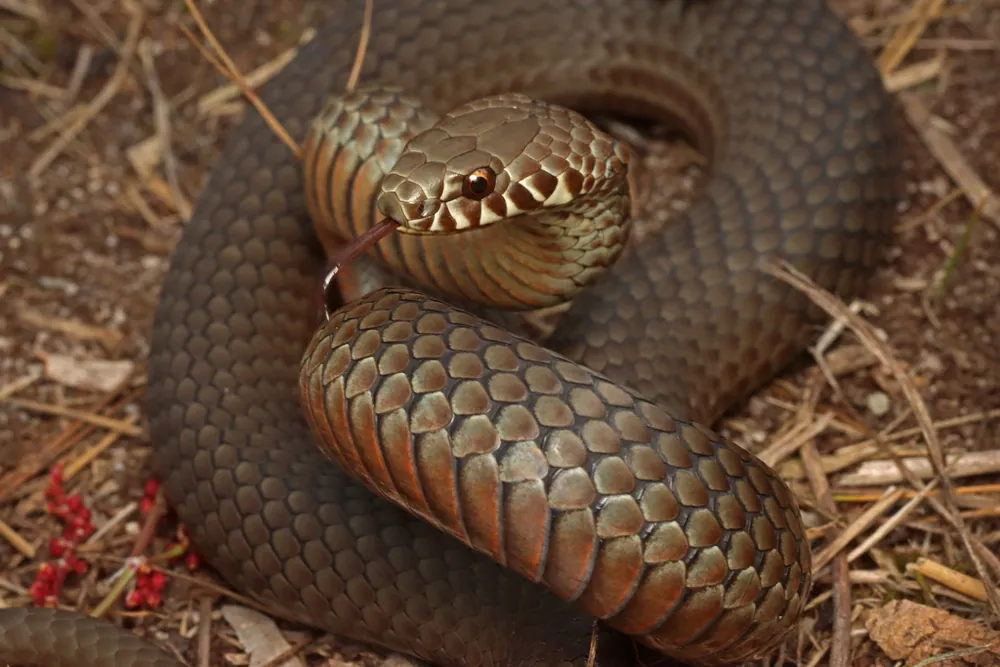
 Engeri y'okukitegeera
- Dorsal scales are brown to grey, with a darker stripe along the spine.1
- The belly is cream to light grey, with red along the edges that fades to a brown-grey underside.1
- The lip scales are barred with dark colour.1
- Adults average about 80 cm long, with males usually larger than females.1
- Newborns often have paler backsides than adults.1
Kitera okutabulwa ne: The highland and lowland copperheads are larger, and the pygmy copperhead is the smallest of the Australian copperheads. It is not closely related to the American copperhead, Agkistrodon contortrix.1
Amaanyi g'obusagwa
Obusagwa buyita mu mannyo gaakyo amawanvu (fangs) oba mu mannyo amalala nga kiruma.
Obusagwa bwakyo bukola ki?
The venom is strongly neurotoxic, which means it attacks the nerves, and its toxicity is similar to that of the Indian cobra. It is weakly coagulant and strongly anticoagulant, meaning it can both disrupt blood clotting and destroy blood and muscle. Without prompt treatment, a bite can cause possibly irreversible damage to nerve endings.1
Kirina akabi kenkana wa eri abantu?
Akabi eri abantu: Kya maanyiOkulumwa kwetaaga omusawo. Okufa kubaawo kitono nnyo.Bites are considered possibly lethal. The snake is not known for being aggressive and is unlikely to attack unless it is stepped on or purposely provoked.1
 Amawulire amalungi: abasawo balina eddagala (antivenom) oba obujjanjabi ku kino.1
Kikola ki nga kitidde?
It is generally unobtrusive and usually hides under leaf litter, old iron and haystacks.1
 Bwe kiruma
- Prompt antivenom treatment is essential, because bites are considered lethal without it. Antivenom developed from tiger snake venom cannot completely neutralise the neurotoxicity of pygmy copperhead venom.1
- Okunyiga n'okunyweza ekitundu (pressure immobilisation): zinga bandeeji egolomoka ennywevu ku kifo ekirumiddwa, oluvannyuma ogende waggulu ku kitundu kyonna, kinyweze n'omuti (splint), era omuntu muleke ateetambulira ddala okutuusa obuyambi lwe butuuka.
- Tonaaza kifo ekirumiddwa: amalwaliro gasobola okukebera obusagwa obusigadde ku lususu okulonda eddagala eriwonya obusagwa (antivenom) erituufu.
Bulijjo sooka kuba ennamba y'ebigwa bitalaze (112, 000, 911). Buno bulagirizi bwa bujjanjabi obusooka obwa bulijjo, si kuwabula kwa musawo. Obujjanjabi obusooka obw'omusingi
 Weekuume
- Tokwatako, tokwata wadde okusoomooza ensolo ey'omu nsiko, ne bw'eba ntono, era ne bw'eba erabika nga yeebase oba nga efudde.
- Gireke n'ebbanga. Bw'osisinkana emu, beera mukkakkamu, dda emabega mpola era gireke egende mu kkubo lyayo.
- Bw'emu ekuluma: beera mukkakkamu, totambula, kuba ennamba y'ebigwa bitalaze (112, 000, 911) oba tuuka mu ddwaliro mangu. Jjukira bwe yali efaanana, ekifaananyi kiyamba.
Tekikunoonya. Kikozesa obusagwa bwakyo okukwata emmere oba okwekuuma, era kyandisinze kwekweka. Ebirala ku kwekuuma
Wa mu nsi?
Kinene kyenkana wa?
Kiwanvu kyenkana wa?
 kiwanvu nga kkapa ez'awaka 2,5 okuva ku nnyindo okutuuka ku mukira
 kiwanvu nga ndiizi 7 eziteekeddwa mu lunyiriri
 kyandisobodde okudduka mita 100 mu sikonda 56 (omuntu asinga embiro yeetaaga 9,6)
Pygmy copperhead kinene kyenkana wa bw'ogeraageranya ne GGWE?
Kubala bwokka mu browser yo. Tewali kitterekebwa wadde okusindikibwa wonna.
Kidduka kyenkana wa?


Ebituufu
Sightings on islands near Tasmania are probably the result of snakes stowing away on boats.1
It is the only snake endemic to South Australia.1
It is the smallest of the Australian copperhead snakes.1
Its litter size is about half that of the other Australian copperheads, which is linked to its smaller body size.1
In field research, only about two thirds of surveyed adult females were reproductive, which suggests females do not breed every year.1
Omumenyi w'enfumo
Enfumo: Because it is small and not aggressive, the pygmy copperhead is harmless.
Amazima: Its venom is strongly neurotoxic, and its bite is considered possibly lethal without prompt antivenom treatment.1
Ku bakugu mu busagwa
Ebituufu we biva
- Pygmy copperhead (Wikipedia (CC BY-SA 4.0))
- Austrelaps labialis (iNaturalist): amannya n'ensengeka y'ebika.
- Venom Wiki: omutendera gw'akabi, obunene obwa bulijjo n'okuteebereza kw'embiro bibyaffe. Laba engeri gye tubibalamu: Engeri gye tupimamu akabi.
Buli kituufu ku lupapula luno kirina ennamba eraga we kyava. Bwe tuba tukoze ensobi, tusonyiwe, tuli bayagazi ba nsolo, so si magazini ya ssaayansi. Tubuulire ku [email protected] tujja kugitereeza.
 Enjaba erumwa enjala! Venom Wiki pulojekiti ya muntu omu: ya bwereere, tewali birango era tewali bikulondoola. Akasiimo akatono kayamba okugikuuma ku yintaneti.Liisa enjaba
Ebirala okuva mu kibinja kye kimu: Emisota gy'e Awusitureeliya
 Coastal taipanEmisota gy'e AwusitureeliyaKitta
 Common death adderEmisota gy'e AwusitureeliyaKitta
 Eastern brown snakeEmisota gy'e AwusitureeliyaKitta
 Taipani ow'omu bitundu by'omundaEmisota gy'e AwusitureeliyaKitta
 Omusota tayigaEmisota gy'e AwusitureeliyaKitta
 Collett's snakeEmisota gy'e AwusitureeliyaKisobola okutta
Era kibeera mu: Awusitureeliya ne Oseyaniya
 Sydney funnel-web spiderTarantula ne funnel-webKitta
 Redback spiderNnabbubiKyetaaga omusawo
 Brown tree snakeEmisota egirina amannyo ag'obusagwa emabegaKiruma bwokka
 Hooded pitohuiEnsolo endala ez'obutwaKiruma bwokkaTokwatako
 PlatypusEbisolo ebiyonsa eby'obusagwaKiruma bwokka
 Northern tree-dwelling funnel-web spiderTarantula ne funnel-webKitta