
 Afirika
 Asiya
Asiya Bulaaya
 Amerika ey'Obukiikaddyo
 Awusitureeliya ne Oseyaniya
 Antakitika
 Oseyani ya Pasifiki
 Oseyani ya Atlantiki
 Oseyani y'e Buyindi
 Oseyani ya Arakitiki
 Ennyanja ya Mediterenia
 Ennyanja Emmyufu
 Ennyanja ya Karibiyani
 Ennyanja ya Korali
 Ennyanja ya China ey'Obukiikaddyo
 Ennyanja ya Bufilipino
 Ennyanja ya Andaman
 Ennyanja ey'Obukiikakkono (North Sea)
 Ennyanja ya Timor ne Arafura
 Ekikono kya Bengal
 Ekikono kya Kalifoniya
Rabbit hutch spider
 Kiruma
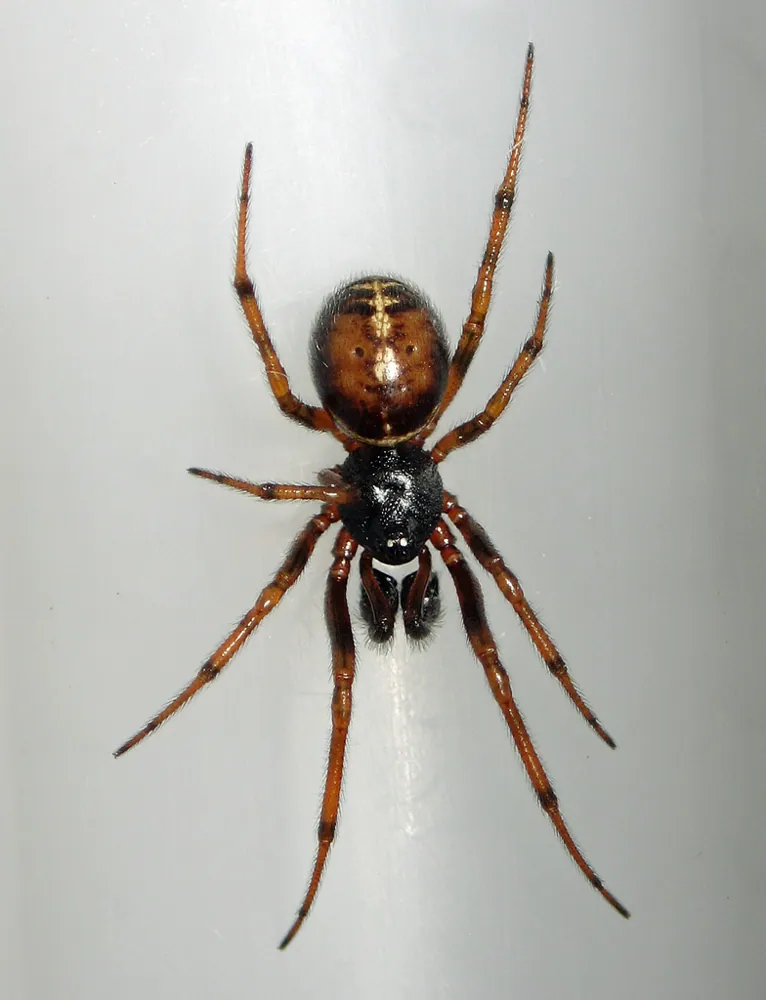
The rabbit hutch spider is a small, brown cobweb spider. It is common in North America and Europe, and often lives close to people in basements and sheds. It is special because it looks a lot like the dangerous black widow spiders, but it is much less harmful.1
 Engeri y'okukitegeera
- The abdomen (rear body) is bulbous, or rounded, and brownish in both sexes.1
- A broken pale line runs down the centre of the abdomen, with another pale line across the front part.1
- The top of the abdomen has a pair of dark dimples, which are places where muscles attach.1
- The underside of the abdomen has a pattern that looks like the infinity sign.1
- Females are light brown and often shiny, while males are usually duller.1
- It rarely grows bigger than 7 mm in body length.1
Kitera okutabulwa ne: It has a similar shape to black widow spiders in the genus Latrodectus, so it can be mistaken for them. Species of the genus Steatoda are commonly called 'false widows' for this reason. Its bite is much less dangerous to people than a black widow's bite.1
Amaanyi g'obusagwa
Obusagwa buyita mu mannyo gaakyo amawanvu (fangs) oba mu mannyo amalala nga kiruma.
Kirina akabi kenkana wa eri abantu?
Akabi eri abantu: KitonoNga okubojja kw'enjuki oba okutono okusingawo. Kumpi tekirina kabi eri abantu.There are no known cases of envenomation (venom being injected into a person) by this spider. It is highly unlikely that its small fangs can penetrate human skin. Its bite is significantly less dangerous than that of black widow spiders.1
 Bwe kiruma
- Naaza ekifo ekirumiddwa era okiteekeko ayisi olw'obulumi. Funa obuyambi bw'abasawo singa obulumi bungi, busaasaana oba omuntu awulira bubi.
Bulijjo sooka kuba ennamba y'ebigwa bitalaze (112, 000, 911). Buno bulagirizi bwa bujjanjabi obusooka obwa bulijjo, si kuwabula kwa musawo. Obujjanjabi obusooka obw'omusingi
 Weekuume
- Tokwatako, tokwata wadde okusoomooza ensolo ey'omu nsiko, ne bw'eba ntono, era ne bw'eba erabika nga yeebase oba nga efudde.
- Gireke n'ebbanga. Bw'osisinkana emu, beera mukkakkamu, dda emabega mpola era gireke egende mu kkubo lyayo.
- Bw'emu ekuluma: beera mukkakkamu, totambula, kuba ennamba y'ebigwa bitalaze (112, 000, 911) oba tuuka mu ddwaliro mangu. Jjukira bwe yali efaanana, ekifaananyi kiyamba.
Tekikunoonya. Kikozesa obusagwa bwakyo okukwata emmere oba okwekuuma, era kyandisinze kwekweka. Ebirala ku kwekuuma
Wa mu nsi?
Kinene kyenkana wa?
Kiwanvu kyenkana wa?
 kitono nnyo nti kisobola okutuula ku lwala lwo
Rabbit hutch spider kinene kyenkana wa bw'ogeraageranya ne GGWE?
Kubala bwokka mu browser yo. Tewali kitterekebwa wadde okusindikibwa wonna.
Kidduka kyenkana wa?


Ebituufu
Despite its look, it is not dangerous to people, and no envenomation has been recorded.1
Rabbit hutches often make a suitable home for it, which is why it has its common name.1
The pattern on the underside of its abdomen looks like the infinity sign.1
The dark dimples on its back are places where muscles attach, and they probably gave the spider its Latin name.1
It is called a 'false widow' because it is similar in shape to black widow spiders.1
Omumenyi w'enfumo
Enfumo: Because it looks like a black widow, it is a dangerous spider to people.
Amazima: No envenomation by this spider is known, and its fangs are unlikely to penetrate human skin.1
Ebituufu we biva
- Steatoda bipunctata (Wikipedia (CC BY-SA 4.0))
- Steatoda bipunctata (iNaturalist): amannya n'ensengeka y'ebika.
- Venom Wiki: omutendera gw'akabi, obunene obwa bulijjo n'okuteebereza kw'embiro bibyaffe. Laba engeri gye tubibalamu: Engeri gye tupimamu akabi.
Buli kituufu ku lupapula luno kirina ennamba eraga we kyava. Bwe tuba tukoze ensobi, tusonyiwe, tuli bayagazi ba nsolo, so si magazini ya ssaayansi. Tubuulire ku [email protected] tujja kugitereeza.
 Enjaba erumwa enjala! Venom Wiki pulojekiti ya muntu omu: ya bwereere, tewali birango era tewali bikulondoola. Akasiimo akatono kayamba okugikuuma ku yintaneti.Liisa enjaba
Ebirala okuva mu kibinja kye kimu: Nnabbubi
 Brown recluse
 Southern black widow
 Mediterranean black widow
 Northern black widow
 Western black widow
 Diving bell spider
Era kibeera mu: Bulaaya
 Common European adderVipers n'essalambwaKyetaaga omusawo
 Spanish flyEnsolo endala ez'obutwaKyetaaga omusawoTokwatako
 Common waspEnjuki, ennumba n'ennumba enneneKiruma bwokka
 European hornetEnjuki, ennumba n'ennumba enneneKiruma bwokka
 Fire salamanderEbikere eby'obutwa, ebikere ebinene (toads) ne newtsKiruma bwokkaTokwatako
 Western honey beeEnjuki, ennumba n'ennumba enneneKiruma bwokka