
 Afrika
 Azia
Azia Erópa
Erópa Amerika ya Sude
 Australia & Océanie
 Antarctique
 Océan Pacifique
 Océan Atlantique
 Océan Indien
 Océan Arctique
 Mer Méditerranée
 Mer Rouge
 Mer des Caraïbes
 Mer de Corail
 Mer de Chine méridionale
 Mer des Philippines
 Mer d'Andaman
 Mer du Nord
 Mer de Timor & Mer d'Arafura
 Golfe du Bengale
 Golfe de Californie
Black long-spined urchin
 Ba nsende ya venin
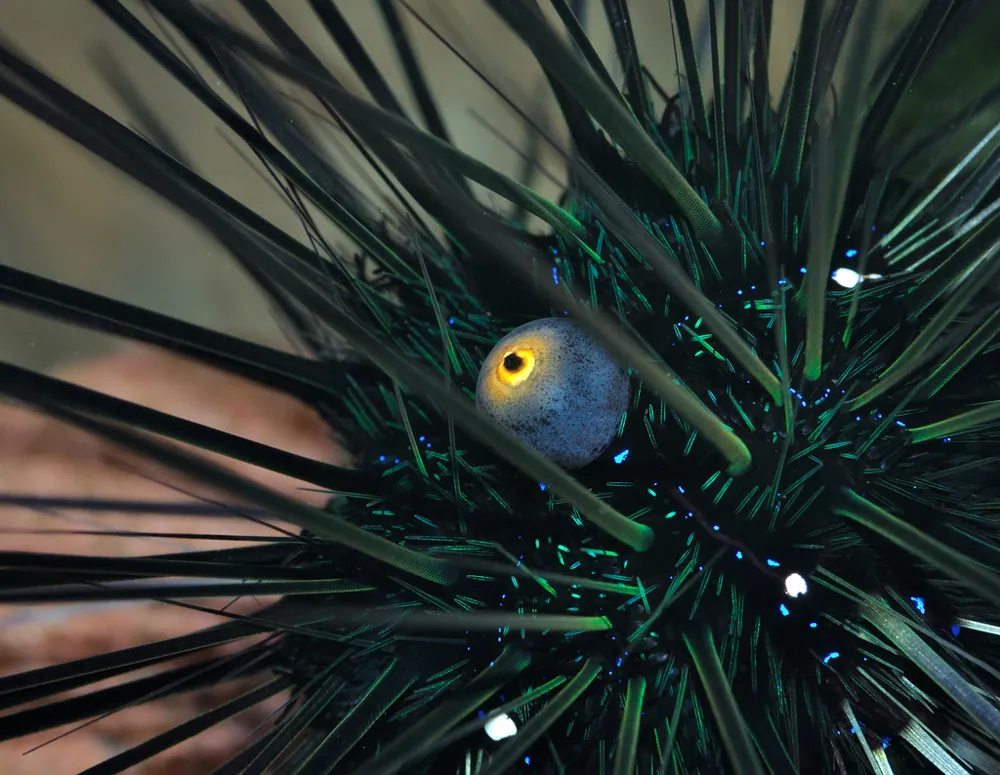
The black long-spined urchin is a sea urchin with very long, hollow spines. It lives on coral reefs, sand flats and seagrass beds across the Indo-Pacific, and it is one of the most widespread sea urchins in that region. Its spines can deliver a mild venom, so it is best to watch where you put your feet.1


 Ndenge ya koyeba yango
- Black, near-spherical body (test) with extremely long, narrow, hollow spines, often black but sometimes brown-banded1
- Five white spots on the body, which separate it from other Diadema species1
- A bright orange ring around the periproctal cone (the 'anal cone'), which is often mistaken for an eye1
- Bluish spots on the genital plates and a line of blue spots along the body1
- Adults are no more than 70 mm across the body and about 40 mm high1
Bakosanaka yango mbala mingi na: Other Diadema species are similar in shape and spines, but they lack the five white spots that mark this species. Its orange ring and blue spots also help to tell it apart.1
Makasi ya venin
Ba nsende ya songe ememaka venin. Konyata yango to kosimba yango epesaka pasi.
Venin na yango esalaka nini?
The spines are hollow and contain a mild venom. The toxin mostly causes swelling and pain, which spreads gradually over several hours. The venom is not fatal to humans. The spines themselves are a bigger problem, because they are brittle and needle-like, break off in flesh and are difficult to remove.1
Likama na yango mpo na bato ezali boni?
Likama mpo na bato: Epesaka pasiEkoki kopesa pasi mingi, kasi pene na ntango nyonso ezalaka likambo monene te.The venom is only mild, and the species is not considered a serious threat to humans. Stepping on it can cause painful stings.1
Esalaka nini ntango ebangi?
When threatened by a sudden impact or by spines snapping, it rapidly flips its body over and 'runs' on the tips of its longest spines.1
 Soki ba nsende na yango etubi yo
- Tia mpota na mai ya moto, ya moto ndenge moto akoki kondima kozanga kozika, mpe luka lisalisi ya monganga mpo na kolongola ba nsende. Kotimola mpota yo moko mpo na koluka yango te.
Benga ntango nyonso nimero ya urgence liboso (112, 000, 911). Oyo ezali toli ya lisalisi ya liboso, ezali toli ya monganga te. Makambo ya moboko ya lisalisi ya liboso
 Zala na libateli
- Ata mokolo moko te, simba, kanga to silikisa nyama ya zamba te, ata ya moke, mpe ata soki emonani lokola elali to ekufi.
- Tika yango esika. Soki okutani na moko, zala kimia, zonga sima malembe mpe tika ekende nzela na yango.
- Soki ba nsende na yango etubi yo: zala kimia, ningana te, benga nimero ya urgence na yo (112, 000, 911) to kende na lopitalo noki. Kanisa ndenge ezalaki, foto esalisaka.
Ezali koluka yo te. Esalelaka venin na yango mpo na kokanga bilei to komibatela, mpe elingaka mingi kobombama. Makambo mosusu mpo na komibatela
Wapi na mokili?
Monene na yango boni?
Molai na yango boni?
Kilo na yango boni?

 molai lokola ba brique ya masano 2 na molongo
 malembe koleka escargot ya elanga
Black long-spined urchin azali monene boni soki tokokanisi na YO?
Kaka ba calcul na navigateur na yo. Eloko moko te ebombamaka to etindamaka esika moko.
Mbangu na yango boni?

Makambo ya solo
It can move 760 mm in just 7 seconds by rolling and walking on the tips of its spines.1
It has no eye, but it has a diffuse light-sensing system that lets it detect light levels and the size and colour of objects.1
In 2006, living specimens were found off Turkey, making it the first invasive Erythrean sea urchin recorded in the Mediterranean.1
Goose barnacles of the genus Microlepas are known to live on it as parasites.1
It is considered one of the oldest living species in its genus, Diadema.1
Solo to lokuta?
Lokuta: Black long-spined urchins are deadly and their stings can kill people.
Solo: Their venom is mild and is not fatal to humans. The main problems are pain, swelling and spines that break off in the skin.1
Mpo na ba expert ya venin
- Kombo ya siansi
- Diadema setosum
- Ebota
- Ba oursin, ba étoile ya mbu & ba ver
- Libota
- Diadematidae2
- Molongo
- Diadematoida
- Bakontina
- Océan Indien, Océan Pacifique, Mer Rouge, Mer de Corail, Mer des Philippines, Mer d'Arabie & Golfe Persique, Mer de Timor & Mer d'Arafura, Golfe du Bengale, Ba océan
- Bana
- It is a broadcast spawner, releasing eggs and sperm into the water. Spawning happens seasonally or year-round depending on the location, and in some places it follows the full moon.1
- Likama mpo na bato
- 2 / 5: Epesaka pasi3
Esika makambo euti
- Diadema setosum (Wikipedia (CC BY-SA 4.0))
- Diadema setosum (iNaturalist): bankombo mpe classification.
- Venom Wiki: niveau ya likama, monene ya momesano mpe kokanisa ya mbangu ezali ya biso moko. Tala ndenge tolukaka yango: Ndenge tomekaka likama.
Likambo nyonso na lokasa oyo ezali na nimero oyo elakisi source na yango. Soki tosali libunga, limbisa biso, tozali bato oyo balingaka banyama, zulunale ya siansi te. Yebisa biso na [email protected] mpe tokobongisa yango.
 Scorpion azali na nzala! Venom Wiki ezali mosala ya moto moko: ya ofele, pibilisite te mpe trackers te. Mwa mbongo moke ya kosalisa esalisaka mpo ete etikala na internet.Pesa scorpion bilei
Mosusu ya ebota moko: Ba oursin, ba étoile ya mbu & ba ver
 Crown-of-thorns starfishBa oursin, ba étoile ya mbu & ba verEsengeli mongangaKosimba te
 Flower urchinBa oursin, ba étoile ya mbu & ba verEkoki koboma
 Fire urchinBa oursin, ba étoile ya mbu & ba verEsengeli mongangaKosimba te
 Bearded firewormBa oursin, ba étoile ya mbu & ba verEpesaka kaka pasiKosimba te
 BloodwormBa oursin, ba étoile ya mbu & ba verEpesaka kaka pasi
 Bobbit wormBa oursin, ba étoile ya mbu & ba verEpesaka kaka pasi
Ezalaka mpe na: Océan Indien
 Australian box jellyfishBa méduse & banyama ya mbu oyo etubakaEkoki kobomaKosimba te
 Geography coneBa escargot cône & ba pieuvreEkoki koboma
 Greater blue-ringed octopusBa escargot cône & ba pieuvreEkoki koboma
 Southern blue-ringed octopusBa escargot cône & ba pieuvreEkoki koboma
 Hawksbill sea turtleBanyama mosusu ya poisonEkoki koboma
 Irukandji jellyfishBa méduse & banyama ya mbu oyo etubakaEkoki kobomaKosimba te