
 Afrika
 Azia
Azia Erópa
Erópa Amerika ya Sude
 Australia & Océanie
 Antarctique
 Océan Pacifique
 Océan Atlantique
 Océan Indien
 Océan Arctique
 Mer Méditerranée
 Mer Rouge
 Mer des Caraïbes
 Mer de Corail
 Mer de Chine méridionale
 Mer des Philippines
 Mer d'Andaman
 Mer du Nord
 Mer de Timor & Mer d'Arafura
 Golfe du Bengale
 Golfe de Californie
Green-head ant
 Kotuba
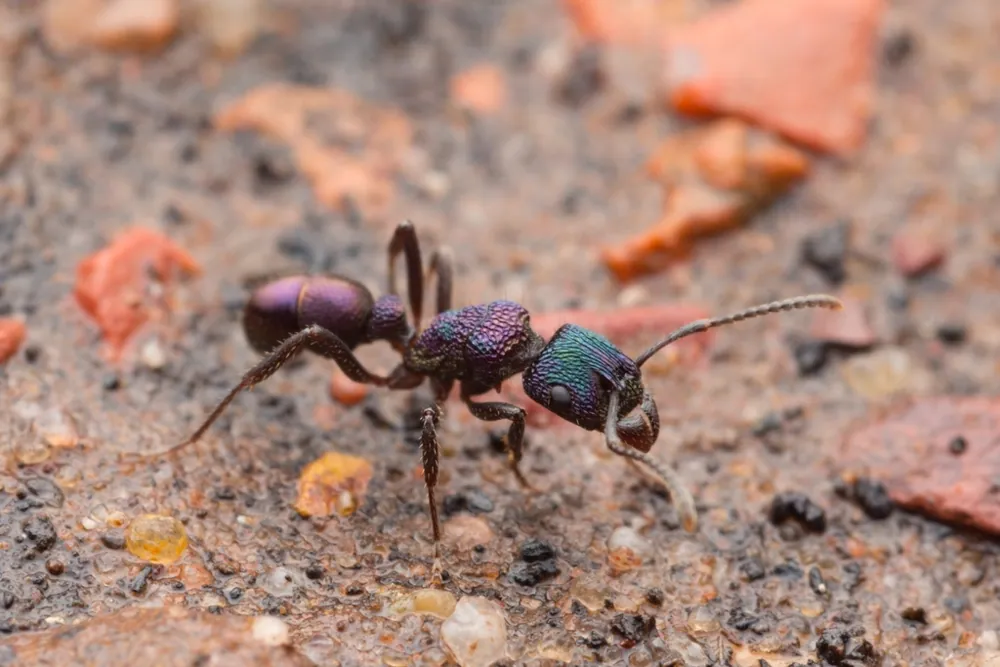
The green-head ant is a small, shiny ant that lives in Australia. It has a metallic colour that can look green, purple or reddish-violet. It is one of the most widespread insects in Australia, and it can give a painful, venomous sting.1


 Ndenge ya koyeba yango
- Measures 5 to 7 mm long.1
- Metallic colour that varies by region, from green to purple or reddish-violet.1
- Hard, heavily armoured body with a single-segmented waist.1
- Queens and workers look similar and differ mainly in size. Males are the smallest and look black and dark.1
Bakosanaka yango mbala mingi na: Residents of northern Queensland use the name 'green ant' for the green-tree ant (Oecophylla smaragdina), so the two can be confused by name. The name 'green-head ant' is more specific.1
Makasi ya venin
Venin ebimaka na nzela ya nsende ya kotuba.
Venin na yango esalaka nini?
The sting is painful and venomous. It can cause anaphylactic shock, a severe allergic reaction, in people who are sensitive to it.1
Likama na yango mpo na bato ezali boni?
Likama mpo na bato: Epesaka pasiEkoki kopesa pasi mingi, kasi pene na ntango nyonso ezalaka likambo monene te.The sting can cause anaphylactic shock in sensitive people. Ordinary stings are described as painful.1
 Soki etubi
- Sukola mpe pesa malili na bisika etubami.
- Soki moto azali na mpasi ya kopema, elongi to kingo evimbi, to ayoki lokola azali kobunga makanisi, ezali likama ya allergie: benga nimero ya urgence na yo.
Benga ntango nyonso nimero ya urgence liboso (112, 000, 911). Oyo ezali toli ya lisalisi ya liboso, ezali toli ya monganga te. Makambo ya moboko ya lisalisi ya liboso
 Zala na libateli
- Ata mokolo moko te, simba, kanga to silikisa nyama ya zamba te, ata ya moke, mpe ata soki emonani lokola elali to ekufi.
- Tika yango esika. Soki okutani na moko, zala kimia, zonga sima malembe mpe tika ekende nzela na yango.
- Soki moko etubi yo: zala kimia, ningana te, benga nimero ya urgence na yo (112, 000, 911) to kende na lopitalo noki. Kanisa ndenge ezalaki, foto esalisaka.
Ezali koluka yo te. Esalelaka venin na yango mpo na kokanga bilei to komibatela, mpe elingaka mingi kobombama. Makambo mosusu mpo na komibatela
Monene na yango boni?
Molai na yango boni?
 moke boye ete ekoki kofanda likolo ya ongle ya mosapi na yo
Green-head ant azali monene boni soki tokokanisi na YO?
Kaka ba calcul na navigateur na yo. Eloko moko te ebombamaka to etindamaka esika moko.
Mbangu na yango boni?


Makambo ya solo
Green-head ants are among the first insects to appear in burnt-off areas, arriving once the embers have stopped smouldering.1
Workers can reproduce with winged males, so queens are rarely produced in colonies.1
They are useful to farmers because they prey on agricultural pests such as beetles, moths and termites.1
They help plants by scattering and eating seeds from a variety of species, which plays an important role in seed dispersal.1
The short-beaked echidna and a number of bird species prey on them.1
The ant was introduced to New Zealand, where it was first seen in 1959, probably on cargoes of timber.1
Solo to lokuta?
Lokuta: The name 'green ant' always means the green-head ant.
Solo: In northern Queensland, residents use the name 'green ant' for the green-tree ant, so the shortened name can cause confusion.1
Esika makambo euti
- Green-head ant (Wikipedia (CC BY-SA 4.0))
- Rhytidoponera metallica (iNaturalist): bankombo mpe classification.
- Venom Wiki: niveau ya likama, monene ya momesano mpe kokanisa ya mbangu ezali ya biso moko. Tala ndenge tolukaka yango: Ndenge tomekaka likama.
Likambo nyonso na lokasa oyo ezali na nimero oyo elakisi source na yango. Soki tosali libunga, limbisa biso, tozali bato oyo balingaka banyama, zulunale ya siansi te. Yebisa biso na [email protected] mpe tokobongisa yango.
 Scorpion azali na nzala! Venom Wiki ezali mosala ya moto moko: ya ofele, pibilisite te mpe trackers te. Mwa mbongo moke ya kosalisa esalisaka mpo ete etikala na internet.Pesa scorpion bilei
Mosusu ya ebota moko: Nsonso
 Bulldog ant
 Jack jumper ant
 Green weaver ant
 Black-banded jumper ant
 Giant bull ant
 Inchman ant
Ezalaka mpe na: Australia & Océanie
 Coastal taipanBanyoka ya AustraliaEkoki koboma
 Common death adderBanyoka ya AustraliaEkoki koboma
 Eastern brown snakeBanyoka ya AustraliaEkoki koboma
 Taipan ya kati ya AustralieBanyoka ya AustraliaEkoki koboma
 Sydney funnel-web spiderBa mygale & ba funnel-webEkoki koboma
 Nyoka-nkɔ́iBanyoka ya AustraliaEkoki koboma