
 Afrika
 Azia
Azia Erópa
Erópa Amerika ya Sude
 Australia & Océanie
 Antarctique
 Océan Pacifique
 Océan Atlantique
 Océan Indien
 Océan Arctique
 Mer Méditerranée
 Mer Rouge
 Mer des Caraïbes
 Mer de Corail
 Mer de Chine méridionale
 Mer des Philippines
 Mer d'Andaman
 Mer du Nord
 Mer de Timor & Mer d'Arafura
 Golfe du Bengale
 Golfe de Californie
Spotted jelly
 Ba tentacule oyo etubaka
The spotted jelly is a jellyfish with spots on the top of its bell, the rounded body. It lives in the warm Indo-Pacific oceans, and in some saltwater lakes in Palau and Indonesia. Its lake populations are famous because they have lost most of their sting.1


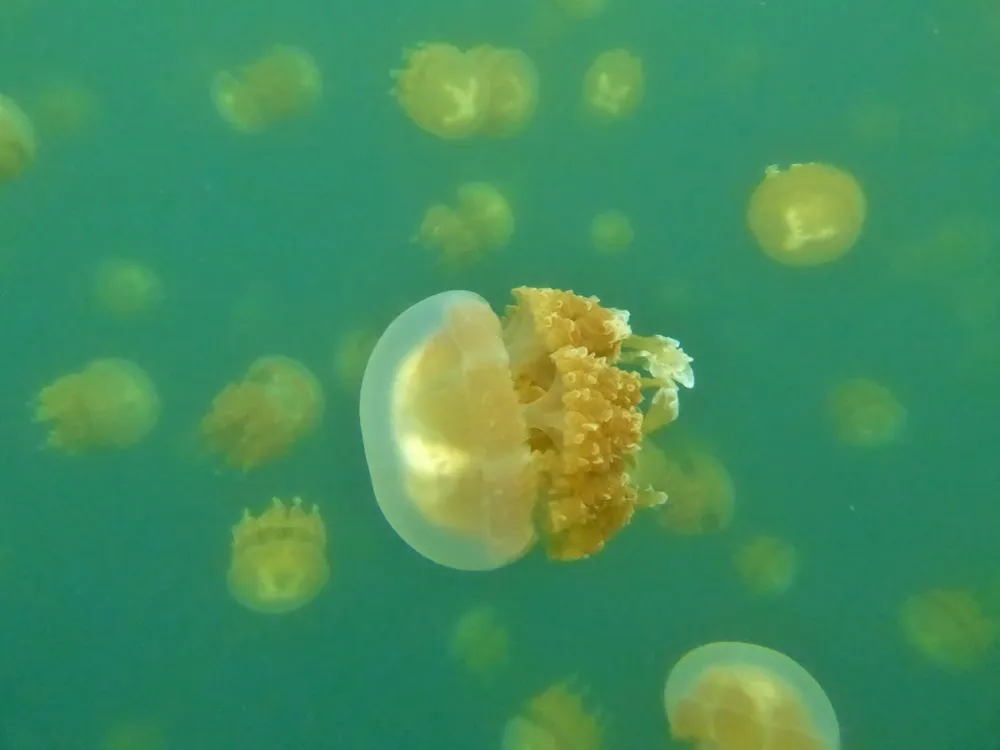
 Ndenge ya koyeba yango
- Distinctive spots on the top of the bell1
- Colour ranges from greenish blue to olive green, from the algae living in its tissues1
- Eight rhopalia (sensory organs) along the edge of the bell1
- Eight frilled oral arms, each ending in a club-like appendage1
- Numerous small mouths along the bottom of the oral arms, unlike many other jellies1
Makasi ya venin
Ba cellule ya mike nkoto na nkoto oyo etubaka ebetaka ntango eloko moko esimbi yango.
Venin na yango esalaka nini?
The venom is protein-based and is delivered by stinging cells called nematocytes (cnidocytes) on the upper surfaces of the oral arms. In jellyfish living in marine lakes, conditions in the lake are thought to break down this venom, so those populations do not sting humans.1
Likama na yango mpo na bato ezali boni?
Likama mpo na bato: Ya mokeLokola kotuba ya nzoi to moke koleka. Pene na likama te mpo na bato.Jellyfish in the open ocean have stinging cells on their oral arms. Populations in marine lakes, such as Jellyfish Lake in Palau, do not sting humans.1
 Soki etubi
- Bima na mai mpe longola ba tentacule nyonso (na ba gants to na elamba).
- Mpo na ba méduse-boîte ya mai ya molunge: sopa vinaigre na esika etubami mpo na sekonde 30 to koleka, benga lisalisi mpe bongisama mpo na kosala RCP (massage ya motema). Mpo na ba bluebottle mpe mingi mosusu: sukola na mai ya mbu, sima na mai ya moto mpo na pasi.
Benga ntango nyonso nimero ya urgence liboso (112, 000, 911). Oyo ezali toli ya lisalisi ya liboso, ezali toli ya monganga te. Makambo ya moboko ya lisalisi ya liboso
 Zala na libateli
- Ata mokolo moko te, simba, kanga to silikisa nyama ya zamba te, ata ya moke, mpe ata soki emonani lokola elali to ekufi.
- Tika yango esika. Soki okutani na moko, zala kimia, zonga sima malembe mpe tika ekende nzela na yango.
- Soki moko etubi yo: zala kimia, ningana te, benga nimero ya urgence na yo (112, 000, 911) to kende na lopitalo noki. Kanisa ndenge ezalaki, foto esalisaka.
Ezali koluka yo te. Esalelaka venin na yango mpo na kokanga bilei to komibatela, mpe elingaka mingi kobombama. Makambo mosusu mpo na komibatela
Wapi na mokili?
Monene na yango boni?
Molai na yango boni?
 molai lokola ba brique ya masano 9 na molongo
Spotted jelly azali monene boni soki tokokanisi na YO?
Kaka ba calcul na navigateur na yo. Eloko moko te ebombamaka to etindamaka esika moko.
Mbangu na yango boni?


Makambo ya solo
Lake populations of spotted jellies have lost most of their ability to sting, probably after being cut off in marine lakes long ago.1
Each day, spotted jellies rise to the surface and follow the sun from east to west, so their algae can photosynthesise.1
Lake jellyfish are over three times wider than ocean ones, yet their tentacles are about the same length.1
Unlike many jellies, spotted jellies have several small mouths along their oral arms.1
A sea anemone called Entacmaea medusivora preys on spotted jellies, catching them in its tentacles.1
At night they stay lower in the water column.1
Solo to lokuta?
Lokuta: All spotted jellies sting people.
Solo: Ocean populations have stinging cells, but the jellyfish in marine lakes such as Jellyfish Lake in Palau do not sting humans.1
Esika makambo euti
- Spotted jelly (Wikipedia (CC BY-SA 4.0))
- Mastigias papua (iNaturalist): bankombo mpe classification.
- Venom Wiki: niveau ya likama, monene ya momesano mpe kokanisa ya mbangu ezali ya biso moko. Tala ndenge tolukaka yango: Ndenge tomekaka likama.
Likambo nyonso na lokasa oyo ezali na nimero oyo elakisi source na yango. Soki tosali libunga, limbisa biso, tozali bato oyo balingaka banyama, zulunale ya siansi te. Yebisa biso na [email protected] mpe tokobongisa yango.
 Scorpion azali na nzala! Venom Wiki ezali mosala ya moto moko: ya ofele, pibilisite te mpe trackers te. Mwa mbongo moke ya kosalisa esalisaka mpo ete etikala na internet.Pesa scorpion bilei
Mosusu ya ebota moko: Ba méduse & banyama ya mbu oyo etubaka
 Australian box jellyfishBa méduse & banyama ya mbu oyo etubakaEkoki kobomaKosimba te
 Irukandji jellyfishBa méduse & banyama ya mbu oyo etubakaEkoki kobomaKosimba te
 Portuguese man o' warBa méduse & banyama ya mbu oyo etubakaEsengeli mongangaKosimba te
 Lion's mane jellyfishBa méduse & banyama ya mbu oyo etubakaEpesaka kaka pasiKosimba te
 Moon jellyfishBa méduse & banyama ya mbu oyo etubakaEzangi likama
 Common kingslayerBa méduse & banyama ya mbu oyo etubakaEkoki kobomaKosimba te
Ezalaka mpe na: Océan Pacifique
 Geography coneBa escargot cône & ba pieuvreEkoki koboma
 Greater blue-ringed octopusBa escargot cône & ba pieuvreEkoki koboma
 Japanese pufferfishBanyama mosusu ya poisonEkoki koboma
 Southern blue-ringed octopusBa escargot cône & ba pieuvreEkoki koboma
 Hawksbill sea turtleBanyama mosusu ya poisonEkoki koboma
 Reef stonefishMbisi ya veninEkoki kobomaKosimba te