
 Afrika
 Azia
Azia Erópa
Erópa Amerika ya Sude
 Australia & Océanie
 Antarctique
 Océan Pacifique
 Océan Atlantique
 Océan Indien
 Océan Arctique
 Mer Méditerranée
 Mer Rouge
 Mer des Caraïbes
 Mer de Corail
 Mer de Chine méridionale
 Mer des Philippines
 Mer d'Andaman
 Mer du Nord
 Mer de Timor & Mer d'Arafura
 Golfe du Bengale
 Golfe de Californie
Stephens' banded snake
 Kosua
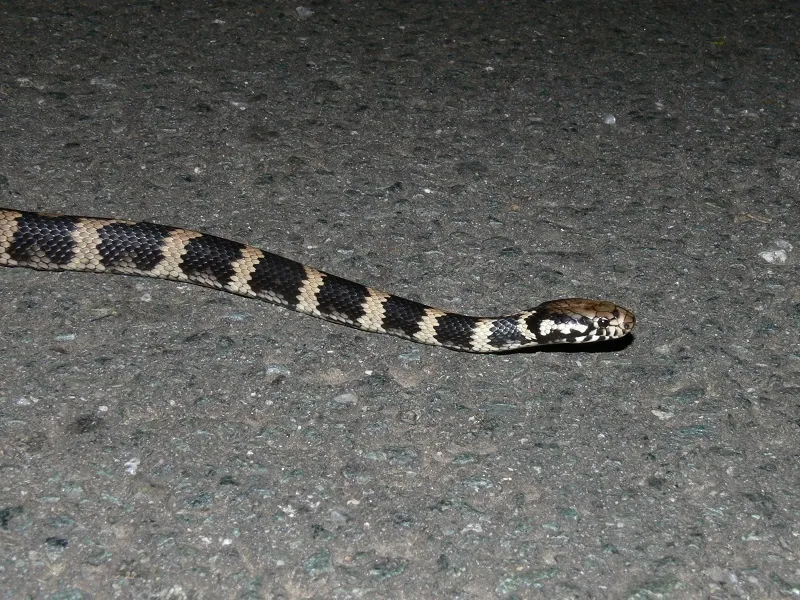
KosuaStephens' banded snake is a tree-dwelling snake that lives only on the east coast of Australia. It is highly venomous, and its venom affects the blood, so it is one of the snakes that people should give plenty of space. It spends most of its life high in the trees of forests.1



 Ndenge ya koyeba yango
- Alternating bands of grey or black and dirty-white along the back, with over 40 of each colour from the back of the head to the tip of the tail1
- A flat, mostly dirty-white belly, with occasional grey splotches towards the head and tail1
- A dark brown top of the head, with pale blotches or bars along the lips1
- A slender body with a broadened, arrow-shaped head1
- Mostly active at night, and often found in tree hollows high in the canopy1
Bakosanaka yango mbala mingi na: Its closest relatives are the broad-headed snake, which shares its coastal range, and the pale-headed snake, which lives further inland. All three are tree-dwelling snakes in the same genus.1
Makasi ya venin
Venin ebimaka na nzela ya mino na yango ntango esui.
Venin na yango esalaka nini?
Its venom is procoagulant, meaning it makes blood clot. It contains prothrombinase, which triggers the production of thrombin in the blood, causing tiny clots throughout the body. Symptoms include nausea, headache, abdominal pain, vomiting, diarrhoea and sweating. If left untreated, the clotting leads to excessive bleeding as blood vessels rupture.1
Likama na yango mpo na bato ezali boni?
Likama mpo na bato: Ya makasiSoki esui yo, kende epai ya monganga. Kokufa ezalaka mpenza mbala moke.It is described as a ready biter, and its envenoming is potentially fatal. Only one death has been recorded: an elderly man in his 60s in Kalang, New South Wales, whose rescue was delayed by torrential rain and floods.1
 Nsango malamu: ba monganga bazali na nkisi (antivenin) to bosalisi mpo na yango.1
Esalaka nini ntango ebangi?
It is described as nervous and defensive towards other animals, and it is a ready biter when threatened.1
 Soki esui
- Victims have been successfully treated with up to four doses of 3,000 unit tiger snake antivenom. The wounded person must be transported to hospital for medical treatment.1
- Immobilisation na pression: zinga bande élastique makasi likolo ya esika esui, sima mata na yango na lokolo to loboko mobimba, tia attelle, mpe tika moto aningana ata moke te kino lisalisi ekoya.
- Sukola esika esui te: na lopitalo bakoki kotala venin oyo etikali na loposo mpo na kopona antivenin oyo ebongi.
Benga ntango nyonso nimero ya urgence liboso (112, 000, 911). Oyo ezali toli ya lisalisi ya liboso, ezali toli ya monganga te. Makambo ya moboko ya lisalisi ya liboso
 Zala na libateli
- Ata mokolo moko te, simba, kanga to silikisa nyama ya zamba te, ata ya moke, mpe ata soki emonani lokola elali to ekufi.
- Tika yango esika. Soki okutani na moko, zala kimia, zonga sima malembe mpe tika ekende nzela na yango.
- Soki moko esui yo: zala kimia, ningana te, benga nimero ya urgence na yo (112, 000, 911) to kende na lopitalo noki. Kanisa ndenge ezalaki, foto esalisaka.
Ezali koluka yo te. Esalelaka venin na yango mpo na kokanga bilei to komibatela, mpe elingaka mingi kobombama. Makambo mosusu mpo na komibatela
Monene na yango boni?
Molai na yango boni?
Kilo na yango boni?
 molai lokola ba pusu ya ndako 2,5, zolo kino mokila
 molai lokola bitabe 7 oyo etiami moko na sima ya mosusu
 ekoki kopota metre 100 na sekonde 55 (moto ya mbangu koleka asengaka 9,6)
Stephens' banded snake azali monene boni soki tokokanisi na YO?
Kaka ba calcul na navigateur na yo. Eloko moko te ebombamaka to etindamaka esika moko.
Mbangu na yango boni?


Makambo ya solo
It is one of the few mainly tree-dwelling elapid snakes in Australia.1
A single individual may use up to 30 different trees within its range.1
It hibernates, or brumates, for up to five months through winter inside a tree hollow.1
Males may use home ranges averaging 20.2 hectares, while females average 5.4 hectares.1
It is the largest species in the genus Hoplocephalus, and females are usually larger than males.1
It is slow to mature, with males reaching sexual maturity at three years and females at four years.1
Mpo na ba expert ya venin
- Kombo ya siansi
- Hoplocephalus stephensii
- Ebota
- Banyoka ya Australia
- Libota
- Elapidae2
- Molongo
- Squamata
- Bakontina
- Australia & Océanie
- Bana
- It gives birth to live young, with between one and nine offspring per litter. Females are only pregnant every two years.1
- Ndenge ezali kobika na zamba
- Near Threatened (IUCN Red List)1
- Likama mpo na bato
- 3 / 5: Ya makasi3
Esika makambo euti
- Stephens's banded snake (Wikipedia (CC BY-SA 4.0))
- Hoplocephalus stephensii (iNaturalist): bankombo mpe classification.
- Venom Wiki: niveau ya likama, monene ya momesano mpe kokanisa ya mbangu ezali ya biso moko. Tala ndenge tolukaka yango: Ndenge tomekaka likama.
Likambo nyonso na lokasa oyo ezali na nimero oyo elakisi source na yango. Soki tosali libunga, limbisa biso, tozali bato oyo balingaka banyama, zulunale ya siansi te. Yebisa biso na [email protected] mpe tokobongisa yango.
 Scorpion azali na nzala! Venom Wiki ezali mosala ya moto moko: ya ofele, pibilisite te mpe trackers te. Mwa mbongo moke ya kosalisa esalisaka mpo ete etikala na internet.Pesa scorpion bilei
Mosusu ya ebota moko: Banyoka ya Australia
 Coastal taipan
 Common death adder
 Eastern brown snake
 Taipan ya kati ya Australie
 Nyoka-nkɔ́i
 Collett's snake
Ezalaka mpe na: Australia & Océanie
 Sydney funnel-web spiderBa mygale & ba funnel-webEkoki koboma
 Redback spiderBa tandambulaEsengeli monganga
 Brown tree snakeBanyoka ya mino ya venin na simaEpesaka kaka pasi
 Hooded pitohuiBanyama mosusu ya poisonEpesaka kaka pasiKosimba te
 PlatypusBa mammifère ya veninEpesaka kaka pasi
 Northern tree-dwelling funnel-web spiderBa mygale & ba funnel-webEkoki koboma