
 Africa
 Asia
Asia Ulaya
Ulaya Amereka ya Kumwera
 Australia ndi Oceania
 Antarctica
 Nyanja ya Pacific
 Nyanja ya Atlantic
 Nyanja ya Indian
 Nyanja ya Arctic
 Nyanja ya Mediterranean
 Nyanja Yofiira
 Nyanja ya Caribbean
 Nyanja ya Coral
 Nyanja ya South China
 Nyanja ya Philippine
 Nyanja ya Andaman
 Nyanja ya Kumpoto (North Sea)
 Nyanja ya Timor ndi Arafura
 Nyanja ya Bengal
 Gulf ya California
Baron's mantella
 Poizoni pakhungu lakeImadya: TizilomboYa poizoni, si yaululu
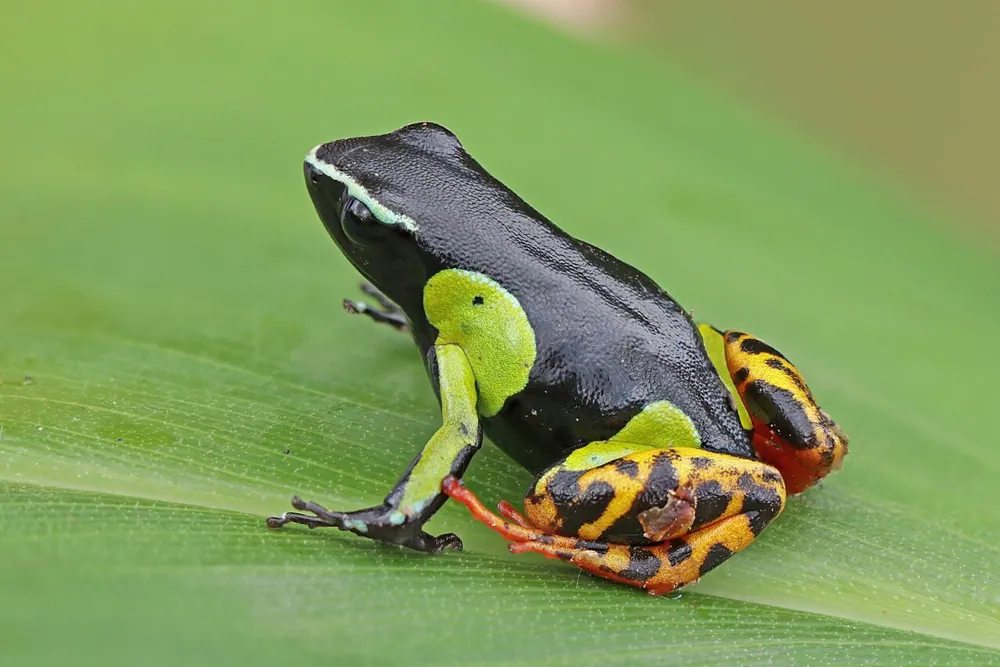
Baron's mantella is a small, brightly coloured frog that lives only on the island of Madagascar. Its skin contains toxic chemicals that make it harmful to predators, and its bright colours warn them to stay away.1



 Mmene ungaizindikirire
- Has a light line above the eyes, called a rostral line.1
- Hind limbs are orange with irregular black stripes, giving a tiger-like pattern.1
- Front limbs range from light green to bright orange or yellow, with a large rounded flank blotch.1
- Adults are 2.4 to 3.2 cm long, and females are slightly larger than males.1
- Males call during the day, and it is an active hunter in daylight.1
Nthawi zambiri imasokonezedwa ndi: It is often confused with the painted mantella (Mantella madagascariensis), which has a similar look. The painted mantella has a sky-blue, horseshoe-shaped marking on its throat. Baron's mantella does not have the flashmarks on its lower hind limbs.1
Mphamvu ya poizoni
Khungu lake lili ndi poizoni. Ndi yoopsa kuikhudza, kuinyambita kapena kuidya.
Poizoni wake umachita chiyani?
It does not inject venom. Its skin contains alkaloids, which are toxic chemicals it gets from eating mites. These make it harmful to predators that eat it, and they can cause sickness. The strength of the toxin varies over time and by location, and frogs in remote populations may be more potent.1
Ndi yoopsa bwanji kwa anthu?
Ngozi kwa anthu: YofatsaNgati kulasidwa ndi njuchi kapena pang'ono kuposa pamenepo. Pafupifupi yosavulaza anthu.Its toxicity can vary, and careless handling is discouraged.1
Imachita chiyani ikachita mantha?
Its bright colours warn predators that eating it could be dangerous and cause sickness.1
 Ngati munthu waikhudza kapena waidya
- Ngati munthu wakhudza imodzi: sambitsa m'manja bwino ndipo usakhudze maso kapena pakamwa. Ngati mwana kapena chiweto chanyambita kapena chadya imodzi: imbira malo othandiza pa za poizoni kapena nambala yadzidzidzi.
Nthawi zonse yamba wayimbira nambala yadzidzidzi (112, 000, 911). Awa ndi malangizo wamba a chithandizo choyamba, osati malangizo a dokotala. Zoyambira za chithandizo choyamba
 Khala wotetezeka
- Usakhudze, kugwira kapena kuseweretsa nyama yakuthengo, ngakhale yaing'ono, ndipo ngakhale ikuoneka ngati yagona kapena yafa.
- Ipatse malo. Ukakumana nayo, khala chete, bwerera m'mbuyo pang'onopang'ono ndipo uilole ipite njira yake.
- Ngati unaikhudza kapena kuidya: usasisite maso kapena pakamwa, sambitsa m'manja ndipo peza thandizo la dokotala.
Sikufuna kukuvulaza. Poizoni wake ulipo kuti pasapezeke choidya. Zambiri za kukhala wotetezeka
Kuti padziko lapansi?
Ndi yaikulu bwanji?
Ndi yaitali bwanji?
 yaitali pafupifupi ngati kachitsulo komangira mapepala
 ingathamange mamita 100 m'masekondi 100 (munthu wothamanga kwambiri amafunika 9.6)
Baron's mantella ndi yaikulu bwanji poyerekeza ndi IWE?
Ndi masamu chabe mu msakatuli wako. Palibe chomwe chimasungidwa kapena kutumizidwa kwina.
Imathamanga bwanji?


Mfundo
Its toxicity comes from the mites it eats, so its poison depends on its diet.1
Mantella frogs look like poison dart frogs from Latin America, but they are only distant relatives. The likeness is an example of convergent evolution.1
Unlike most frogs, which are active at night, it hunts during the day.1
Its bright colours and its toxins are a warning system, a pattern called aposematism.1
Its family arrived on Madagascar an estimated 76 to 87 million years ago.1
It is one of the largest species in the Mantella genus, with only some Mantella viridis individuals reaching a similar size.1
Kuthetsa nthano zabodza
Nthano yabodza: Baron's mantella is the same as the painted mantella, and is sometimes called a painted mantella.
Zoona: The two are distinct species. They look alike, but the painted mantella has a sky-blue throat marking that Baron's mantella lacks.1
Za akatswiri a ululu
- Dzina la sayansi
- Mantella baroni
- Gulu
- Achule a poizoni, achule a mphini (toads) ndi ma newt
- Banja
- Mantellidae2
- Dongosolo
- Anura
- Makontinenti
- Africa
- Ana akhanda
- Females can lay up to 130 eggs in a single clutch, usually near water. Rain washes the tadpoles into the water.1
- Mmene ilili kuthengo
- Least Concern (IUCN, 2016). It appears in CITES Appendix II.1
- Ngozi kwa anthu
- 1 / 5: Yofatsa3
Kumene mfundo zimachokera
- Mantella baroni (Wikipedia (CC BY-SA 4.0))
- Mantella baroni (iNaturalist): mayina ndi magulu a sayansi.
- Venom Wiki: mlingo wa ngozi, kukula wamba ndi kuyerekeza kwa liwiro ndi zathu. Ona mmene timazipezera: Mmene timayezera ngozi.
Mfundo iliyonse patsamba lino ili ndi nambala yosonyeza kochokera. Ngati talakwitsa, pepani, ndife okonda nyama, osati magazini a sayansi. Tiuze pa [email protected] ndipo tikonza.
 Chinkhanira chili ndi njala! Venom Wiki ndi ntchito ya munthu mmodzi: yaulere, yopanda zotsatsa ndi zokutsatira. Mphatso yaing'ono imathandiza kuti ikhalebe pa intaneti.Dyetsa chinkhanira
Zina za gulu lomwelo: Achule a poizoni, achule a mphini (toads) ndi ma newt
 Golden mantellaAchule a poizoni, achule a mphini (toads) ndi ma newtYosavulaza
 Iberian ribbed newtAchule a poizoni, achule a mphini (toads) ndi ma newtYosavulaza
 Tomato frogAchule a poizoni, achule a mphini (toads) ndi ma newtYosavulaza
 African common toadAchule a poizoni, achule a mphini (toads) ndi ma newtImangopwetekaUsakhudze
 Blue-legged mantellaAchule a poizoni, achule a mphini (toads) ndi ma newtYosavulaza
 Climbing mantellaAchule a poizoni, achule a mphini (toads) ndi ma newtYosavulaza
 Black mamba
 Deathstalker
 Egyptian cobra
 Puff adder
 Boomslang
 Fat-tailed scorpion
_Ranomafana.jpg)