
 Africa
 Asia
Asia Ulaya
Ulaya Amereka ya Kumwera
 Australia ndi Oceania
 Antarctica
 Nyanja ya Pacific
 Nyanja ya Atlantic
 Nyanja ya Indian
 Nyanja ya Arctic
 Nyanja ya Mediterranean
 Nyanja Yofiira
 Nyanja ya Caribbean
 Nyanja ya Coral
 Nyanja ya South China
 Nyanja ya Philippine
 Nyanja ya Andaman
 Nyanja ya Kumpoto (North Sea)
 Nyanja ya Timor ndi Arafura
 Nyanja ya Bengal
 Gulf ya California
Iberian ribbed newt
 Minga yaululuImadya: NyamaYa poizoni, si yaululu
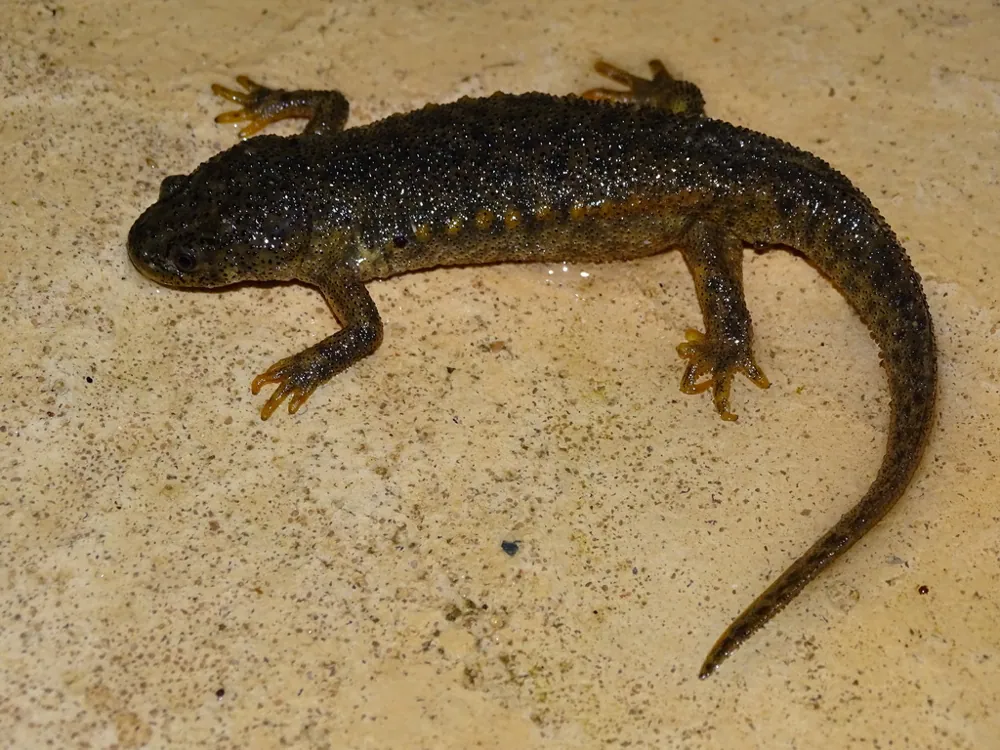
The Iberian ribbed newt is a salamander that lives in ponds and wells in Spain, Portugal and northern Morocco. It is the largest European newt species. When threatened, it can push its sharp ribs out through its skin, which gives it a way to defend itself against predators.1



 Mmene ungaizindikirire
- Dark grey on its back and lighter grey on its belly, with small rust-coloured spots1
- Usually 8 to 10 orange, wart-like bumps (tubercles) running down each side of the body1
- Flat, spade-shaped head and a long tail, about half of its body length1
- Males are more slender and usually smaller than females1
- Larvae have bushy external gills and paler colours than adults1
Nthawi zambiri imasokonezedwa ndi: It is sometimes confused with the Iberian newt (Lissotriton boscai), a different species with a similar common name.1
Mphamvu ya ululu
Minga yakuthwa imanyamula ululu. Kuiponda kapena kuigwira kumapweteka.
Ululu wake umachita chiyani?
When threatened, the newt releases a milky, thick poison from glands on its neck, back, sides and tail as its ribs push out. The poison coats the ribs, which can pierce the skin of a predator's mouth and inject toxins.1
Ndi yoopsa bwanji kwa anthu?
Ngozi kwa anthu: YofatsaNgati kulasidwa ndi njuchi kapena pang'ono kuposa pamenepo. Pafupifupi yosavulaza anthu.The rib defence is completely harmless to humans. The ribs cause only little harm to the newt itself, and its skin quickly heals without infection.1
Imachita chiyani ikachita mantha?
It tries to run away from predators first. If it cannot escape, it pushes its sharp ribs through its sides and releases poison.1
 Minga yake ikakubaya
- Ngati munthu wakhudza imodzi: sambitsa m'manja bwino ndipo usakhudze maso kapena pakamwa. Ngati mwana kapena chiweto chanyambita kapena chadya imodzi: imbira malo othandiza pa za poizoni kapena nambala yadzidzidzi.
Nthawi zonse yamba wayimbira nambala yadzidzidzi (112, 000, 911). Awa ndi malangizo wamba a chithandizo choyamba, osati malangizo a dokotala. Zoyambira za chithandizo choyamba
 Khala wotetezeka
- Usakhudze, kugwira kapena kuseweretsa nyama yakuthengo, ngakhale yaing'ono, ndipo ngakhale ikuoneka ngati yagona kapena yafa.
- Ipatse malo. Ukakumana nayo, khala chete, bwerera m'mbuyo pang'onopang'ono ndipo uilole ipite njira yake.
- Minga yake ikakubaya: khala chete, usasunthe, imbira nambala yadzidzidzi (112, 000, 911) kapena pita kuchipatala mwachangu. Kumbukira m'mene inkaonekera, chithunzi chimathandiza.
Sikufuna kukuvulaza. Imagwiritsa ntchito ululu wake kugwira chakudya kapena kudziteteza, ndipo imakonda kwambiri kubisala. Zambiri za kukhala wotetezeka
Kuti padziko lapansi?
Ndi yaikulu bwanji?
Ndi yaitali bwanji?
 yaitali ngati zidutswa zomangira zoseweretsa 9 pamzere
Iberian ribbed newt ndi yaikulu bwanji poyerekeza ndi IWE?
Ndi masamu chabe mu msakatuli wako. Palibe chomwe chimasungidwa kapena kutumizidwa kwina.
Imathamanga bwanji?


Mfundo
Its ribs can push through its skin to act as a defence, a primitive and rudimentary form of envenomation.1
It is a model animal for regeneration research. It can regrow lost limbs, injured heart tissue, brain cells, eye lenses and parts of its spinal cord.1
This newt has been sent into space on at least six missions, starting in 1985.1
In genetic males and females, temperature can override sex chromosomes. Some ZW larvae reared at 32 °C (90 °F) become functional males.1
Its immune system, rib-coated collagen and antimicrobial peptides let the pierced skin heal quickly without infection.1
Females can keep live sperm in their cloaca for up to five months.1
Kuthetsa nthano zabodza
Nthano yabodza: The newt's ribs and poison are dangerous to people.
Zoona: The ribs and poison are a defence against predators. The rib defence is completely harmless to humans.1
Za akatswiri a ululu
- Dzina la sayansi
- Pleurodeles waltl
- Gulu
- Achule a poizoni, achule a mphini (toads) ndi ma newt
- Banja
- Salamandridae2
- Dongosolo
- Caudata
- Makontinenti
- Ulaya, Africa
- Ana akhanda
- The young are born in water as larvae, breathing through gills. They lose their gills as their limbs grow and can then live on land as well as in water.1
- Mmene ilili kuthengo
- Least Concern (IUCN, assessed October 2020)1
- Ngozi kwa anthu
- 1 / 5: Yofatsa3
Kumene mfundo zimachokera
- Iberian ribbed newt (Wikipedia (CC BY-SA 4.0))
- Pleurodeles waltl (iNaturalist): mayina ndi magulu a sayansi.
- Venom Wiki: mlingo wa ngozi, kukula wamba ndi kuyerekeza kwa liwiro ndi zathu. Ona mmene timazipezera: Mmene timayezera ngozi.
Mfundo iliyonse patsamba lino ili ndi nambala yosonyeza kochokera. Ngati talakwitsa, pepani, ndife okonda nyama, osati magazini a sayansi. Tiuze pa [email protected] ndipo tikonza.
 Chinkhanira chili ndi njala! Venom Wiki ndi ntchito ya munthu mmodzi: yaulere, yopanda zotsatsa ndi zokutsatira. Mphatso yaing'ono imathandiza kuti ikhalebe pa intaneti.Dyetsa chinkhanira
Zina za gulu lomwelo: Achule a poizoni, achule a mphini (toads) ndi ma newt
 Fire salamanderAchule a poizoni, achule a mphini (toads) ndi ma newtImangopwetekaUsakhudze
 Common toadAchule a poizoni, achule a mphini (toads) ndi ma newtImangopwetekaUsakhudze
 European fire-bellied toadAchule a poizoni, achule a mphini (toads) ndi ma newtYosavulaza
 Golden mantellaAchule a poizoni, achule a mphini (toads) ndi ma newtYosavulaza
 Natterjack toadAchule a poizoni, achule a mphini (toads) ndi ma newtYosavulaza
 Tomato frogAchule a poizoni, achule a mphini (toads) ndi ma newtYosavulaza
Imakhalanso ku: Ulaya
 Common European adderMa viper ndi adderIkufuna dokotala
 Spanish flyNyama zina za poizoniIkufuna dokotalaUsakhudze
 Common waspNjuchi, mavu ndi mavu akuluakulu (hornets)Imangopweteka
 European hornetNjuchi, mavu ndi mavu akuluakulu (hornets)Imangopweteka
 Western honey beeNjuchi, mavu ndi mavu akuluakulu (hornets)Imangopweteka
 Blunt-nosed viperMa viper ndi adderIngathe kupha