
 Africa
 Asia
Asia Ulaya
Ulaya Amereka ya Kumwera
 Australia ndi Oceania
 Antarctica
 Nyanja ya Pacific
 Nyanja ya Atlantic
 Nyanja ya Indian
 Nyanja ya Arctic
 Nyanja ya Mediterranean
 Nyanja Yofiira
 Nyanja ya Caribbean
 Nyanja ya Coral
 Nyanja ya South China
 Nyanja ya Philippine
 Nyanja ya Andaman
 Nyanja ya Kumpoto (North Sea)
 Nyanja ya Timor ndi Arafura
 Nyanja ya Bengal
 Gulf ya California
Cane toad
 Poizoni pakhungu lakeImadya: Pang'ono pa chilichonseYa poizoni, si yaululu
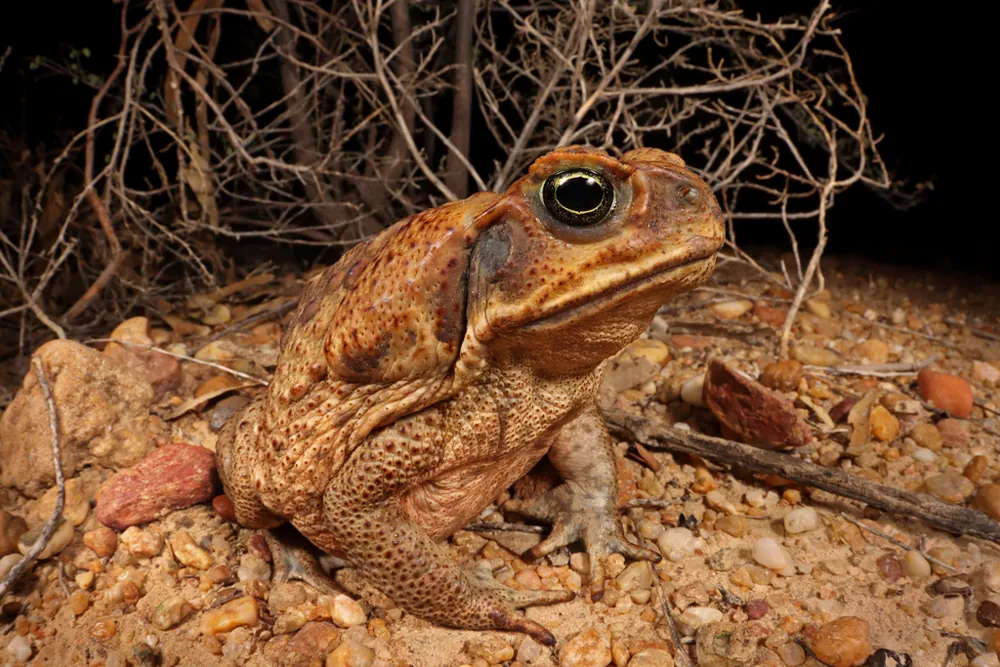
The cane toad is a large toad that is very poisonous to many animals. It is native to South and mainland Central America, but people have moved it to islands in Oceania and the Caribbean and to northern Australia. It matters because it spreads quickly and harms native wildlife and pets.1
 Mmene ungaizindikirire
- Very large, with adults usually 10 to 15 cm long1
- Dry, warty skin with distinct ridges above the eyes that run down the snout1
- A large parotoid gland (a swollen gland) behind each eye1
- Grey, yellowish, red-brown or olive-brown skin, often with patterns1
- Horizontal pupils and golden irises1
Nthawi zambiri imasokonezedwa ndi: In Australia, adults can be confused with large native frogs, but these lack the large parotoid glands and the ridge between the nostril and eye. The giant burrowing frog has vertical pupils and silver-grey irises, while the cane toad has horizontal pupils and golden irises. In the United States, the southern toad has two bulbs in front of the parotoid glands.1
Mphamvu ya poizoni
Khungu lake lili ndi poizoni. Ndi yoopsa kuikhudza, kuinyambita kapena kuidya.
Poizoni wake umachita chiyani?
The toad's glands secrete a milky-white fluid called bufotoxin when it is threatened. Components of bufotoxin are toxic to many animals. In dogs, signs of poisoning include excessive drooling, extremely red gums, head-shaking, crying and loss of coordination.1
Ndi yoopsa bwanji kwa anthu?
Ngozi kwa anthu: YoopsaMunthu akaikhudza kapena kuidya, pita kwa dokotala. Imfa ndi zosowa kwambiri.The toxic skin can kill many wild and domestic animals. Dogs are especially at risk from licking or biting the toad. Human deaths have also been recorded after people ate cane toads.1
Imachita chiyani ikachita mantha?
When threatened, it releases bufotoxin from its glands.1
 Ngati munthu waikhudza kapena waidya
- Ngati munthu wakhudza imodzi: sambitsa m'manja bwino ndipo usakhudze maso kapena pakamwa. Ngati mwana kapena chiweto chanyambita kapena chadya imodzi: imbira malo othandiza pa za poizoni kapena nambala yadzidzidzi.
Nthawi zonse yamba wayimbira nambala yadzidzidzi (112, 000, 911). Awa ndi malangizo wamba a chithandizo choyamba, osati malangizo a dokotala. Zoyambira za chithandizo choyamba
 Khala wotetezeka
- Usakhudze, kugwira kapena kuseweretsa nyama yakuthengo, ngakhale yaing'ono, ndipo ngakhale ikuoneka ngati yagona kapena yafa.
- Ipatse malo. Ukakumana nayo, khala chete, bwerera m'mbuyo pang'onopang'ono ndipo uilole ipite njira yake.
- Ngati unaikhudza kapena kuidya: usasisite maso kapena pakamwa, sambitsa m'manja ndipo peza thandizo la dokotala.
Sikufuna kukuvulaza. Poizoni wake ulipo kuti pasapezeke choidya. Zambiri za kukhala wotetezeka
Kuti padziko lapansi?
Ndi yaikulu bwanji?
Ndi yaitali bwanji?
 yaitali ngati zidutswa zomangira zoseweretsa 8 pamzere
 ingathamange mamita 100 m'masekondi 180 (munthu wothamanga kwambiri amafunika 9.6)
Cane toad ndi yaikulu bwanji poyerekeza ndi IWE?
Ndi masamu chabe mu msakatuli wako. Palibe chomwe chimasungidwa kapena kutumizidwa kwina.
Imathamanga bwanji?


Mfundo
Young toads lose the toxicity they had as eggs and tadpoles, and they only develop their poison glands later. Only an estimated 0.5% of cane toads reach adulthood.1
In Australia, tadpoles have evolved to be more likely to eat their siblings than tadpoles in South America.1
A female can lay thousands of eggs in one spawn, in strings up to 20 metres long.1
In the wild, cane toads can live 10 to 15 years, and one captive toad was reported to have lived 35 years.1
The cane toad is considered the largest species in the Bufonidae, the toad family.1
Cane toads eat both living and dead matter, which is unusual among frogs and toads.1
Kuthetsa nthano zabodza
Nthano yabodza: The name 'marine toad' suggests that cane toads live in the sea.
Zoona: Cane toads do not live in the sea. The name came from a mistaken belief by an early naturalist.1
Za akatswiri a ululu
- Dzina la sayansi
- Rhinella marina
- Gulu
- Achule a poizoni, achule a mphini (toads) ndi ma newt
- Banja
- Bufonidae2
- Dongosolo
- Anura
- Makontinenti
- Amereka ya Kumpoto, Amereka ya Kumwera
- Ana akhanda
- A female lays 8,000 to 25,000 eggs at once, in long jelly strings that can stretch up to 20 metres.1
- Kutalika kwa moyo
- pafupifupi zaka 151
- Ngozi kwa anthu
- 3 / 5: Yoopsa3
Kumene mfundo zimachokera
- Cane toad (Wikipedia (CC BY-SA 4.0))
- Rhinella marina (iNaturalist): mayina ndi magulu a sayansi.
- Venom Wiki: mlingo wa ngozi, kukula wamba ndi kuyerekeza kwa liwiro ndi zathu. Ona mmene timazipezera: Mmene timayezera ngozi.
Mfundo iliyonse patsamba lino ili ndi nambala yosonyeza kochokera. Ngati talakwitsa, pepani, ndife okonda nyama, osati magazini a sayansi. Tiuze pa [email protected] ndipo tikonza.
 Chinkhanira chili ndi njala! Venom Wiki ndi ntchito ya munthu mmodzi: yaulere, yopanda zotsatsa ndi zokutsatira. Mphatso yaing'ono imathandiza kuti ikhalebe pa intaneti.Dyetsa chinkhanira
Zina za gulu lomwelo: Achule a poizoni, achule a mphini (toads) ndi ma newt
 Golden poison frogAchule a poizoni, achule a mphini (toads) ndi ma newtYakuphaUsakhudze
 Dyeing poison dart frogAchule a poizoni, achule a mphini (toads) ndi ma newtImangopwetekaUsakhudze
 Strawberry poison-dart frogAchule a poizoni, achule a mphini (toads) ndi ma newtImangopwetekaUsakhudze
 Black-legged poison frogAchule a poizoni, achule a mphini (toads) ndi ma newtIngathe kuphaUsakhudze
 California newtAchule a poizoni, achule a mphini (toads) ndi ma newtIngathe kuphaUsakhudze
 Rough-skinned newtAchule a poizoni, achule a mphini (toads) ndi ma newtIngathe kuphaUsakhudze
Imakhalanso ku: Amereka ya Kumpoto
 TerciopeloNjoka za pit viperYakupha
 Eastern coral snakeNjoka za coralIngathe kupha
 Eastern diamondback rattlesnakeNjoka za rattlesnakeIngathe kupha
 Eyelash viperNjoka za pit viperIngathe kupha
 Timber rattlesnakeNjoka za rattlesnakeIngathe kupha
 Western diamondback rattlesnakeNjoka za rattlesnakeIngathe kupha