
 Africa
 Asia
Asia Ulaya
Ulaya Amereka ya Kumwera
 Australia ndi Oceania
 Antarctica
 Nyanja ya Pacific
 Nyanja ya Atlantic
 Nyanja ya Indian
 Nyanja ya Arctic
 Nyanja ya Mediterranean
 Nyanja Yofiira
 Nyanja ya Caribbean
 Nyanja ya Coral
 Nyanja ya South China
 Nyanja ya Philippine
 Nyanja ya Andaman
 Nyanja ya Kumpoto (North Sea)
 Nyanja ya Timor ndi Arafura
 Nyanja ya Bengal
 Gulf ya California
Eastern copperhead
 Imaluma
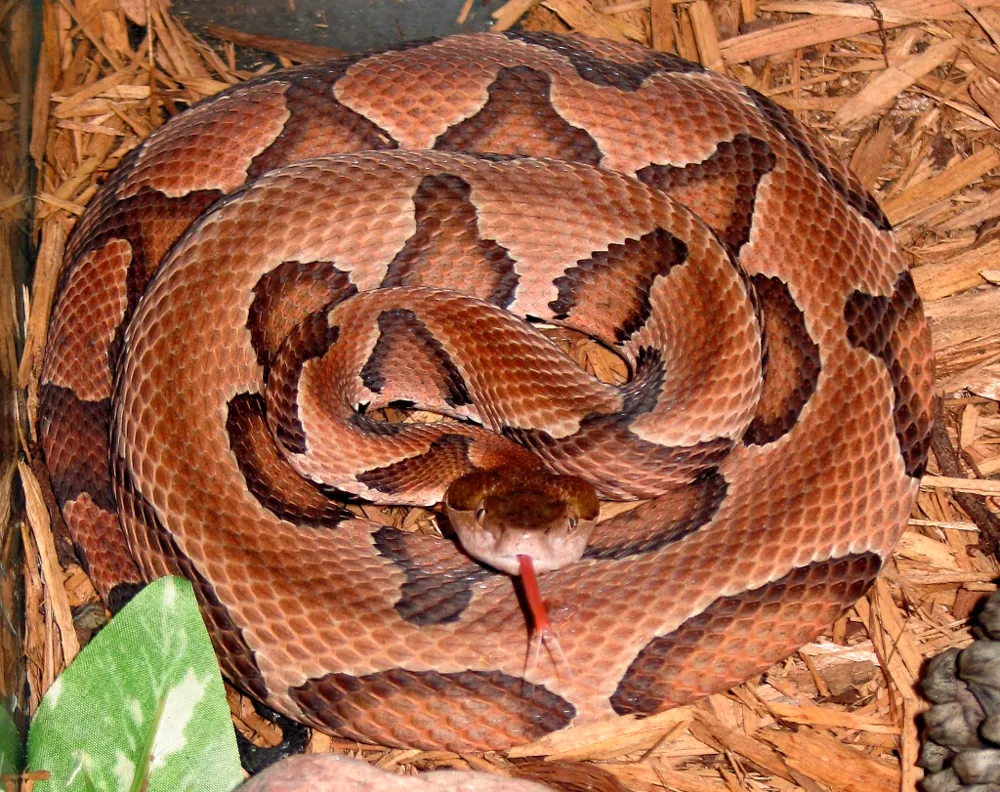
The eastern copperhead is a venomous pit viper that lives across much of the eastern United States. It has hourglass-shaped bands on a tan or reddish-brown body, which help it hide in leaves and clay. It is common, so people sometimes meet it without realising, and it makes up half of the treated snake bites in the United States.1



 Mmene ungaizindikirire
- Dark brown, hourglass-shaped crossbands on a light reddish-brown or brown background1
- A heavy, stout body rather than a slender one1
- A broad head that is distinct from the neck1
- Young have green or yellow tail tips, which darken to brown or black within a year1
- Adults are typically 50 to 95 cm long, including the tail1
Nthawi zambiri imasokonezedwa ndi: The snout slopes down and back, so it looks less blunt than the snout of the cottonmouth. The head also extends further forward than the mouth.1
Mphamvu ya ululu
Ululu umatuluka kudzera m'mano ake ikaluma.
Ndi yoopsa bwanji kwa anthu?
Ngozi kwa anthu: YoopsaKulumidwa kumafuna dokotala. Imfa ndi zosowa kwambiri.Copperhead bites account for half of the treated snake bites in the United States. Bites usually happen when people unknowingly step on or near the snake. It is generally nonaggressive and will strike only if threatened as a last resort.1
Imachita chiyani ikachita mantha?
It often freezes instead of fleeing, relying on its camouflage, and may vibrate its tail when closely approached.1
 Ikaluma
- Munthuyo akhale chete ndi wodekha, chiwalo cholumidwacho chikhale pamlingo wa mtima, chotsa mphete ndi zinthu zothina, ndipo mufikitse kuchipatala mwachangu.
Nthawi zonse yamba wayimbira nambala yadzidzidzi (112, 000, 911). Awa ndi malangizo wamba a chithandizo choyamba, osati malangizo a dokotala. Zoyambira za chithandizo choyamba
 Khala wotetezeka
- Usakhudze, kugwira kapena kuseweretsa nyama yakuthengo, ngakhale yaing'ono, ndipo ngakhale ikuoneka ngati yagona kapena yafa.
- Ipatse malo. Ukakumana nayo, khala chete, bwerera m'mbuyo pang'onopang'ono ndipo uilole ipite njira yake.
- Ikakuluma: khala chete, usasunthe, imbira nambala yadzidzidzi (112, 000, 911) kapena pita kuchipatala mwachangu. Kumbukira m'mene inkaonekera, chithunzi chimathandiza.
Sikufuna kukuvulaza. Imagwiritsa ntchito ululu wake kugwira chakudya kapena kudziteteza, ndipo imakonda kwambiri kubisala. Zambiri za kukhala wotetezeka
Kuti padziko lapansi?
Ndi yaikulu bwanji?
Ndi yaitali bwanji?
Ndi yolemera bwanji?
 yaitali ngati amphaka apakhomo 2 mphuno ndi mchira motsatizana
 yaitali ngati nthochi 5 zoyalidwa motsatizana
 ingathamange mamita 100 m'masekondi 100 (munthu wothamanga kwambiri amafunika 9.6)
Eastern copperhead ndi yaikulu bwanji poyerekeza ndi IWE?
Ndi masamu chabe mu msakatuli wako. Palibe chomwe chimasungidwa kapena kutumizidwa kwina.
Imathamanga bwanji?


Mfundo
Its tail can vibrate more than 40 times per second, faster than almost any non-rattlesnake snake.1
Juveniles wave a brightly coloured tail to attract frogs and perhaps lizards, a behaviour called caudal luring.1
Its camouflage is so good that it can be almost impossible to see on dead leaves or red clay.1
In Texas, copperheads have been found in bushes, vines and trees up to 12 metres above the ground, seeking newly emerged cicadas.1
Its venom has potential medicinal value to humans.1
Historically, kingsnakes were major predators of copperheads, and recent copperhead numbers have risen where kingsnake populations have declined.1
Kuthetsa nthano zabodza
Nthano yabodza: Copperheads are aggressive snakes that chase people and go looking for trouble.
Zoona: They are generally nonaggressive. They usually freeze or flee, and they strike only if threatened as a last resort. Most bites happen when people step on or near them without noticing.1
Za akatswiri a ululu
- Dzina la sayansi
- Agkistrodon contortrix
- Gulu
- Njoka za pit viper
- Banja
- Viperidae2
- Dongosolo
- Squamata
- Makontinenti
- Amereka ya Kumpoto
- Ana akhanda
- Newborn copperheads are born with green or yellow tail tips, which darken to brown or black within one year.1
- Mmene ilili kuthengo
- Least Concern (IUCN Red List, v3.1, 2001); population trend stable when assessed in 20071
- Ngozi kwa anthu
- 3 / 5: Yoopsa3
Kumene mfundo zimachokera
- Eastern copperhead (Wikipedia (CC BY-SA 4.0))
- Agkistrodon contortrix (iNaturalist): mayina ndi magulu a sayansi.
- Venom Wiki: mlingo wa ngozi, kukula wamba ndi kuyerekeza kwa liwiro ndi zathu. Ona mmene timazipezera: Mmene timayezera ngozi.
Mfundo iliyonse patsamba lino ili ndi nambala yosonyeza kochokera. Ngati talakwitsa, pepani, ndife okonda nyama, osati magazini a sayansi. Tiuze pa [email protected] ndipo tikonza.
 Chinkhanira chili ndi njala! Venom Wiki ndi ntchito ya munthu mmodzi: yaulere, yopanda zotsatsa ndi zokutsatira. Mphatso yaing'ono imathandiza kuti ikhalebe pa intaneti.Dyetsa chinkhanira
Zina za gulu lomwelo: Njoka za pit viper
 Terciopelo
 Eyelash viper
 Cottonmouth
 Cantil
 Central American bushmaster
 Martinique lancehead
Imakhalanso ku: Amereka ya Kumpoto
 Eastern coral snakeNjoka za coralIngathe kupha
 Eastern diamondback rattlesnakeNjoka za rattlesnakeIngathe kupha
 Timber rattlesnakeNjoka za rattlesnakeIngathe kupha
 Western diamondback rattlesnakeNjoka za rattlesnakeIngathe kupha
 Arizona bark scorpionZinkhaniraIkufuna dokotala
 Brown recluseAkangaudeIkufuna dokotala