
 Africa
 Asia
Asia Ulaya
Ulaya Amereka ya Kumwera
 Australia ndi Oceania
 Antarctica
 Nyanja ya Pacific
 Nyanja ya Atlantic
 Nyanja ya Indian
 Nyanja ya Arctic
 Nyanja ya Mediterranean
 Nyanja Yofiira
 Nyanja ya Caribbean
 Nyanja ya Coral
 Nyanja ya South China
 Nyanja ya Philippine
 Nyanja ya Andaman
 Nyanja ya Kumpoto (North Sea)
 Nyanja ya Timor ndi Arafura
 Nyanja ya Bengal
 Gulf ya California
Eastern green mamba
 Imaluma
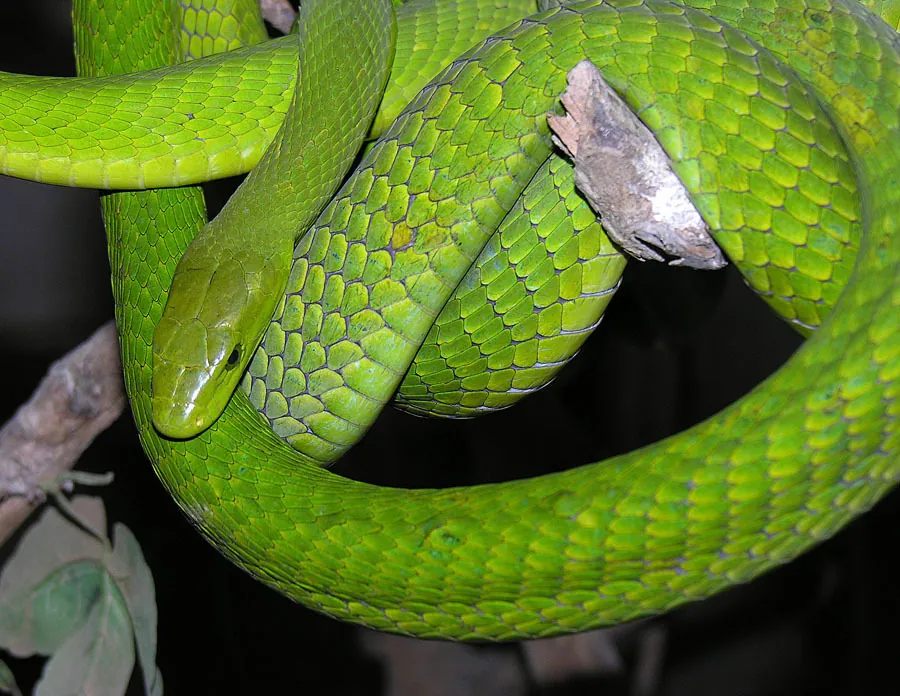
The eastern green mamba is a highly venomous snake with a slender body and bright green back. It lives in trees along the coasts of southern and East Africa. Although it is one of the most common green mambas, it is shy and usually hidden in leaves, so it is rarely seen.1



 Mmene ungaizindikirire
- Bright green upperparts, sometimes with a few isolated yellow scales.1
- Pale yellow-green belly.1
- Juveniles are blue-green and turn bright green at about 75 cm long.1
- Long, slender, coffin-shaped head. It can flatten its neck into a slight hood when threatened.1
- The inside of the mouth is white or bluish-white.1
Nthawi zambiri imasokonezedwa ndi: Green forms of the boomslang are often called green mambas in Southern Africa. They have larger eyes and shorter heads. Green bush snakes of the genus Philothamnus are often confused with smaller eastern green mambas. The boomslang is also venomous.1
Mphamvu ya ululu
Ululu umatuluka kudzera m'mano ake ikaluma.
Ululu wake umachita chiyani?
Its venom contains neurotoxins, which attack the nerves, and cardiotoxins, which damage the heart. Symptoms include swelling at the bite, dizziness, nausea, dehydration, laboured breathing and difficulty swallowing. These can progress to irregular heartbeat, convulsions and respiratory paralysis, which stops breathing and can be fatal. Paralysis may be mild or absent.1
Ndi yoopsa bwanji kwa anthu?
Ngozi kwa anthu: YakuphaImodzi mwa nyama zoopsa kwambiri padziko lonse.A survey in southern Africa from 1957 to 1979 recorded 17 bites confirmed as eastern green mambas. Ten of these caused systemic envenomation, and no victims died. Bites are most common from September to February, the breeding season, when the snake is most irritable. The average dose able to kill a human is about 18 to 20 mg of venom, and one bite can deliver 60 to 95 mg (dry weight). In 2024, a YouTuber died after being bitten, following anaphylactic shock.1
Imachita chiyani ikachita mantha?
It is shy and avoids people and predators, attacking only when it feels threatened, and it can flatten its neck into a hood.1
 Ikaluma
- Severe bites must be treated immediately on site, as they can quickly prove deadly.1
- Munthuyo akhale chete ndi wodekha, chotsa mphete ndi zinthu zothina, ndipo mufikitse kuchipatala mwachangu: antivenom ndiye mankhwala ake.
Nthawi zonse yamba wayimbira nambala yadzidzidzi (112, 000, 911). Awa ndi malangizo wamba a chithandizo choyamba, osati malangizo a dokotala. Zoyambira za chithandizo choyamba
 Khala wotetezeka
- Usakhudze, kugwira kapena kuseweretsa nyama yakuthengo, ngakhale yaing'ono, ndipo ngakhale ikuoneka ngati yagona kapena yafa.
- Ipatse malo. Ukakumana nayo, khala chete, bwerera m'mbuyo pang'onopang'ono ndipo uilole ipite njira yake.
- Ikakuluma: khala chete, usasunthe, imbira nambala yadzidzidzi (112, 000, 911) kapena pita kuchipatala mwachangu. Kumbukira m'mene inkaonekera, chithunzi chimathandiza.
Sikufuna kukuvulaza. Imagwiritsa ntchito ululu wake kugwira chakudya kapena kudziteteza, ndipo imakonda kwambiri kubisala. Zambiri za kukhala wotetezeka
Kuti padziko lapansi?
Ndi yaikulu bwanji?
Ndi yaitali bwanji?
 yaitali ngati agalu 2,5 mphuno ndi mchira motsatizana
 yaitali ngati nthochi 14 zoyalidwa motsatizana
 ingathamange mamita 100 m'masekondi 43 (munthu wothamanga kwambiri amafunika 9.6)
Eastern green mamba ndi yaikulu bwanji poyerekeza ndi IWE?
Ndi masamu chabe mu msakatuli wako. Palibe chomwe chimasungidwa kapena kutumizidwa kwina.
Imathamanga bwanji?


Mfundo
Males fight each other during the breeding season, usually entwining and pushing to pin each other's heads down. These fights can last several hours, but the snakes do not bite each other.1
Unlike most elapid snakes, which hunt actively, it often waits in ambush for its prey, a style more common among vipers.1
On average, an individual moves only about 5.4 metres per day, and it can stay in the same place for days.1
It has the least toxic venom of the three green mamba species, but it is still highly venomous.1
The oldest recorded eastern green mamba was a captive snake that lived 18.8 years.1
Kuthetsa nthano zabodza
Nthano yabodza: It is an aggressive, fast-moving 'people-chaser'.
Zoona: It is shy and elusive, usually hidden in trees, and it generally avoids people. It attacks only when it feels threatened.1
Za akatswiri a ululu
- Dzina la sayansi
- Dendroaspis angusticeps
- Gulu
- Ma cobra, mamba ndi krait
- Banja
- Elapidae2
- Dongosolo
- Squamata
- Makontinenti
- Africa
- Ana akhanda
- The female lays 4 to 17 eggs, usually 10 to 15, in leaf litter in hollow trees, from October to November. The young measure about 30 to 45 cm in the wild.1
- Kutalika kwa moyo
- pafupifupi zaka 18,81
- Ngozi kwa anthu
- 5 / 5: Yakupha3
Kumene mfundo zimachokera
- Eastern green mamba (Wikipedia (CC BY-SA 4.0))
- Dendroaspis angusticeps (iNaturalist): mayina ndi magulu a sayansi.
- Venom Wiki: mlingo wa ngozi, kukula wamba ndi kuyerekeza kwa liwiro ndi zathu. Ona mmene timazipezera: Mmene timayezera ngozi.
Mfundo iliyonse patsamba lino ili ndi nambala yosonyeza kochokera. Ngati talakwitsa, pepani, ndife okonda nyama, osati magazini a sayansi. Tiuze pa [email protected] ndipo tikonza.
 Chinkhanira chili ndi njala! Venom Wiki ndi ntchito ya munthu mmodzi: yaulere, yopanda zotsatsa ndi zokutsatira. Mphatso yaing'ono imathandiza kuti ikhalebe pa intaneti.Dyetsa chinkhanira
 Black mamba
 Egyptian cobra
 Cape cobra
 Jameson's mamba
 Western green mamba
 Ashe's spitting cobra
 Deathstalker
 Puff adder
 Boomslang
 Fat-tailed scorpion
 Gaboon viper
 Western honey bee