
 Africa
 Asia
Asia Ulaya
Ulaya Amereka ya Kumwera
 Australia ndi Oceania
 Antarctica
 Nyanja ya Pacific
 Nyanja ya Atlantic
 Nyanja ya Indian
 Nyanja ya Arctic
 Nyanja ya Mediterranean
 Nyanja Yofiira
 Nyanja ya Caribbean
 Nyanja ya Coral
 Nyanja ya South China
 Nyanja ya Philippine
 Nyanja ya Andaman
 Nyanja ya Kumpoto (North Sea)
 Nyanja ya Timor ndi Arafura
 Nyanja ya Bengal
 Gulf ya California
Giant vinegaroon
 Imapopera kapena kulavulira
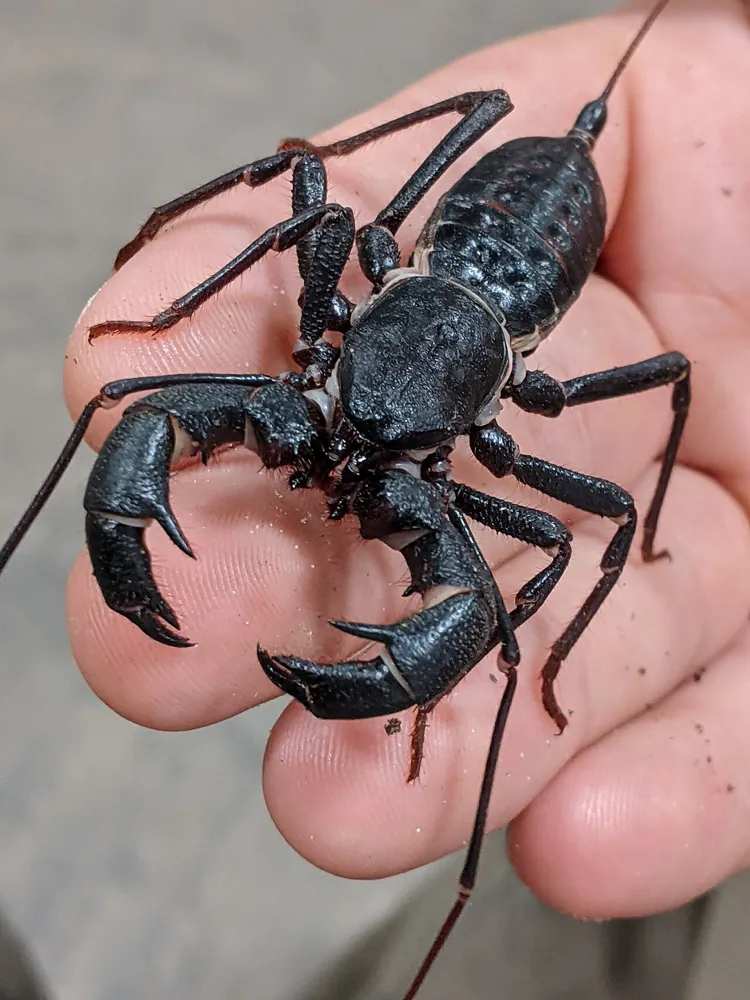
The giant vinegaroon is a large, harmless-to-people relative of the scorpion, known for the vinegar smell it gives off when threatened. It lives in the southern United States and Mexico, where it hunts insects and other small creatures at night. It is useful to people because it eats scorpions and other pests.1



 Mmene ungaizindikirire
- Body length is 40 to 60 millimetres, not counting the tail.1
- Has a long, thin, whip-like tail at the back.1
- Has two long front legs that it uses to feel around and sense vibrations.1
- Has two large pedipalps (front limbs) modified into claws for crushing prey.1
- When sprayed, it smells strongly of vinegar.1
Mphamvu ya ululu
Imapopera kapena kulavulira madzi olasa kwa omwe akuiukira.
Ululu wake umachita chiyani?
It is not venomous. From the base of its tail it sprays a liquid made of 85% acetic acid, the main component of vinegar. If the spray gets into mucous membranes or cuts, it can sting, and it can irritate the eyes.1
Ndi yoopsa bwanji kwa anthu?
Ngozi kwa anthu: YofatsaNgati kulasidwa ndi njuchi kapena pang'ono kuposa pamenepo. Pafupifupi yosavulaza anthu.It seldom bites or pinches people. Its main risk is the acid spray, which can sting and cause eye irritation.1
Imachita chiyani ikachita mantha?
When threatened, it sprays acetic acid from the base of its tail.1
 Ikakupopera
- Pa ubweya wa mbozi zolasa: uchotse ndi tepi yomata, kenako sambitsa khungu. Usasisite.
- Polumidwa: sambitsa ndi kuziziritsa. Peza thandizo la dokotala ngati munthuyo sakumva bwino kapena akutuluka magazi mosavuta.
Nthawi zonse yamba wayimbira nambala yadzidzidzi (112, 000, 911). Awa ndi malangizo wamba a chithandizo choyamba, osati malangizo a dokotala. Zoyambira za chithandizo choyamba
 Khala wotetezeka
- Usakhudze, kugwira kapena kuseweretsa nyama yakuthengo, ngakhale yaing'ono, ndipo ngakhale ikuoneka ngati yagona kapena yafa.
- Ipatse malo. Ukakumana nayo, khala chete, bwerera m'mbuyo pang'onopang'ono ndipo uilole ipite njira yake.
- Ikakupopera: khala chete, usasunthe, imbira nambala yadzidzidzi (112, 000, 911) kapena pita kuchipatala mwachangu. Kumbukira m'mene inkaonekera, chithunzi chimathandiza.
Sikufuna kukuvulaza. Imagwiritsa ntchito ululu wake kugwira chakudya kapena kudziteteza, ndipo imakonda kwambiri kubisala. Zambiri za kukhala wotetezeka
Kuti padziko lapansi?
Ndi yaikulu bwanji?
Ndi yaitali bwanji?
 yaitali ngati zidutswa zomangira zoseweretsa 2 pamzere
Giant vinegaroon ndi yaikulu bwanji poyerekeza ndi IWE?
Ndi masamu chabe mu msakatuli wako. Palibe chomwe chimasungidwa kapena kutumizidwa kwina.
Imathamanga bwanji?


_face.jpg)
Mfundo
Its common name 'vinegaroon' comes from the vinegar smell of the acid it sprays.1
It is an efficient predator of scorpions, and it is sometimes bought for that purpose.1
Males fight each other at night in fierce battles for the chance to mate with a female.1
It has eight eyes, but they are very weak, so it finds its way mostly by feeling with its front legs, tail and pedipalps.1
Raccoons, coatis, armadillos, skunks, bears, roadrunners, lizards and tarantulas may all eat it.1
It is sold in the exotic animal trade as a pet.1
Kuthetsa nthano zabodza
Nthano yabodza: Giant vinegaroons are dangerous and venomous to people.
Zoona: They are non-venomous and seldom bite or pinch people. The main risk is the acid spray, which can irritate the eyes or sting if it reaches cuts or mucous membranes.1
Za akatswiri a ululu
- Dzina la sayansi
- Mastigoproctus giganteus
- Gulu
- Mbozi ndi tizilombo
- Banja
- Thelyphonidae2
- Dongosolo
- Uropygi
- Makontinenti
- Amereka ya Kumpoto
- Ana akhanda
- The female produces about 40 offspring, which she protects and feeds during their early lives. She reproduces only once.1
- Kutalika kwa moyo
- pafupifupi zaka 71
- Ngozi kwa anthu
- 1 / 5: Yofatsa3
Kumene mfundo zimachokera
- Mastigoproctus giganteus (Wikipedia (CC BY-SA 4.0))
- Mastigoproctus giganteus (iNaturalist): mayina ndi magulu a sayansi.
- Venom Wiki: mlingo wa ngozi, kukula wamba ndi kuyerekeza kwa liwiro ndi zathu. Ona mmene timazipezera: Mmene timayezera ngozi.
Mfundo iliyonse patsamba lino ili ndi nambala yosonyeza kochokera. Ngati talakwitsa, pepani, ndife okonda nyama, osati magazini a sayansi. Tiuze pa [email protected] ndipo tikonza.
 Chinkhanira chili ndi njala! Venom Wiki ndi ntchito ya munthu mmodzi: yaulere, yopanda zotsatsa ndi zokutsatira. Mphatso yaing'ono imathandiza kuti ikhalebe pa intaneti.Dyetsa chinkhanira
Zina za gulu lomwelo: Mbozi ndi tizilombo
 Giant water bugMbozi ndi tizilomboImangopweteka
 Puss caterpillarMbozi ndi tizilomboImangopwetekaUsakhudze
 Saddleback caterpillarMbozi ndi tizilomboImangopwetekaUsakhudze
 Wheel bugMbozi ndi tizilomboImangopweteka
 Rhodnius kissing bugMbozi ndi tizilomboIkufuna dokotala
 Black-waved flannel mothMbozi ndi tizilomboImangopwetekaUsakhudze
Imakhalanso ku: Amereka ya Kumpoto
 TerciopeloNjoka za pit viperYakupha
 Eastern coral snakeNjoka za coralIngathe kupha
 Eastern diamondback rattlesnakeNjoka za rattlesnakeIngathe kupha
 Eyelash viperNjoka za pit viperIngathe kupha
 Timber rattlesnakeNjoka za rattlesnakeIngathe kupha
 Western diamondback rattlesnakeNjoka za rattlesnakeIngathe kupha