
 Africa
 Asia
Asia Ulaya
Ulaya Amereka ya Kumwera
 Australia ndi Oceania
 Antarctica
 Nyanja ya Pacific
 Nyanja ya Atlantic
 Nyanja ya Indian
 Nyanja ya Arctic
 Nyanja ya Mediterranean
 Nyanja Yofiira
 Nyanja ya Caribbean
 Nyanja ya Coral
 Nyanja ya South China
 Nyanja ya Philippine
 Nyanja ya Andaman
 Nyanja ya Kumpoto (North Sea)
 Nyanja ya Timor ndi Arafura
 Nyanja ya Bengal
 Gulf ya California
Greek meadow viper
 Imaluma
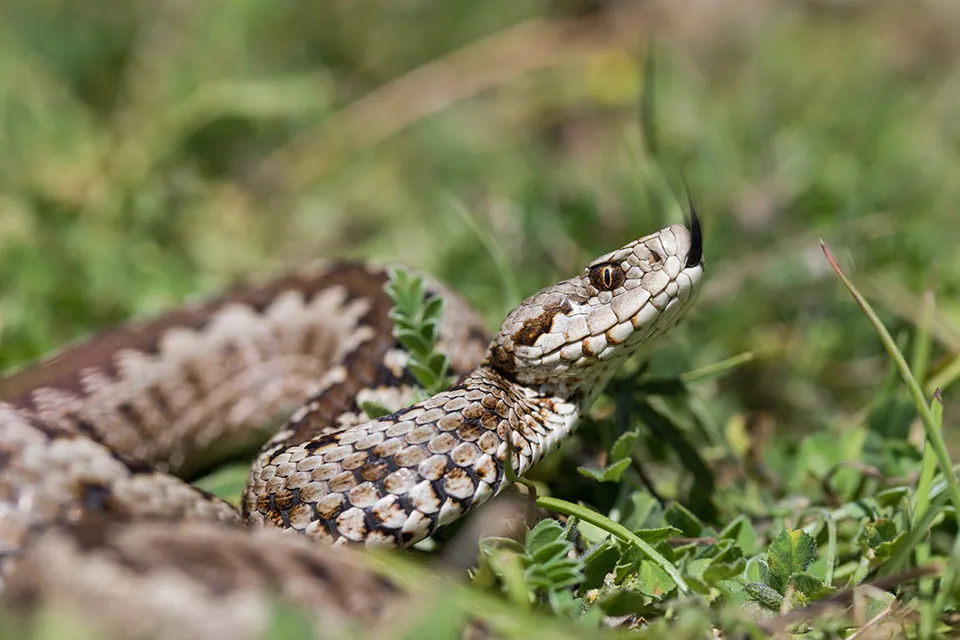
The Greek meadow viper is a small venomous snake that lives in mountain meadows in Albania and Greece. It was once thought to be a type of meadow viper, but scientists now see it as its own species. Its bite is venomous, so it is important to know what it looks like.1

 Mmene ungaizindikirire
- Small body, with a maximum snout-vent length of about 40 to 44 cm, depending on sex. Females are larger.1
- Maximum tail length of about 4 to 5 cm. Males have longer tails.1
- Dark spots are absent from the sides and top of the head, except for stripes behind the eyes and at the back of the head.1
- White or brownish-grey underside.1
- A sharp zigzag pattern along the back. Some males and young show a faint similarity to the meadow viper.1
Nthawi zambiri imasokonezedwa ndi: It is often compared with the meadow viper (Vipera ursinii), which it closely resembles. The Greek viper has no dark spots on the head sides or top, apart from the head stripes, and it has different scale counts. Some males and juveniles show faint pattern similarities.1
Mphamvu ya ululu
Ululu umatuluka kudzera m'mano ake ikaluma.
Ndi yoopsa bwanji kwa anthu?
Ngozi kwa anthu: YopwetekaIngathe kupweteka kwambiri, koma pafupifupi nthawi zonse si vuto lalikulu. Ikaluma
- Munthuyo akhale chete ndi wodekha, chiwalo cholumidwacho chikhale pamlingo wa mtima, chotsa mphete ndi zinthu zothina, ndipo mufikitse kuchipatala mwachangu.
Nthawi zonse yamba wayimbira nambala yadzidzidzi (112, 000, 911). Awa ndi malangizo wamba a chithandizo choyamba, osati malangizo a dokotala. Zoyambira za chithandizo choyamba
 Khala wotetezeka
- Usakhudze, kugwira kapena kuseweretsa nyama yakuthengo, ngakhale yaing'ono, ndipo ngakhale ikuoneka ngati yagona kapena yafa.
- Ipatse malo. Ukakumana nayo, khala chete, bwerera m'mbuyo pang'onopang'ono ndipo uilole ipite njira yake.
- Ikakuluma: khala chete, usasunthe, imbira nambala yadzidzidzi (112, 000, 911) kapena pita kuchipatala mwachangu. Kumbukira m'mene inkaonekera, chithunzi chimathandiza.
Sikufuna kukuvulaza. Imagwiritsa ntchito ululu wake kugwira chakudya kapena kudziteteza, ndipo imakonda kwambiri kubisala. Zambiri za kukhala wotetezeka
Kuti padziko lapansi?
Ndi yaikulu bwanji?
Ndi yaitali bwanji?
 yaitali ngati nthochi 2,5 zoyalidwa motsatizana
 yaitali ngati zidutswa zomangira zoseweretsa 14 pamzere
 ingathamange mamita 100 m'masekondi 110 (munthu wothamanga kwambiri amafunika 9.6)
Greek meadow viper ndi yaikulu bwanji poyerekeza ndi IWE?
Ndi masamu chabe mu msakatuli wako. Palibe chomwe chimasungidwa kapena kutumizidwa kwina.
Imathamanga bwanji?


Mfundo
The red fox, common kestrel and short-toed snake eagle are the only known predators of this viper.1
It is most common at high elevations, where annual temperatures average about 6 °C and snow lies until summer.1
Scientists were not sure it was a separate species until 2012, when DNA analysis showed it was its own species.1
Kumene mfundo zimachokera
- Vipera graeca (Wikipedia (CC BY-SA 4.0))
- Vipera graeca (iNaturalist): mayina ndi magulu a sayansi.
- Venom Wiki: mlingo wa ngozi, kukula wamba ndi kuyerekeza kwa liwiro ndi zathu. Ona mmene timazipezera: Mmene timayezera ngozi.
Mfundo iliyonse patsamba lino ili ndi nambala yosonyeza kochokera. Ngati talakwitsa, pepani, ndife okonda nyama, osati magazini a sayansi. Tiuze pa [email protected] ndipo tikonza.
 Chinkhanira chili ndi njala! Venom Wiki ndi ntchito ya munthu mmodzi: yaulere, yopanda zotsatsa ndi zokutsatira. Mphatso yaing'ono imathandiza kuti ikhalebe pa intaneti.Dyetsa chinkhanira
Zina za gulu lomwelo: Ma viper ndi adder
 Common European adder
 Blunt-nosed viper
 Nose-horned viper
 Ottoman viper
 Asp viper
 Lataste's viper
Imakhalanso ku: Ulaya
 Spanish flyNyama zina za poizoniIkufuna dokotalaUsakhudze
 Common waspNjuchi, mavu ndi mavu akuluakulu (hornets)Imangopweteka
 European hornetNjuchi, mavu ndi mavu akuluakulu (hornets)Imangopweteka
 Fire salamanderAchule a poizoni, achule a mphini (toads) ndi ma newtImangopwetekaUsakhudze
 Western honey beeNjuchi, mavu ndi mavu akuluakulu (hornets)Imangopweteka
 Mediterranean black widowAkangaudeIkufuna dokotala