
 Africa
 Asia
Asia Ulaya
Ulaya Amereka ya Kumwera
 Australia ndi Oceania
 Antarctica
 Nyanja ya Pacific
 Nyanja ya Atlantic
 Nyanja ya Indian
 Nyanja ya Arctic
 Nyanja ya Mediterranean
 Nyanja Yofiira
 Nyanja ya Caribbean
 Nyanja ya Coral
 Nyanja ya South China
 Nyanja ya Philippine
 Nyanja ya Andaman
 Nyanja ya Kumpoto (North Sea)
 Nyanja ya Timor ndi Arafura
 Nyanja ya Bengal
 Gulf ya California
Habu
 Imaluma
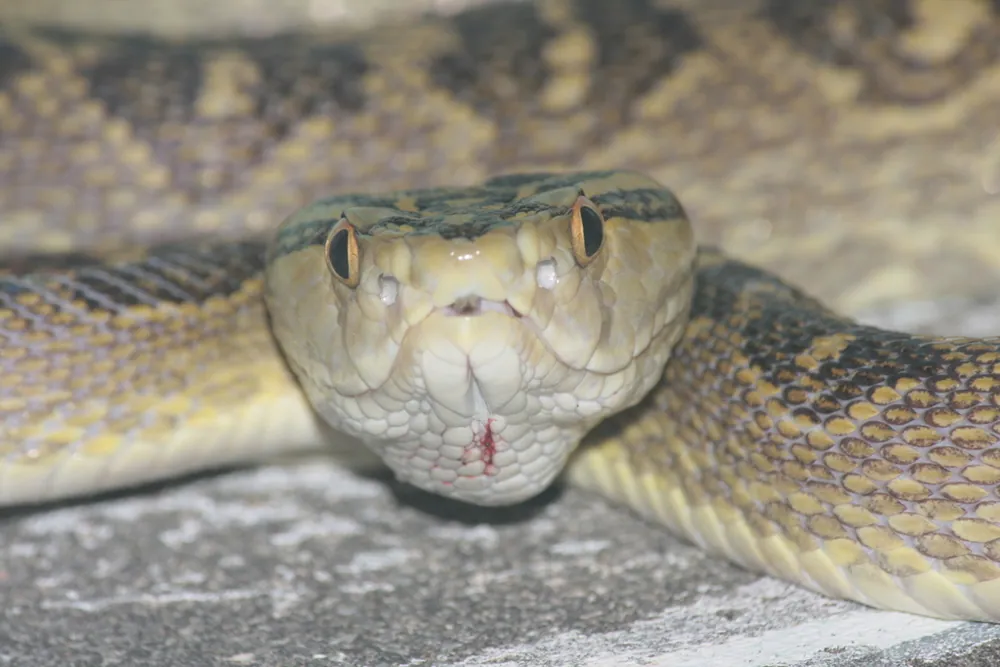
The habu is a venomous pit viper that lives on the Ryukyu Islands of Japan, including Okinawa and the Amami Islands. It is the largest member of its genus, Protobothrops. Its bite is serious, so it is important to know what it looks like.1

 Mmene ungaizindikirire
- Typically 120 to 150 cm long, including the tail, and slender with a large head1
- Light olive or brown body with elongated dark green or brownish blotches1
- Blotches have yellow edges, sometimes yellow spots, and often join to form wavy stripes1
- Whitish belly with dark edges1
- Crown of the head covered with small scales1
Nthawi zambiri imasokonezedwa ndi: In Okinawa Prefecture, the name habu can also refer to the Sakishima habu (Protobothrops elegans), also called the elegant pit viper. This is a different species.1
Mphamvu ya ululu
Ululu umatuluka kudzera m'mano ake ikaluma.
Ululu wake umachita chiyani?
The venom is highly toxic and contains cytotoxin, which damages body cells, and hemorrhagin, which damages blood vessels and causes bleeding. A bite can cause nausea, vomiting and low blood pressure, and it can possibly cause death. Some victims have lost movement in their hands and legs, even after treatment.1
Ndi yoopsa bwanji kwa anthu?
Ngozi kwa anthu: Yoopsa kwambiriIngathe kupha munthu amene sanalandire chithandizo.The Amami Islands have about two snakebites per 1,000 people, which is considered very high. The fatality rate is less than 1%. Bites are not life-threatening if the victim receives medical care promptly, but 6 to 8% of victims suffer permanent disability.1
Imachita chiyani ikachita mantha?
The habu is bold and irritable, and it can strike quickly from a long reach.1
 Ikaluma
- Get medical care promptly. With prompt medical care, bites are not life-threatening.1
- Munthuyo akhale chete ndi wodekha, chiwalo cholumidwacho chikhale pamlingo wa mtima, chotsa mphete ndi zinthu zothina, ndipo mufikitse kuchipatala mwachangu.
Nthawi zonse yamba wayimbira nambala yadzidzidzi (112, 000, 911). Awa ndi malangizo wamba a chithandizo choyamba, osati malangizo a dokotala. Zoyambira za chithandizo choyamba
 Khala wotetezeka
- Usakhudze, kugwira kapena kuseweretsa nyama yakuthengo, ngakhale yaing'ono, ndipo ngakhale ikuoneka ngati yagona kapena yafa.
- Ipatse malo. Ukakumana nayo, khala chete, bwerera m'mbuyo pang'onopang'ono ndipo uilole ipite njira yake.
- Ikakuluma: khala chete, usasunthe, imbira nambala yadzidzidzi (112, 000, 911) kapena pita kuchipatala mwachangu. Kumbukira m'mene inkaonekera, chithunzi chimathandiza.
Sikufuna kukuvulaza. Imagwiritsa ntchito ululu wake kugwira chakudya kapena kudziteteza, ndipo imakonda kwambiri kubisala. Zambiri za kukhala wotetezeka
Kuti padziko lapansi?
Ndi yaikulu bwanji?
Ndi yaitali bwanji?
 yaitali ngati amphaka apakhomo 5 mphuno ndi mchira motsatizana
 yaitali ngati nthochi 13 zoyalidwa motsatizana
 ingathamange mamita 100 m'masekondi 86 (munthu wothamanga kwambiri amafunika 9.6)
Habu ndi yaikulu bwanji poyerekeza ndi IWE?
Ndi masamu chabe mu msakatuli wako. Palibe chomwe chimasungidwa kapena kutumizidwa kwina.
Imathamanga bwanji?


Mfundo
On Okinawa, habus are heavily collected to make habushu, a liquor made from awamori sake, which is said to have medicinal properties.1
Unlike most pit vipers, the habu lays eggs rather than giving birth to live young.1
Hatchlings are about 25 cm long and look the same as the adults.1
The small Indian mongoose was introduced to Okinawa in 1910 to reduce the habu population. The effects of this have not been studied, but similar introductions have harmed native wildlife.1
The habu is the largest member of its genus, Protobothrops.1
Za akatswiri a ululu
- Dzina la sayansi
- Protobothrops flavoviridis
- Gulu
- Njoka za pit viper
- Banja
- Viperidae2
- Dongosolo
- Squamata
- Makontinenti
- Asia
- Ana akhanda
- Unlike most pit vipers, the habu lays eggs. Up to 18 eggs are laid in mid-summer, and the hatchlings are about 25 cm long and look like adults.1
- Ngozi kwa anthu
- 4 / 5: Yoopsa kwambiri3
Kumene mfundo zimachokera
- Protobothrops flavoviridis (Wikipedia (CC BY-SA 4.0))
- Protobothrops flavoviridis (iNaturalist): mayina ndi magulu a sayansi.
- Venom Wiki: mlingo wa ngozi, kukula wamba ndi kuyerekeza kwa liwiro ndi zathu. Ona mmene timazipezera: Mmene timayezera ngozi.
Mfundo iliyonse patsamba lino ili ndi nambala yosonyeza kochokera. Ngati talakwitsa, pepani, ndife okonda nyama, osati magazini a sayansi. Tiuze pa [email protected] ndipo tikonza.
 Chinkhanira chili ndi njala! Venom Wiki ndi ntchito ya munthu mmodzi: yaulere, yopanda zotsatsa ndi zokutsatira. Mphatso yaing'ono imathandiza kuti ikhalebe pa intaneti.Dyetsa chinkhanira
 Brown spotted pit viper
 Hump-nosed viper
 Hundred-pace viper
 Malayan pit viper
 Mamushi
 Mangshan pit viper
 Deathstalker
 Indian cobra
 Indian saw-scaled viper
 King cobra
 Puff adder
 Njoka ya Russell (Russell's viper)