
 Africa
 Asia
Asia Ulaya
Ulaya Amereka ya Kumwera
 Australia ndi Oceania
 Antarctica
 Nyanja ya Pacific
 Nyanja ya Atlantic
 Nyanja ya Indian
 Nyanja ya Arctic
 Nyanja ya Mediterranean
 Nyanja Yofiira
 Nyanja ya Caribbean
 Nyanja ya Coral
 Nyanja ya South China
 Nyanja ya Philippine
 Nyanja ya Andaman
 Nyanja ya Kumpoto (North Sea)
 Nyanja ya Timor ndi Arafura
 Nyanja ya Bengal
 Gulf ya California
Lollyfish
 Poizoni pakhungu lakeImadya: Pang'ono pa chilichonseYa poizoni, si yaululu
The lollyfish is a black sea cucumber, a soft-bodied animal that lives on the seabed. It is found in shallow tropical waters across the Indo-Pacific, from the Red Sea and East Africa to Australia. It matters to people because its skin releases a toxic red fluid when it is damaged.1
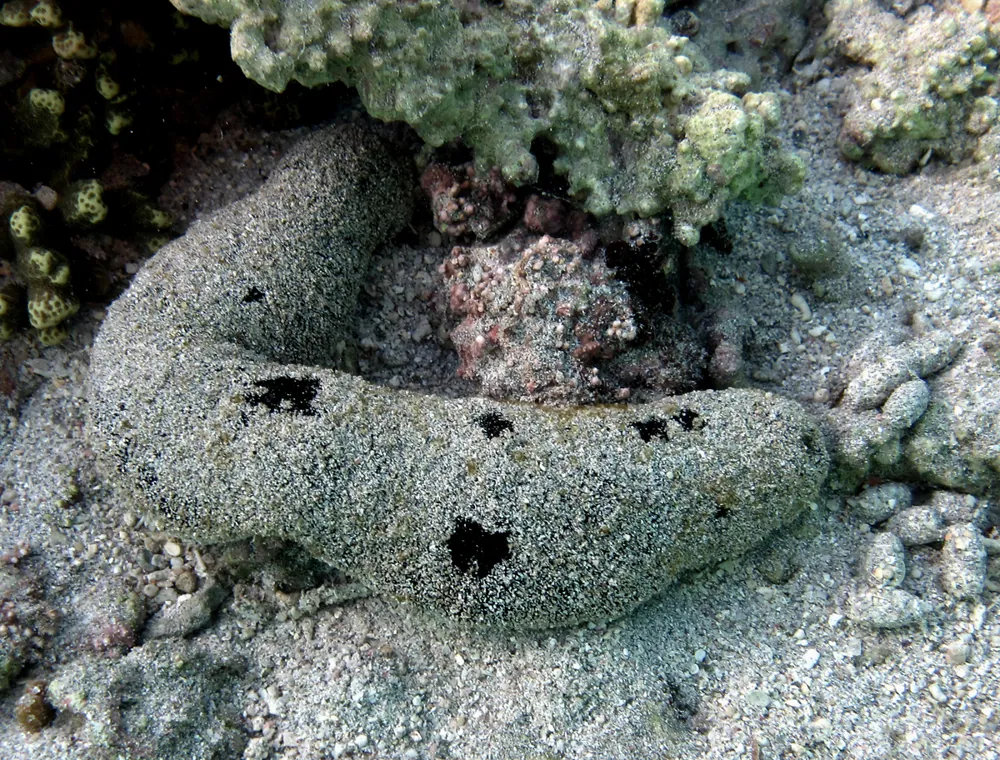
 Mmene ungaizindikirire
Mphamvu ya poizoni
Khungu lake lili ndi poizoni. Ndi yoopsa kuikhudza, kuinyambita kapena kuidya.
Poizoni wake umachita chiyani?
It is not venomous. When its skin is rubbed or damaged, it releases a toxic red fluid.1
Ndi yoopsa bwanji kwa anthu?
Ngozi kwa anthu: YofatsaNgati kulasidwa ndi njuchi kapena pang'ono kuposa pamenepo. Pafupifupi yosavulaza anthu.Imachita chiyani ikachita mantha?
When attacked, it pushes its internal organs out through its anus, and it releases a toxic red fluid when its skin is rubbed or damaged.1
 Ngati munthu waikhudza kapena waidya
- Ika bala m'madzi otentha, otentha monga momwe munthuyo angapirire osapsa, ndipo peza thandizo la dokotala kuti achotse minga. Usaikumbe wekha.
Nthawi zonse yamba wayimbira nambala yadzidzidzi (112, 000, 911). Awa ndi malangizo wamba a chithandizo choyamba, osati malangizo a dokotala. Zoyambira za chithandizo choyamba
 Khala wotetezeka
- Usakhudze, kugwira kapena kuseweretsa nyama yakuthengo, ngakhale yaing'ono, ndipo ngakhale ikuoneka ngati yagona kapena yafa.
- Ipatse malo. Ukakumana nayo, khala chete, bwerera m'mbuyo pang'onopang'ono ndipo uilole ipite njira yake.
- Ngati unaikhudza kapena kuidya: usasisite maso kapena pakamwa, sambitsa m'manja ndipo peza thandizo la dokotala.
Sikufuna kukuvulaza. Poizoni wake ulipo kuti pasapezeke choidya. Zambiri za kukhala wotetezeka
Kuti padziko lapansi?
Ndi yaikulu bwanji?
Ndi yaitali bwanji?
 yaitali ngati nthochi 3 zoyalidwa motsatizana
 yochedwa kuposa nkhono ya m'munda
Lollyfish ndi yaikulu bwanji poyerekeza ndi IWE?
Ndi masamu chabe mu msakatuli wako. Palibe chomwe chimasungidwa kapena kutumizidwa kwina.
Imathamanga bwanji?


Mfundo
When attacked, it pushes its internal organs out through its anus rather than firing sticky Cuvierian tubules as some sea cucumbers do.1
On Guam, its toxic red fluid is used to drive octopuses out of their hiding holes.1
It can split in two by transverse fission, and a sand coating does not stick to the new surfaces.1
Pools warmed by the sun can reach 39 °C, and individuals there still appeared healthy and fed.1
A thick coating of sand may help keep it cool by shading it from the sun.1
Za akatswiri a ululu
- Dzina la sayansi
- Holothuria atra
- Gulu
- Nungu za m'nyanja, nyenyezi za m'nyanja ndi nyongolotsi
- Banja
- Holothuriidae2
- Dongosolo
- Holothuriida
- Makontinenti
- Nyanja ya Pacific, Nyanja ya Indian, Nyanja Yofiira, Nyanja ya Coral, Nyanja ya Philippine, Nyanja ya South China, Nyanja ya Timor ndi Arafura, Nyanja ya Bengal, Nyanja zikuluzikulu
- Ana akhanda
- It is not possible to tell males from females by looking at them. It spawns mostly in summer and autumn, or all year in equatorial waters. It can also reproduce by splitting in two, which mostly happens to smaller animals.1
- Ngozi kwa anthu
- 1 / 5: Yofatsa3
Kumene mfundo zimachokera
- Holothuria atra (Wikipedia (CC BY-SA 4.0))
- Holothuria atra (iNaturalist): mayina ndi magulu a sayansi.
- Venom Wiki: mlingo wa ngozi, kukula wamba ndi kuyerekeza kwa liwiro ndi zathu. Ona mmene timazipezera: Mmene timayezera ngozi.
Mfundo iliyonse patsamba lino ili ndi nambala yosonyeza kochokera. Ngati talakwitsa, pepani, ndife okonda nyama, osati magazini a sayansi. Tiuze pa [email protected] ndipo tikonza.
 Chinkhanira chili ndi njala! Venom Wiki ndi ntchito ya munthu mmodzi: yaulere, yopanda zotsatsa ndi zokutsatira. Mphatso yaing'ono imathandiza kuti ikhalebe pa intaneti.Dyetsa chinkhanira
Zina za gulu lomwelo: Nungu za m'nyanja, nyenyezi za m'nyanja ndi nyongolotsi
 Crown-of-thorns starfishNungu za m'nyanja, nyenyezi za m'nyanja ndi nyongolotsiIkufuna dokotalaUsakhudze
 Flower urchinNungu za m'nyanja, nyenyezi za m'nyanja ndi nyongolotsiIngathe kupha
 Fire urchinNungu za m'nyanja, nyenyezi za m'nyanja ndi nyongolotsiIkufuna dokotalaUsakhudze
 Bearded firewormNungu za m'nyanja, nyenyezi za m'nyanja ndi nyongolotsiImangopwetekaUsakhudze
 Black long-spined urchinNungu za m'nyanja, nyenyezi za m'nyanja ndi nyongolotsiImangopwetekaUsakhudze
 BloodwormNungu za m'nyanja, nyenyezi za m'nyanja ndi nyongolotsiImangopweteka
Imakhalanso ku: Nyanja ya Pacific
 Australian box jellyfishJellyfish ndi zolasa za m'nyanjaYakuphaUsakhudze
 Geography coneNkhono za cone ndi ma octopusYakupha
 Greater blue-ringed octopusNkhono za cone ndi ma octopusYakupha
 Japanese pufferfishNyama zina za poizoniYakupha
 Southern blue-ringed octopusNkhono za cone ndi ma octopusYakupha
 Hawksbill sea turtleNyama zina za poizoniIngathe kupha