
 Africa
 Asia
Asia Ulaya
Ulaya Amereka ya Kumwera
 Australia ndi Oceania
 Antarctica
 Nyanja ya Pacific
 Nyanja ya Atlantic
 Nyanja ya Indian
 Nyanja ya Arctic
 Nyanja ya Mediterranean
 Nyanja Yofiira
 Nyanja ya Caribbean
 Nyanja ya Coral
 Nyanja ya South China
 Nyanja ya Philippine
 Nyanja ya Andaman
 Nyanja ya Kumpoto (North Sea)
 Nyanja ya Timor ndi Arafura
 Nyanja ya Bengal
 Gulf ya California
Geography cone
 Imalasa
The geography cone is a predatory sea snail that lives on shallow tropical reefs in the Indo-Pacific. It hunts small fish. Its venom is strong enough to kill a person, which makes it one of the most dangerous cone snails.1


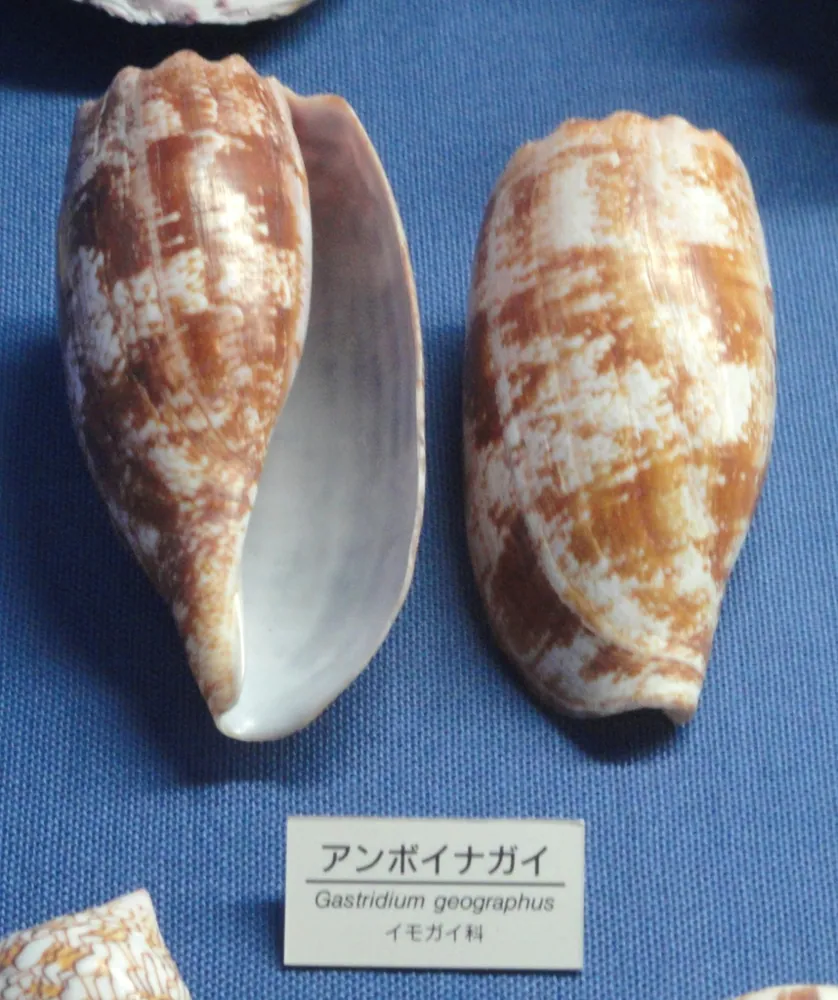
 Mmene ungaizindikirire
- Broad, thin shell that is cylindrically inflated, usually 10 to 15 cm long1
- Ground colour is pink or violet-white, sometimes reddish1
- Mottled pattern of chestnut or chocolate brown, usually forming two irregular bands1
- Wide pink or violet-white opening and numerous shoulder ridges or spines1
Nthawi zambiri imasokonezedwa ndi: Compared with other cone shells of a similar size, the geography cone has a noticeably wider, more convex middle and a flattened spire. Its walls are also thinner and lighter.1
Mphamvu ya ululu
Ululu umatuluka kudzera mu mbola.
Ululu wake umachita chiyani?
Its venom is a complex mix of hundreds of different toxins, delivered through the harpoon-like tooth. It has the most toxic sting known among cone snails. Even the most venomous cone snails take about one to five hours to kill a healthy adult, but medical care must still be prompt.1
Ndi yoopsa bwanji kwa anthu?
Ngozi kwa anthu: YakuphaImodzi mwa nyama zoopsa kwambiri padziko lonse.There are reports of about 36 human deaths over the past 300 years. Live specimens should be handled with extreme caution.1
Imachita chiyani ikachita mantha?
Most of the venom's toxic compounds are believed to be used for defence rather than feeding.1
 Ikalasa
- There is no antivenom for a cone snail sting. Treatment consists of keeping the victim alive until the symptoms wear off, so prompt medical care is essential.1
- Kumanga ndi kusasuntha (pressure immobilisation): manga bandeji yotanuka mwamphamvu pamene walumidwa kenako mmwamba chiwalo chonse, ika chogwiriziza (splint), ndipo munthuyo akhale chete osasuntha konse mpaka thandizo litafika.
- Octopus ya mphete zabuluu kapena nkhono ya cone ingathe kuletsa munthu kupuma ali chizindikire: itana thandizo ndipo ukhale wokonzeka kumupumira m'kamwa mpaka anthu a ambulansi atatenga udindo.
Nthawi zonse yamba wayimbira nambala yadzidzidzi (112, 000, 911). Awa ndi malangizo wamba a chithandizo choyamba, osati malangizo a dokotala. Zoyambira za chithandizo choyamba
 Khala wotetezeka
- Usakhudze, kugwira kapena kuseweretsa nyama yakuthengo, ngakhale yaing'ono, ndipo ngakhale ikuoneka ngati yagona kapena yafa.
- Ipatse malo. Ukakumana nayo, khala chete, bwerera m'mbuyo pang'onopang'ono ndipo uilole ipite njira yake.
- Ikakulasa: khala chete, usasunthe, imbira nambala yadzidzidzi (112, 000, 911) kapena pita kuchipatala mwachangu. Kumbukira m'mene inkaonekera, chithunzi chimathandiza.
Sikufuna kukuvulaza. Imagwiritsa ntchito ululu wake kugwira chakudya kapena kudziteteza, ndipo imakonda kwambiri kubisala. Zambiri za kukhala wotetezeka
Kuti padziko lapansi?
Ndi yaikulu bwanji?
Ndi yaitali bwanji?
 yaitali ngati zidutswa zomangira zoseweretsa 5 pamzere
 yochedwa kuposa nkhono ya m'munda
Geography cone ndi yaikulu bwanji poyerekeza ndi IWE?
Ndi masamu chabe mu msakatuli wako. Palibe chomwe chimasungidwa kapena kutumizidwa kwina.
Imathamanga bwanji?

Mfundo
Its venom contains a form of insulin, which it uses to stun fish. Once the venom passes through a fish's gills, the fish goes into hypoglycaemic shock (a dangerous drop in blood sugar).1
Apart from the tulip cone snail, no other known living thing is known to use its own biological insulin as a weapon.1
Research shows that some proteins from cone snail venom can be up to 10,000 times more effective than morphine as painkillers, without morphine's addictive properties and side effects.1
Of the venom's 100 to 200 toxic peptides, only 15 to 20 are used for feeding.1
Adult geography cones can fall prey to sea turtles, rays, birds and human shell collectors.1
Kuthetsa nthano zabodza
Nthano yabodza: The nickname 'cigarette snail' means a sting gives you just enough time to smoke a cigarette before you die.
Zoona: This is a gallows humour exaggeration. Even the most venomous cone snails take about one to five hours to kill a healthy human.1
Za akatswiri a ululu
Kumene mfundo zimachokera
- Conus geographus (Wikipedia (CC BY-SA 4.0))
- Conus geographus (iNaturalist): mayina ndi magulu a sayansi.
- Venom Wiki: mlingo wa ngozi, kukula wamba ndi kuyerekeza kwa liwiro ndi zathu. Ona mmene timazipezera: Mmene timayezera ngozi.
Mfundo iliyonse patsamba lino ili ndi nambala yosonyeza kochokera. Ngati talakwitsa, pepani, ndife okonda nyama, osati magazini a sayansi. Tiuze pa [email protected] ndipo tikonza.
 Chinkhanira chili ndi njala! Venom Wiki ndi ntchito ya munthu mmodzi: yaulere, yopanda zotsatsa ndi zokutsatira. Mphatso yaing'ono imathandiza kuti ikhalebe pa intaneti.Dyetsa chinkhanira
Zina za gulu lomwelo: Nkhono za cone ndi ma octopus
 Greater blue-ringed octopusNkhono za cone ndi ma octopusYakupha
 Southern blue-ringed octopusNkhono za cone ndi ma octopusYakupha
 Blue sea dragonNkhono za cone ndi ma octopusImangopweteka
 Common octopusNkhono za cone ndi ma octopusYosavulaza
 Giant Pacific octopusNkhono za cone ndi ma octopusYosavulaza
 Blue-lined octopusNkhono za cone ndi ma octopusYakupha
Imakhalanso ku: Nyanja ya Indian
 Australian box jellyfishJellyfish ndi zolasa za m'nyanjaYakuphaUsakhudze
 Hawksbill sea turtleNyama zina za poizoniIngathe kupha
 Irukandji jellyfishJellyfish ndi zolasa za m'nyanjaIngathe kuphaUsakhudze
 Reef stonefishNsomba zaululuIngathe kuphaUsakhudze
 Crown-of-thorns starfishNungu za m'nyanja, nyenyezi za m'nyanja ndi nyongolotsiIkufuna dokotalaUsakhudze
 Portuguese man o' warJellyfish ndi zolasa za m'nyanjaIkufuna dokotalaUsakhudze