
 Africa
 Asia
Asia Ulaya
Ulaya Amereka ya Kumwera
 Australia ndi Oceania
 Antarctica
 Nyanja ya Pacific
 Nyanja ya Atlantic
 Nyanja ya Indian
 Nyanja ya Arctic
 Nyanja ya Mediterranean
 Nyanja Yofiira
 Nyanja ya Caribbean
 Nyanja ya Coral
 Nyanja ya South China
 Nyanja ya Philippine
 Nyanja ya Andaman
 Nyanja ya Kumpoto (North Sea)
 Nyanja ya Timor ndi Arafura
 Nyanja ya Bengal
 Gulf ya California
Greater blue-ringed octopus
 Imaluma
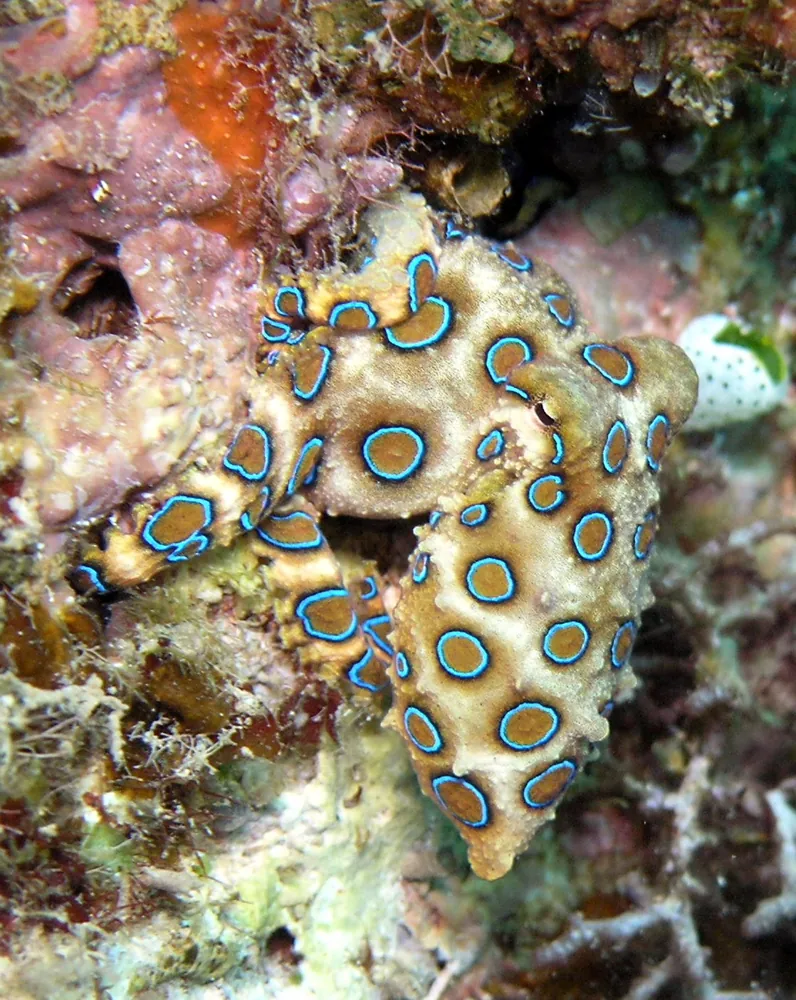
The greater blue-ringed octopus is a small sea creature that lives in the warm shallow waters of the Indo-West Pacific, including around Australia. It is one of the most venomous marine animals in the world, so knowing what it looks like matters.1



 Mmene ungaizindikirire
- A small octopus, up to 10 cm with its arms included, weighing about 80 grams on average.1
- Electric blue rings, about 7 to 8 mm across, roughly 60 of them, spread over its whole skin.1
- The rings flash iridescent blue as a warning signal, each flash lasting about a third of a second.1
- Its body colour varies from yellow ochre to light brown, or whitish when inactive.1
- Blue lines run through its eyes.1
Mphamvu ya ululu
Ululu umatuluka kudzera m'mano ake ikaluma.
Ululu wake umachita chiyani?
Its venom contains tetrodotoxin (TTX), a powerful neurotoxin, which is a poison that attacks the nerves. It paralyses the muscles needed for movement, and in people it can lead to death through respiratory paralysis, which means the breathing muscles stop working. Symptoms include tingling and numbness of the face and lips, sweating, severe headaches, dizziness, speech problems, weakness and vomiting. Symptoms can appear between 15 minutes and four hours after a bite, and the victim stays conscious throughout.1
Ndi yoopsa bwanji kwa anthu?
Ngozi kwa anthu: YakuphaImodzi mwa nyama zoopsa kwambiri padziko lonse.The bite is capable of being fatal to humans. The bite is painless, so a person may not notice it. Children are more sensitive to the toxin. Death can occur between 20 minutes and 24 hours after symptoms begin.1
Imachita chiyani ikachita mantha?
It flashes its blue rings as a warning to predators, and it uses its venom to defend itself.1
 Ikaluma
- Kumanga ndi kusasuntha (pressure immobilisation): manga bandeji yotanuka mwamphamvu pamene walumidwa kenako mmwamba chiwalo chonse, ika chogwiriziza (splint), ndipo munthuyo akhale chete osasuntha konse mpaka thandizo litafika.
- Octopus ya mphete zabuluu kapena nkhono ya cone ingathe kuletsa munthu kupuma ali chizindikire: itana thandizo ndipo ukhale wokonzeka kumupumira m'kamwa mpaka anthu a ambulansi atatenga udindo.
Nthawi zonse yamba wayimbira nambala yadzidzidzi (112, 000, 911). Awa ndi malangizo wamba a chithandizo choyamba, osati malangizo a dokotala. Zoyambira za chithandizo choyamba
 Khala wotetezeka
- Usakhudze, kugwira kapena kuseweretsa nyama yakuthengo, ngakhale yaing'ono, ndipo ngakhale ikuoneka ngati yagona kapena yafa.
- Ipatse malo. Ukakumana nayo, khala chete, bwerera m'mbuyo pang'onopang'ono ndipo uilole ipite njira yake.
- Ikakuluma: khala chete, usasunthe, imbira nambala yadzidzidzi (112, 000, 911) kapena pita kuchipatala mwachangu. Kumbukira m'mene inkaonekera, chithunzi chimathandiza.
Sikufuna kukuvulaza. Imagwiritsa ntchito ululu wake kugwira chakudya kapena kudziteteza, ndipo imakonda kwambiri kubisala. Zambiri za kukhala wotetezeka
Kuti padziko lapansi?
Ndi yaikulu bwanji?
Ndi yaitali bwanji?
 yaitali ngati zidutswa zomangira zoseweretsa 3 pamzere
 ingasambire kutalika kwa dziwe lalikulu losambira (50 m) m'masekondi 7,2
Greater blue-ringed octopus ndi yaikulu bwanji poyerekeza ndi IWE?
Ndi masamu chabe mu msakatuli wako. Palibe chomwe chimasungidwa kapena kutumizidwa kwina.
Imathamanga bwanji?


Mfundo
The greater blue-ringed octopus is one of the most venomous marine animals in the world, despite being small.1
Its venom contains tetrodotoxin, the same toxin found in pufferfish.1
There is no known antidote or antitoxin for tetrodotoxin, and the toxin does not break down when heated or boiled.1
Its blue rings are a warning signal to predators, showing that it is highly venomous.1
Males die after mating, and females die after guarding their eggs because they refuse to eat.1
Kuthetsa nthano zabodza
Nthano yabodza: A small octopus is harmless.
Zoona: Despite its small size, its bite can be deadly to humans.1
Za akatswiri a ululu
- Dzina la sayansi
- Hapalochlaena lunulata
- Gulu
- Nkhono za cone ndi ma octopus
- Banja
- Octopodidae2
- Dongosolo
- Octopoda
- Makontinenti
- Nyanja ya Indian, Nyanja ya Pacific, Nyanja ya Coral, Nyanja ya Philippine, Nyanja ya Timor ndi Arafura, Nyanja zikuluzikulu
- Ana akhanda
- The female lays 50 to 100 eggs, which she carries under her arms for about a month. The young hatch as tiny planktonic paralarvae, about the size of a pea.1
- Kutalika kwa moyo
- pafupifupi zaka 21
- Ngozi kwa anthu
- 5 / 5: Yakupha3
Kumene mfundo zimachokera
- Greater blue-ringed octopus (Wikipedia (CC BY-SA 4.0))
- Hapalochlaena lunulata (iNaturalist): mayina ndi magulu a sayansi.
- Venom Wiki: mlingo wa ngozi, kukula wamba ndi kuyerekeza kwa liwiro ndi zathu. Ona mmene timazipezera: Mmene timayezera ngozi.
Mfundo iliyonse patsamba lino ili ndi nambala yosonyeza kochokera. Ngati talakwitsa, pepani, ndife okonda nyama, osati magazini a sayansi. Tiuze pa [email protected] ndipo tikonza.
 Chinkhanira chili ndi njala! Venom Wiki ndi ntchito ya munthu mmodzi: yaulere, yopanda zotsatsa ndi zokutsatira. Mphatso yaing'ono imathandiza kuti ikhalebe pa intaneti.Dyetsa chinkhanira
Zina za gulu lomwelo: Nkhono za cone ndi ma octopus
 Geography coneNkhono za cone ndi ma octopusYakupha
 Southern blue-ringed octopusNkhono za cone ndi ma octopusYakupha
 Blue sea dragonNkhono za cone ndi ma octopusImangopweteka
 Common octopusNkhono za cone ndi ma octopusYosavulaza
 Giant Pacific octopusNkhono za cone ndi ma octopusYosavulaza
 Blue-lined octopusNkhono za cone ndi ma octopusYakupha
Imakhalanso ku: Nyanja ya Indian
 Australian box jellyfishJellyfish ndi zolasa za m'nyanjaYakuphaUsakhudze
 Hawksbill sea turtleNyama zina za poizoniIngathe kupha
 Irukandji jellyfishJellyfish ndi zolasa za m'nyanjaIngathe kuphaUsakhudze
 Reef stonefishNsomba zaululuIngathe kuphaUsakhudze
 Crown-of-thorns starfishNungu za m'nyanja, nyenyezi za m'nyanja ndi nyongolotsiIkufuna dokotalaUsakhudze
 Portuguese man o' warJellyfish ndi zolasa za m'nyanjaIkufuna dokotalaUsakhudze