
 Africa
 Asia
Asia Ulaya
Ulaya Amereka ya Kumwera
 Australia ndi Oceania
 Antarctica
 Nyanja ya Pacific
 Nyanja ya Atlantic
 Nyanja ya Indian
 Nyanja ya Arctic
 Nyanja ya Mediterranean
 Nyanja Yofiira
 Nyanja ya Caribbean
 Nyanja ya Coral
 Nyanja ya South China
 Nyanja ya Philippine
 Nyanja ya Andaman
 Nyanja ya Kumpoto (North Sea)
 Nyanja ya Timor ndi Arafura
 Nyanja ya Bengal
 Gulf ya California
Many-banded krait
 Imaluma
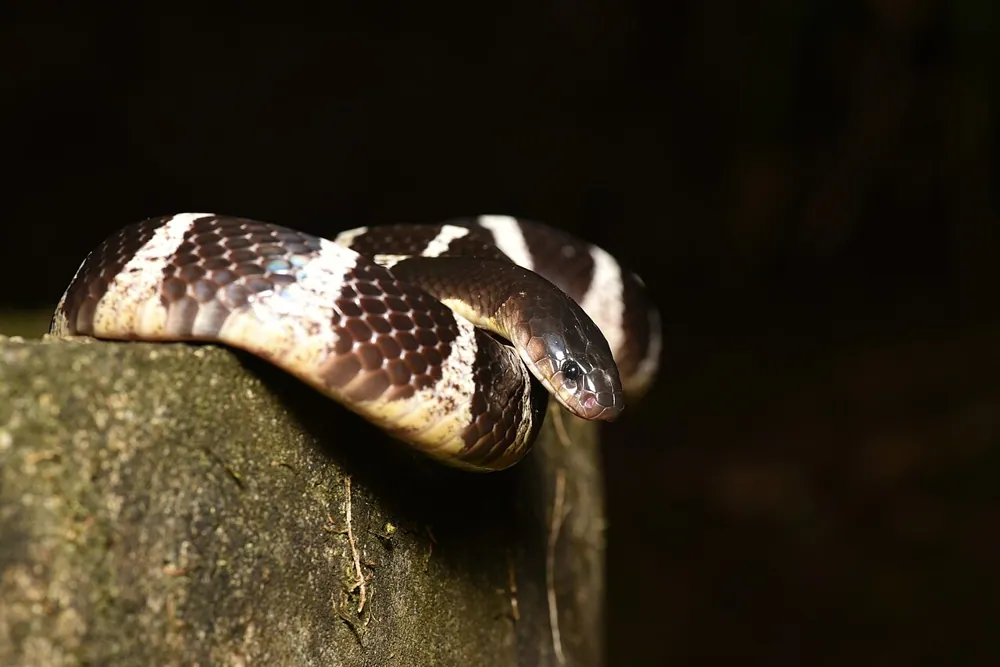
The many-banded krait is an extremely venomous snake found in central and southern China and much of Southeast Asia. It is black or bluish-black with many white bands across its body. It matters because its bite can be fatal, and it is one of the most venomous land snakes in the world.1



 Mmene ungaizindikirire
- The body is black to dark bluish-black.1
- It has about 21 to 30 white or creamy white cross bands along its upper body.1
- The short, pointed tail is black with 7 to 11 white cross bands.1
- The head is mostly black, broad and oval, and slightly flat.1
- Young snakes often have whitish blotches on the underside of the head.1
Nthawi zambiri imasokonezedwa ndi: The Malayan krait (Bungarus candidus) is easily confused with this species. A 2017 genetic study found that many museum specimens labelled as many-banded kraits in China were actually Malayan kraits.1
Mphamvu ya ululu
Ululu umatuluka kudzera m'mano ake ikaluma.
Ululu wake umachita chiyani?
Its venom contains neurotoxins, which attack the nerves and the connections between nerves and muscles. Local effects are usually mild, with slight itching and numbness rather than serious swelling or pain. Symptoms usually start one to six hours after a bite and can include drooping eyelids, double vision, weakness, tongue paralysis, loss of voice and difficulty breathing.1
Ndi yoopsa bwanji kwa anthu?
Ngozi kwa anthu: YakuphaImodzi mwa nyama zoopsa kwambiri padziko lonse.Estimated death rates from untreated bites vary between studies, from 25–35% to 70–100%. In a serious bite, breathing can stop and lead to death. In 2001, a juvenile bit the herpetologist Joe Slowinski in Myanmar and he died 29 hours later.1
Imachita chiyani ikachita mantha?
It is generally timid and placid, but it is more defensive at night and thrashes about when handled.1
 Ikaluma
- Munthuyo akhale chete ndi wodekha, chotsa mphete ndi zinthu zothina, ndipo mufikitse kuchipatala mwachangu: antivenom ndiye mankhwala ake.
Nthawi zonse yamba wayimbira nambala yadzidzidzi (112, 000, 911). Awa ndi malangizo wamba a chithandizo choyamba, osati malangizo a dokotala. Zoyambira za chithandizo choyamba
 Khala wotetezeka
- Usakhudze, kugwira kapena kuseweretsa nyama yakuthengo, ngakhale yaing'ono, ndipo ngakhale ikuoneka ngati yagona kapena yafa.
- Ipatse malo. Ukakumana nayo, khala chete, bwerera m'mbuyo pang'onopang'ono ndipo uilole ipite njira yake.
- Ikakuluma: khala chete, usasunthe, imbira nambala yadzidzidzi (112, 000, 911) kapena pita kuchipatala mwachangu. Kumbukira m'mene inkaonekera, chithunzi chimathandiza.
Sikufuna kukuvulaza. Imagwiritsa ntchito ululu wake kugwira chakudya kapena kudziteteza, ndipo imakonda kwambiri kubisala. Zambiri za kukhala wotetezeka
Kuti padziko lapansi?
Ndi yaikulu bwanji?
Ndi yaitali bwanji?
 yaitali ngati amphaka apakhomo 4 mphuno ndi mchira motsatizana
 yaitali ngati nthochi 10 zoyalidwa motsatizana
 ingathamange mamita 100 m'masekondi 49 (munthu wothamanga kwambiri amafunika 9.6)
Many-banded krait ndi yaikulu bwanji poyerekeza ndi IWE?
Ndi masamu chabe mu msakatuli wako. Palibe chomwe chimasungidwa kapena kutumizidwa kwina.
Imathamanga bwanji?


Mfundo
Its venom is among the most potent of any land snake, based on lab tests on mice dating back to 1943.1
In 2001, a juvenile bite in Myanmar killed Joe Slowinski, which drew worldwide attention to the species.1
The snake that bit Slowinski was first thought to be this species, but it was later classified as a different species.1
It is active from April and retreats into hibernation in November.1
Kuthetsa nthano zabodza
Nthano yabodza: American soldiers in the Vietnam War called it the "two-step snake", believing its venom could kill a person within two steps.
Zoona: Its symptoms usually start one to six hours after a bite, and death can take much longer. The two-step belief is wrong, and a bite still needs urgent medical care.1
Za akatswiri a ululu
- Dzina la sayansi
- Bungarus multicinctus
- Gulu
- Ma cobra, mamba ndi krait
- Banja
- Elapidae2
- Dongosolo
- Squamata
- Makontinenti
- Asia
- Ana akhanda
- It lays eggs. Females usually lay 3 to 15 eggs, and up to 20 are possible. The eggs hatch about six weeks later, and the young are about 25 cm long.1
- Kutalika kwa moyo
- pafupifupi zaka 13,71
- Ngozi kwa anthu
- 5 / 5: Yakupha3
Kumene mfundo zimachokera
- Many-banded krait (Wikipedia (CC BY-SA 4.0))
- Bungarus multicinctus (iNaturalist): mayina ndi magulu a sayansi.
- Venom Wiki: mlingo wa ngozi, kukula wamba ndi kuyerekeza kwa liwiro ndi zathu. Ona mmene timazipezera: Mmene timayezera ngozi.
Mfundo iliyonse patsamba lino ili ndi nambala yosonyeza kochokera. Ngati talakwitsa, pepani, ndife okonda nyama, osati magazini a sayansi. Tiuze pa [email protected] ndipo tikonza.
 Chinkhanira chili ndi njala! Venom Wiki ndi ntchito ya munthu mmodzi: yaulere, yopanda zotsatsa ndi zokutsatira. Mphatso yaing'ono imathandiza kuti ikhalebe pa intaneti.Dyetsa chinkhanira
 Indian cobra
 King cobra
 Caspian cobra
 Common krait
 Malayan krait
 Monocled cobra
 Deathstalker
 Indian saw-scaled viper
 Puff adder
 Njoka ya Russell (Russell's viper)
 Asian giant hornet
 Komodo dragon