
 Africa
 Asia
Asia Ulaya
Ulaya Amereka ya Kumwera
 Australia ndi Oceania
 Antarctica
 Nyanja ya Pacific
 Nyanja ya Atlantic
 Nyanja ya Indian
 Nyanja ya Arctic
 Nyanja ya Mediterranean
 Nyanja Yofiira
 Nyanja ya Caribbean
 Nyanja ya Coral
 Nyanja ya South China
 Nyanja ya Philippine
 Nyanja ya Andaman
 Nyanja ya Kumpoto (North Sea)
 Nyanja ya Timor ndi Arafura
 Nyanja ya Bengal
 Gulf ya California
Noble false widow
 Imaluma
The noble false widow is a spider that looks a lot like the black widow, which is why it has its name. It is now found in many parts of the world, including Europe, the United States and New Zealand, and it is one of the world's most invasive spiders. Its bite can be painful, so it is worth knowing what it looks like.1


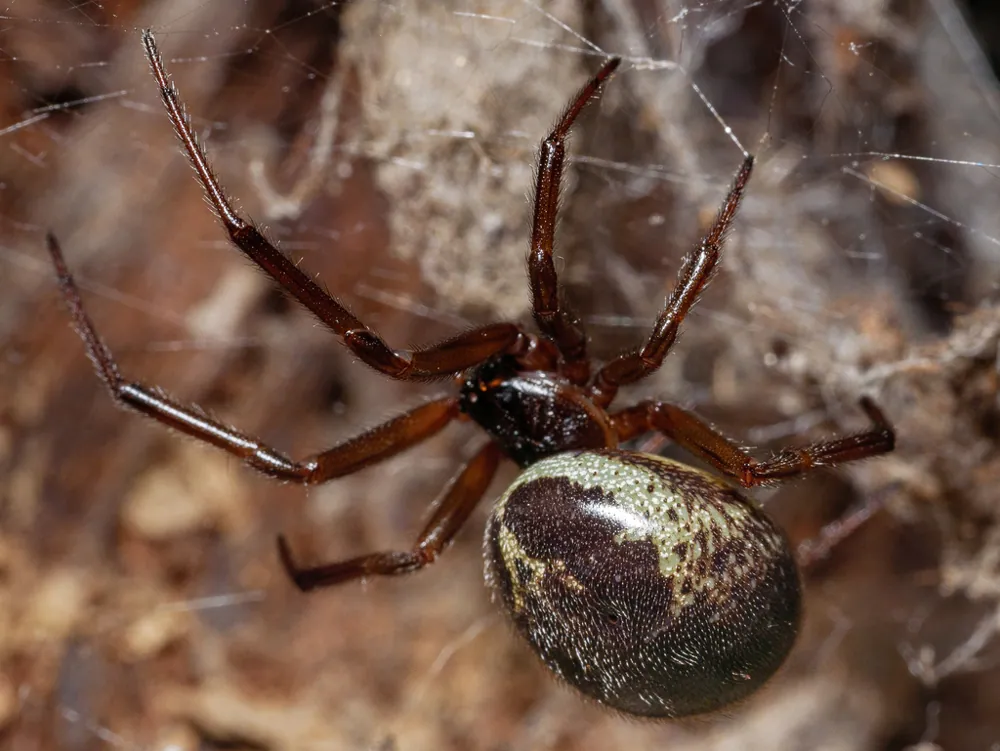
 Mmene ungaizindikirire
- The abdomen (rear body) is brown and rounded, with cream markings that are often said to look like a skull.1
- The legs are reddish-orange.1
- Adult females are about 9.5 to 14 mm in size, and males are about 7 to 11 mm.1
- It is larger than other spiders in its genus, Steatoda, and has a typical colour pattern.1
Nthawi zambiri imasokonezedwa ndi: It is often mistaken for the black widow (Latrodectus) and other false widow species. It can be told apart from the black widow by its larger size within its genus and its typical colouring, though many spiders in this group look similar.1
Mphamvu ya ululu
Ululu umatuluka kudzera m'mano ake ikaluma.
Ululu wake umachita chiyani?
Most of its venom is made of toxins similar to those of the widow spiders, mainly alpha-latrotoxin. This toxin makes holes in nerve cells, which releases chemical messengers and blocks the signals between nerves and muscles, causing paralysis. In people, the venom is most noticeable as pain at the bite site, along with swelling, redness and fever.1
Ndi yoopsa bwanji kwa anthu?
Ngozi kwa anthu: YopwetekaIngathe kupweteka kwambiri, koma pafupifupi nthawi zonse si vuto lalikulu.It is considered moderately medically significant. Most bites cause symptoms similar to a bee or wasp sting, but some can be more serious, partly because of bacteria. It is considered one of the most dangerous spiders in western Europe. Bites from males are less severe than bites from females, and the bite itself is usually painless, with pain coming from the venom.1
 Ikaluma
- Without proper treatment, a bite wound can become infected and develop into gangrene or sepsis, so medical care should be sought.1
- Sambitsa polumidwapo ndipo ikapo paketi ya ayezi kuti uchepetse kupweteka. Peza thandizo la dokotala ngati kupweteka kuli kwakukulu, kukufalikira kapena munthuyo sakumva bwino.
Nthawi zonse yamba wayimbira nambala yadzidzidzi (112, 000, 911). Awa ndi malangizo wamba a chithandizo choyamba, osati malangizo a dokotala. Zoyambira za chithandizo choyamba
 Khala wotetezeka
- Usakhudze, kugwira kapena kuseweretsa nyama yakuthengo, ngakhale yaing'ono, ndipo ngakhale ikuoneka ngati yagona kapena yafa.
- Ipatse malo. Ukakumana nayo, khala chete, bwerera m'mbuyo pang'onopang'ono ndipo uilole ipite njira yake.
- Ikakuluma: khala chete, usasunthe, imbira nambala yadzidzidzi (112, 000, 911) kapena pita kuchipatala mwachangu. Kumbukira m'mene inkaonekera, chithunzi chimathandiza.
Sikufuna kukuvulaza. Imagwiritsa ntchito ululu wake kugwira chakudya kapena kudziteteza, ndipo imakonda kwambiri kubisala. Zambiri za kukhala wotetezeka
Kuti padziko lapansi?
Ndi yaikulu bwanji?
Ndi yaitali bwanji?
 yaing'ono moti ingakhale pa chikhadabo chako
Noble false widow ndi yaikulu bwanji poyerekeza ndi IWE?
Ndi masamu chabe mu msakatuli wako. Palibe chomwe chimasungidwa kapena kutumizidwa kwina.
Imathamanga bwanji?


Mfundo
The spider often catches prey much larger than itself, including bats, because its venom works quickly.1
It can survive without drinking water, getting all its liquid from its prey.1
Males court females by tapping the web and vibrating their bodies, and they can make scraping sounds with their abdomens.1
It has poor eyesight and relies mainly on vibrations travelling through its web.1
It produces three-dimensional cobwebs, and its silk is unusually strong for its genus.1
One adult female lived almost five and a half years in captivity, and adult females are long-lived.1
Kuthetsa nthano zabodza
Nthano yabodza: It is the same spider as the black widow.
Zoona: It only looks similar to the black widow. It belongs to the genus Steatoda, while the black widow belongs to the genus Latrodectus.1
Za akatswiri a ululu
- Dzina la sayansi
- Steatoda nobilis
- Gulu
- Akangaude
- Banja
- Theridiidae2
- Dongosolo
- Araneae
- Makontinenti
- Ulaya, Africa
- Ana akhanda
- Females make egg sacs containing an average of 94 eggs, with a range of 34 to 208 eggs. The young hatch inside the egg sac about 18 days after the eggs are laid.1
- Kutalika kwa moyo
- pafupifupi zaka 51
- Ngozi kwa anthu
- 2 / 5: Yopweteka3
Kumene mfundo zimachokera
- Steatoda nobilis (Wikipedia (CC BY-SA 4.0))
- Steatoda nobilis (iNaturalist): mayina ndi magulu a sayansi.
- Venom Wiki: mlingo wa ngozi, kukula wamba ndi kuyerekeza kwa liwiro ndi zathu. Ona mmene timazipezera: Mmene timayezera ngozi.
Mfundo iliyonse patsamba lino ili ndi nambala yosonyeza kochokera. Ngati talakwitsa, pepani, ndife okonda nyama, osati magazini a sayansi. Tiuze pa [email protected] ndipo tikonza.
 Chinkhanira chili ndi njala! Venom Wiki ndi ntchito ya munthu mmodzi: yaulere, yopanda zotsatsa ndi zokutsatira. Mphatso yaing'ono imathandiza kuti ikhalebe pa intaneti.Dyetsa chinkhanira
Zina za gulu lomwelo: Akangaude
 Mediterranean black widow
 Six-eyed sand spider
 Brown widow
 Diving bell spider
 European yellow sac spider
 Tarantula wolf spider
Imakhalanso ku: Ulaya
 Common European adderMa viper ndi adderIkufuna dokotala
 Spanish flyNyama zina za poizoniIkufuna dokotalaUsakhudze
 Common waspNjuchi, mavu ndi mavu akuluakulu (hornets)Imangopweteka
 European hornetNjuchi, mavu ndi mavu akuluakulu (hornets)Imangopweteka
 Fire salamanderAchule a poizoni, achule a mphini (toads) ndi ma newtImangopwetekaUsakhudze
 Western honey beeNjuchi, mavu ndi mavu akuluakulu (hornets)Imangopweteka