
 Africa
 Asia
Asia Ulaya
Ulaya Amereka ya Kumwera
 Australia ndi Oceania
 Antarctica
 Nyanja ya Pacific
 Nyanja ya Atlantic
 Nyanja ya Indian
 Nyanja ya Arctic
 Nyanja ya Mediterranean
 Nyanja Yofiira
 Nyanja ya Caribbean
 Nyanja ya Coral
 Nyanja ya South China
 Nyanja ya Philippine
 Nyanja ya Andaman
 Nyanja ya Kumpoto (North Sea)
 Nyanja ya Timor ndi Arafura
 Nyanja ya Bengal
 Gulf ya California
Pantropical huntsman spider
 Imaluma
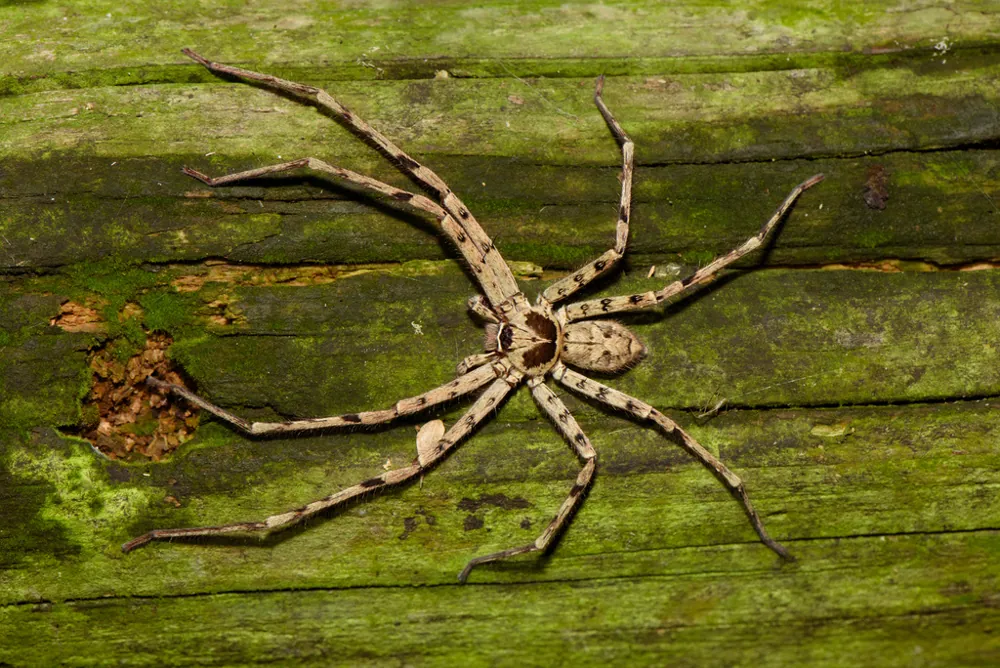
Heteropoda venatoria is a large, flat spider that hunts its prey instead of catching it in a web. It lives in tropical regions around the world and is often found in houses, barns and sheds. Its bite is painful, but it is not considered dangerous.1


 Mmene ungaizindikirire
- Adults have a flat, brown body about 2.2 to 2.8 cm long.1
- Leg span is about 7 to 10 cm.1
- The area just in front of the eyes is cream or yellowish.1
- A wide band behind the eyes is usually tan in females and cream in males.1
- The body is not very hairy, but the legs have hairs (setae), each marked with a black dot.1
Nthawi zambiri imasokonezedwa ndi: In Bermuda, where most are found indoors, it is often called a house spider, which may be confused with the southern house spider. It is sometimes called a wolf spider, which should not be confused with the true wolf spiders of the family Lycosidae.1
Mphamvu ya ululu
Ululu umatuluka kudzera m'mano ake ikaluma.
Ululu wake umachita chiyani?
Its venom contains the toxin HpTX2, which is a potassium channel blocker. The venom is strong enough to cause a painful bite.1
Ndi yoopsa bwanji kwa anthu?
Ngozi kwa anthu: YofatsaNgati kulasidwa ndi njuchi kapena pang'ono kuposa pamenepo. Pafupifupi yosavulaza anthu.The spider is not considered dangerous to people, but its bite is painful.1
 Ikaluma
- Sambitsa polumidwapo ndipo ikapo paketi ya ayezi kuti uchepetse kupweteka. Peza thandizo la dokotala ngati kupweteka kuli kwakukulu, kukufalikira kapena munthuyo sakumva bwino.
Nthawi zonse yamba wayimbira nambala yadzidzidzi (112, 000, 911). Awa ndi malangizo wamba a chithandizo choyamba, osati malangizo a dokotala. Zoyambira za chithandizo choyamba
 Khala wotetezeka
- Usakhudze, kugwira kapena kuseweretsa nyama yakuthengo, ngakhale yaing'ono, ndipo ngakhale ikuoneka ngati yagona kapena yafa.
- Ipatse malo. Ukakumana nayo, khala chete, bwerera m'mbuyo pang'onopang'ono ndipo uilole ipite njira yake.
- Ikakuluma: khala chete, usasunthe, imbira nambala yadzidzidzi (112, 000, 911) kapena pita kuchipatala mwachangu. Kumbukira m'mene inkaonekera, chithunzi chimathandiza.
Sikufuna kukuvulaza. Imagwiritsa ntchito ululu wake kugwira chakudya kapena kudziteteza, ndipo imakonda kwambiri kubisala. Zambiri za kukhala wotetezeka
Kuti padziko lapansi?
Ndi yaikulu bwanji?
Ndi yaitali bwanji?
 yaitali pafupifupi ngati kachitsulo komangira mapepala
 ingathamange mamita 100 m'masekondi 200 (munthu wothamanga kwambiri amafunika 9.6)
Pantropical huntsman spider ndi yaikulu bwanji poyerekeza ndi IWE?
Ndi masamu chabe mu msakatuli wako. Palibe chomwe chimasungidwa kapena kutumizidwa kwina.
Imathamanga bwanji?


Mfundo
It has been known to prey on scorpions and bats, as well as insects.1
During courtship, the male makes a faint buzz or hum by vibrating its abdomen while keeping its feet firmly planted.1
It does not spin webs. It hunts its prey directly.1
Females carry their egg sacs under the body until the young are ready to emerge.1
In one small laboratory sample, males lived an average of 465 days and females an average of 580 days.1
Za akatswiri a ululu
- Dzina la sayansi
- Heteropoda venatoria
- Gulu
- Akangaude
- Banja
- Sparassidae2
- Dongosolo
- Araneae
- Makontinenti
- Asia
- Ana akhanda
- Females carry an egg sac up to about 2.5 cm wide tucked under the body with their pedipalps. Each sac usually holds over 100 eggs, and larger sacs hold over 400. The young moult for the first time while still inside the sac.1
- Ngozi kwa anthu
- 1 / 5: Yofatsa3
Kumene mfundo zimachokera
- Heteropoda venatoria (Wikipedia (CC BY-SA 4.0))
- Heteropoda venatoria (iNaturalist): mayina ndi magulu a sayansi.
- Venom Wiki: mlingo wa ngozi, kukula wamba ndi kuyerekeza kwa liwiro ndi zathu. Ona mmene timazipezera: Mmene timayezera ngozi.
Mfundo iliyonse patsamba lino ili ndi nambala yosonyeza kochokera. Ngati talakwitsa, pepani, ndife okonda nyama, osati magazini a sayansi. Tiuze pa [email protected] ndipo tikonza.
 Chinkhanira chili ndi njala! Venom Wiki ndi ntchito ya munthu mmodzi: yaulere, yopanda zotsatsa ndi zokutsatira. Mphatso yaing'ono imathandiza kuti ikhalebe pa intaneti.Dyetsa chinkhanira
 Mediterranean black widow
 Diving bell spider
 European yellow sac spider
 Daddy long-legs spider
 Giant huntsman spider
 Hobo spider
 Deathstalker
 Indian cobra
 Indian saw-scaled viper
 King cobra
 Puff adder
 Njoka ya Russell (Russell's viper)