
 Africa
 Asia
Asia Ulaya
Ulaya Amereka ya Kumwera
 Australia ndi Oceania
 Antarctica
 Nyanja ya Pacific
 Nyanja ya Atlantic
 Nyanja ya Indian
 Nyanja ya Arctic
 Nyanja ya Mediterranean
 Nyanja Yofiira
 Nyanja ya Caribbean
 Nyanja ya Coral
 Nyanja ya South China
 Nyanja ya Philippine
 Nyanja ya Andaman
 Nyanja ya Kumpoto (North Sea)
 Nyanja ya Timor ndi Arafura
 Nyanja ya Bengal
 Gulf ya California
Radiant sea urchin
 Minga yaululu
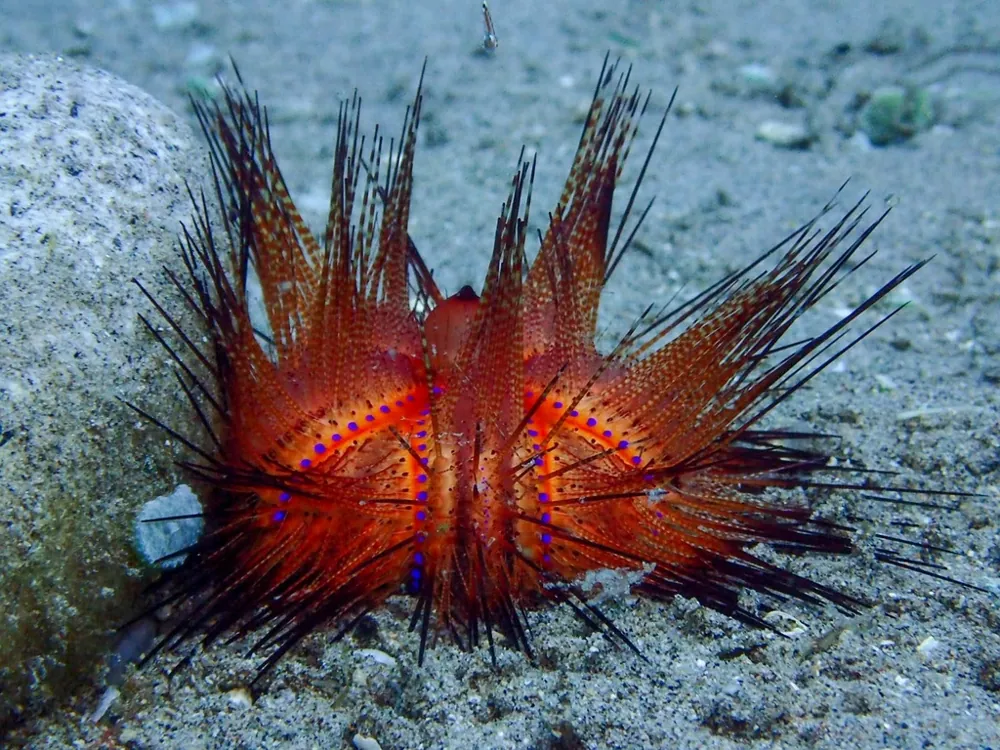
The radiant sea urchin is a large, colourful sea urchin with long, spiky spines. It lives in warm, shallow seas across the Indo-Pacific, from the African coast to Hawaii and Australia. Its spines are venomous, so it is one to admire from a distance.1

 Mmene ungaizindikirire
- A large urchin, with a body (test) up to 20 cm across.1
- Long, hollow spines up to 4 cm, in five vertical clusters.1
- Between the clusters are bare, V-shaped red areas with lines of iridescent blue dots.1
- The rest of the body and spines range from reddish brown to purple, dark brown or nearly black.1
- Juveniles have spines with banding across them, and this sometimes stays into adulthood.1
Nthawi zambiri imasokonezedwa ndi: It is often called the false fire urchin to tell it apart from the true fire urchin, Asthenosoma varium.1
Mphamvu ya ululu
Minga yakuthwa imanyamula ululu. Kuiponda kapena kuigwira kumapweteka.
Ululu wake umachita chiyani?
Its spines are venomous and can cause painful wounds. The spines are long and hollow, and the shorter of the two kinds are the venomous ones.1
Ndi yoopsa bwanji kwa anthu?
Ngozi kwa anthu: YopwetekaIngathe kupweteka kwambiri, koma pafupifupi nthawi zonse si vuto lalikulu.It is not deadly to humans, but its spines can cause painful wounds. Because it is large and brightly coloured, divers can usually see it, so injuries from stepping on one are fairly rare. On the 'Kings of Pain' pain index it scores 12 out of 30.1
Imachita chiyani ikachita mantha?
It is sensitive to light and can angle its spines towards an approaching threat.1
 Minga yake ikakubaya
- Ika bala m'madzi otentha, otentha monga momwe munthuyo angapirire osapsa, ndipo peza thandizo la dokotala kuti achotse minga. Usaikumbe wekha.
Nthawi zonse yamba wayimbira nambala yadzidzidzi (112, 000, 911). Awa ndi malangizo wamba a chithandizo choyamba, osati malangizo a dokotala. Zoyambira za chithandizo choyamba
 Khala wotetezeka
- Usakhudze, kugwira kapena kuseweretsa nyama yakuthengo, ngakhale yaing'ono, ndipo ngakhale ikuoneka ngati yagona kapena yafa.
- Ipatse malo. Ukakumana nayo, khala chete, bwerera m'mbuyo pang'onopang'ono ndipo uilole ipite njira yake.
- Minga yake ikakubaya: khala chete, usasunthe, imbira nambala yadzidzidzi (112, 000, 911) kapena pita kuchipatala mwachangu. Kumbukira m'mene inkaonekera, chithunzi chimathandiza.
Sikufuna kukuvulaza. Imagwiritsa ntchito ululu wake kugwira chakudya kapena kudziteteza, ndipo imakonda kwambiri kubisala. Zambiri za kukhala wotetezeka
Kuti padziko lapansi?
Ndi yaikulu bwanji?
Ndi yaitali bwanji?
 yaitali ngati zidutswa zomangira zoseweretsa 6 pamzere
 yochedwa kuposa nkhono ya m'munda
Radiant sea urchin ndi yaikulu bwanji poyerekeza ndi IWE?
Ndi masamu chabe mu msakatuli wako. Palibe chomwe chimasungidwa kapena kutumizidwa kwina.
Imathamanga bwanji?

Mfundo
A crab called Dorippe frascone carries the urchin on its back.1
Several shrimps, crabs and small fish live among its spines for shelter.1
Its scientific name refers to a star-shaped pattern around its anus, not to the animal's shape as a whole.1
Its bright colours and size make it a favourite subject for underwater photographers and some expert fish-keepers.1
Its young larvae drift in the ocean as plankton before they settle on the seabed.1
Za akatswiri a ululu
- Dzina la sayansi
- Astropyga radiata
- Gulu
- Nungu za m'nyanja, nyenyezi za m'nyanja ndi nyongolotsi
- Banja
- Diadematidae2
- Dongosolo
- Diadematoida
- Makontinenti
- Nyanja ya Indian, Nyanja ya Pacific, Nyanja ya Coral, Nyanja ya Philippine, Nyanja ya Timor ndi Arafura, Nyanja ya Bengal, Nyanja zikuluzikulu
- Ana akhanda
- Males and females are separate. Eggs and sperm are released into the water, and the larvae drift as plankton through several stages before settling on the seabed and becoming juveniles.1
- Ngozi kwa anthu
- 2 / 5: Yopweteka3
Kumene mfundo zimachokera
- Astropyga radiata (Wikipedia (CC BY-SA 4.0))
- Astropyga radiata (iNaturalist): mayina ndi magulu a sayansi.
- Venom Wiki: mlingo wa ngozi, kukula wamba ndi kuyerekeza kwa liwiro ndi zathu. Ona mmene timazipezera: Mmene timayezera ngozi.
Mfundo iliyonse patsamba lino ili ndi nambala yosonyeza kochokera. Ngati talakwitsa, pepani, ndife okonda nyama, osati magazini a sayansi. Tiuze pa [email protected] ndipo tikonza.
 Chinkhanira chili ndi njala! Venom Wiki ndi ntchito ya munthu mmodzi: yaulere, yopanda zotsatsa ndi zokutsatira. Mphatso yaing'ono imathandiza kuti ikhalebe pa intaneti.Dyetsa chinkhanira
Zina za gulu lomwelo: Nungu za m'nyanja, nyenyezi za m'nyanja ndi nyongolotsi
 Crown-of-thorns starfishNungu za m'nyanja, nyenyezi za m'nyanja ndi nyongolotsiIkufuna dokotalaUsakhudze
 Flower urchinNungu za m'nyanja, nyenyezi za m'nyanja ndi nyongolotsiIngathe kupha
 Fire urchinNungu za m'nyanja, nyenyezi za m'nyanja ndi nyongolotsiIkufuna dokotalaUsakhudze
 Bearded firewormNungu za m'nyanja, nyenyezi za m'nyanja ndi nyongolotsiImangopwetekaUsakhudze
 Black long-spined urchinNungu za m'nyanja, nyenyezi za m'nyanja ndi nyongolotsiImangopwetekaUsakhudze
 BloodwormNungu za m'nyanja, nyenyezi za m'nyanja ndi nyongolotsiImangopweteka
Imakhalanso ku: Nyanja ya Indian
 Australian box jellyfishJellyfish ndi zolasa za m'nyanjaYakuphaUsakhudze
 Geography coneNkhono za cone ndi ma octopusYakupha
 Greater blue-ringed octopusNkhono za cone ndi ma octopusYakupha
 Southern blue-ringed octopusNkhono za cone ndi ma octopusYakupha
 Hawksbill sea turtleNyama zina za poizoniIngathe kupha
 Irukandji jellyfishJellyfish ndi zolasa za m'nyanjaIngathe kuphaUsakhudze