
 Africa
 Asia
Asia Ulaya
Ulaya Amereka ya Kumwera
 Australia ndi Oceania
 Antarctica
 Nyanja ya Pacific
 Nyanja ya Atlantic
 Nyanja ya Indian
 Nyanja ya Arctic
 Nyanja ya Mediterranean
 Nyanja Yofiira
 Nyanja ya Caribbean
 Nyanja ya Coral
 Nyanja ya South China
 Nyanja ya Philippine
 Nyanja ya Andaman
 Nyanja ya Kumpoto (North Sea)
 Nyanja ya Timor ndi Arafura
 Nyanja ya Bengal
 Gulf ya California
Red-necked keelback
 Imaluma
The red-necked keelback is a snake from the Indonesian islands of Java and Sumatra. It is unusual because it is venomous, which is rare for snakes in its family, and it was only recently reclassified as dangerous to people.1



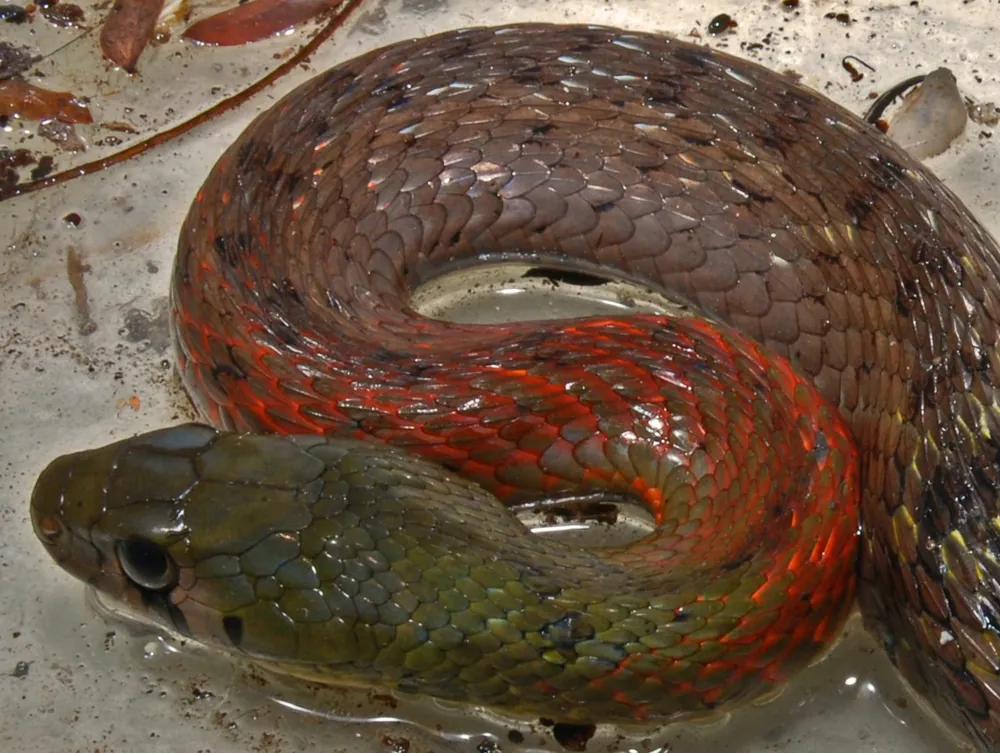
 Mmene ungaizindikirire
Mphamvu ya ululu
Ululu umatuluka kudzera m'mano ake ikaluma.
Ululu wake umachita chiyani?
This snake is rear-fanged, so its venom is delivered through grooved teeth at the back of the upper jaw rather than through hollow front fangs. Its venom can cause internal bleeding, including bleeding in the brain, nausea, and blood clotting problems such as disseminated intravascular coagulation. In animal tests, the venom caused kidney failure.1
Ndi yoopsa bwanji kwa anthu?
Ngozi kwa anthu: YoopsaKulumidwa kumafuna dokotala. Imfa ndi zosowa kwambiri.After one fatal and several near-fatal envenomations, the snake was reclassified as dangerous. Most bites to people involve the front teeth and cause no harmful effects, but rare bites from the rear fangs can be lethal. Recent reports describe severe envenomation and organ failure, affecting the kidneys and liver, after even brief bites.1
Imachita chiyani ikachita mantha?
When threatened, for example by being touched, it can burst its nuchal glands in the red neck, releasing stored toad toxins (bufotoxins) that cause fast heartbeat, drooling, convulsions and paralysis.1
 Ikaluma
- Care is needed when treating a bitten person. Injections should be avoided, as they may cause excessive bleeding.1
- Sambitsa polumidwapo, munthuyo akhale wodekha ndipo peza thandizo la dokotala. Mitundu ina (monga boomslang) ingathe kupha patapita maola.
Nthawi zonse yamba wayimbira nambala yadzidzidzi (112, 000, 911). Awa ndi malangizo wamba a chithandizo choyamba, osati malangizo a dokotala. Zoyambira za chithandizo choyamba
 Khala wotetezeka
- Usakhudze, kugwira kapena kuseweretsa nyama yakuthengo, ngakhale yaing'ono, ndipo ngakhale ikuoneka ngati yagona kapena yafa.
- Ipatse malo. Ukakumana nayo, khala chete, bwerera m'mbuyo pang'onopang'ono ndipo uilole ipite njira yake.
- Ikakuluma: khala chete, usasunthe, imbira nambala yadzidzidzi (112, 000, 911) kapena pita kuchipatala mwachangu. Kumbukira m'mene inkaonekera, chithunzi chimathandiza.
Sikufuna kukuvulaza. Imagwiritsa ntchito ululu wake kugwira chakudya kapena kudziteteza, ndipo imakonda kwambiri kubisala. Zambiri za kukhala wotetezeka
Kuti padziko lapansi?
Ndi yaikulu bwanji?
Ndi yaitali bwanji?
 yaitali ngati amphaka apakhomo 2 mphuno ndi mchira motsatizana
 yaitali ngati nthochi 5 zoyalidwa motsatizana
 ingathamange mamita 100 m'masekondi 71 (munthu wothamanga kwambiri amafunika 9.6)
Red-necked keelback ndi yaikulu bwanji poyerekeza ndi IWE?
Ndi masamu chabe mu msakatuli wako. Palibe chomwe chimasungidwa kapena kutumizidwa kwina.
Imathamanga bwanji?


Mfundo
It stores toxins from the toads it eats in glands in its neck, which it can release when threatened.1
Unusually for a member of the colubrid family, which is a large snake family, this species is venomous.1
Its venom ducts open onto grooved fangs at the back of the mouth, and chewing helps the venom enter a bite.1
During mating, several males may swarm around a single female.1
Kuthetsa nthano zabodza
Nthano yabodza: The red-necked keelback is harmless because it was once thought to be.
Zoona: It is venomous. It was previously thought harmless, but after serious bites it was reclassified as dangerous.1
Kumene mfundo zimachokera
- Rhabdophis subminiatus (Wikipedia (CC BY-SA 4.0))
- Rhabdophis subminiatus (iNaturalist): mayina ndi magulu a sayansi.
- Venom Wiki: mlingo wa ngozi, kukula wamba ndi kuyerekeza kwa liwiro ndi zathu. Ona mmene timazipezera: Mmene timayezera ngozi.
Mfundo iliyonse patsamba lino ili ndi nambala yosonyeza kochokera. Ngati talakwitsa, pepani, ndife okonda nyama, osati magazini a sayansi. Tiuze pa [email protected] ndipo tikonza.
 Chinkhanira chili ndi njala! Venom Wiki ndi ntchito ya munthu mmodzi: yaulere, yopanda zotsatsa ndi zokutsatira. Mphatso yaing'ono imathandiza kuti ikhalebe pa intaneti.Dyetsa chinkhanira
 Brown tree snake
 Tiger keelback
 Green cat snake
 Mangrove snake
 Asian vine snake
 Golden tree snake
 Deathstalker
 Indian cobra
 Indian saw-scaled viper
 King cobra
 Puff adder
 Njoka ya Russell (Russell's viper)