
 Africa
 Asia
Asia Ulaya
Ulaya Amereka ya Kumwera
 Australia ndi Oceania
 Antarctica
 Nyanja ya Pacific
 Nyanja ya Atlantic
 Nyanja ya Indian
 Nyanja ya Arctic
 Nyanja ya Mediterranean
 Nyanja Yofiira
 Nyanja ya Caribbean
 Nyanja ya Coral
 Nyanja ya South China
 Nyanja ya Philippine
 Nyanja ya Andaman
 Nyanja ya Kumpoto (North Sea)
 Nyanja ya Timor ndi Arafura
 Nyanja ya Bengal
 Gulf ya California
Tiger keelback
 Imaluma
The tiger keelback is a venomous snake with a striped olive-green and orange pattern. It lives across East Asia and Southeast Asia. Its venom is delivered by rear fangs, which sit at the back of the mouth, and it is rarely deadly to people.1

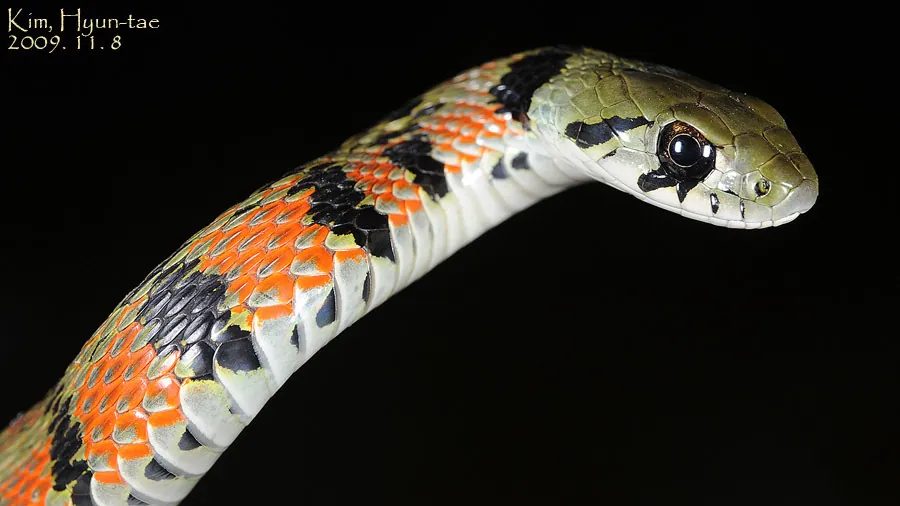
 Mmene ungaizindikirire
Mphamvu ya ululu
Ululu umatuluka kudzera m'mano ake ikaluma.
Ndi yoopsa bwanji kwa anthu?
Ngozi kwa anthu: Yoopsa kwambiriIngathe kupha munthu amene sanalandire chithandizo.Although it is venomous, few deaths have been recorded from its bites. It rarely strikes, because it tends to flatten, lie still or flee instead, and its rear fangs make a strong bite on a large object difficult.1
Imachita chiyani ikachita mantha?
At cooler temperatures it flattens its neck and body and lies still. At higher temperatures it is more likely to flee.1
 Ikaluma
- Sambitsa polumidwapo, munthuyo akhale wodekha ndipo peza thandizo la dokotala. Mitundu ina (monga boomslang) ingathe kupha patapita maola.
Nthawi zonse yamba wayimbira nambala yadzidzidzi (112, 000, 911). Awa ndi malangizo wamba a chithandizo choyamba, osati malangizo a dokotala. Zoyambira za chithandizo choyamba
 Khala wotetezeka
- Usakhudze, kugwira kapena kuseweretsa nyama yakuthengo, ngakhale yaing'ono, ndipo ngakhale ikuoneka ngati yagona kapena yafa.
- Ipatse malo. Ukakumana nayo, khala chete, bwerera m'mbuyo pang'onopang'ono ndipo uilole ipite njira yake.
- Ikakuluma: khala chete, usasunthe, imbira nambala yadzidzidzi (112, 000, 911) kapena pita kuchipatala mwachangu. Kumbukira m'mene inkaonekera, chithunzi chimathandiza.
Sikufuna kukuvulaza. Imagwiritsa ntchito ululu wake kugwira chakudya kapena kudziteteza, ndipo imakonda kwambiri kubisala. Zambiri za kukhala wotetezeka
Kuti padziko lapansi?
Ndi yaikulu bwanji?
Ndi yaitali bwanji?
 yaitali ngati amphaka apakhomo 2 mphuno ndi mchira motsatizana
 yaitali ngati nthochi 6 zoyalidwa motsatizana
 ingathamange mamita 100 m'masekondi 69 (munthu wothamanga kwambiri amafunika 9.6)
Tiger keelback ndi yaikulu bwanji poyerekeza ndi IWE?
Ndi masamu chabe mu msakatuli wako. Palibe chomwe chimasungidwa kapena kutumizidwa kwina.
Imathamanga bwanji?


Mfundo
It stores toxic steroids in special glands on the back of its neck, taken from the toads it eats, and it is resistant to their effects.1
Females can pass the stored toad toxins to their offspring through the egg yolk and the egg membranes.1
Two rows of neck glands give it a chemical defence, a process called kleptotoxisism, meaning it steals toxins from its prey and uses them for its own protection.1
Its fangs are at the back of its mouth, which makes a strong strike on a large animal difficult.1
Kuthetsa nthano zabodza
Nthano yabodza: Its venom is the source of its toxic defence.
Zoona: Its venom is made in glands in the mouth and is not known to contain the toad toxins. The defensive toxins come from glands in its neck.1
Kumene mfundo zimachokera
- Rhabdophis tigrinus (Wikipedia (CC BY-SA 4.0))
- Rhabdophis tigrinus (iNaturalist): mayina ndi magulu a sayansi.
- Venom Wiki: mlingo wa ngozi, kukula wamba ndi kuyerekeza kwa liwiro ndi zathu. Ona mmene timazipezera: Mmene timayezera ngozi.
Mfundo iliyonse patsamba lino ili ndi nambala yosonyeza kochokera. Ngati talakwitsa, pepani, ndife okonda nyama, osati magazini a sayansi. Tiuze pa [email protected] ndipo tikonza.
 Chinkhanira chili ndi njala! Venom Wiki ndi ntchito ya munthu mmodzi: yaulere, yopanda zotsatsa ndi zokutsatira. Mphatso yaing'ono imathandiza kuti ikhalebe pa intaneti.Dyetsa chinkhanira
Zina za gulu lomwelo: Njoka za mano akumbuyo
 Brown tree snakeNjoka za mano akumbuyoImangopweteka
 Red-necked keelbackNjoka za mano akumbuyoIkufuna dokotala
 Green cat snakeNjoka za mano akumbuyoImangopweteka
 Mangrove snakeNjoka za mano akumbuyoImangopweteka
 Asian vine snakeNjoka za mano akumbuyoYosavulaza
 Golden tree snakeNjoka za mano akumbuyoYosavulaza
 Deathstalker
 Indian cobra
 Indian saw-scaled viper
 King cobra
 Puff adder
 Njoka ya Russell (Russell's viper)