
 Africa
 Asia
Asia Ulaya
Ulaya Amereka ya Kumwera
 Australia ndi Oceania
 Antarctica
 Nyanja ya Pacific
 Nyanja ya Atlantic
 Nyanja ya Indian
 Nyanja ya Arctic
 Nyanja ya Mediterranean
 Nyanja Yofiira
 Nyanja ya Caribbean
 Nyanja ya Coral
 Nyanja ya South China
 Nyanja ya Philippine
 Nyanja ya Andaman
 Nyanja ya Kumpoto (North Sea)
 Nyanja ya Timor ndi Arafura
 Nyanja ya Bengal
 Gulf ya California
Western hognose snake
 Imaluma
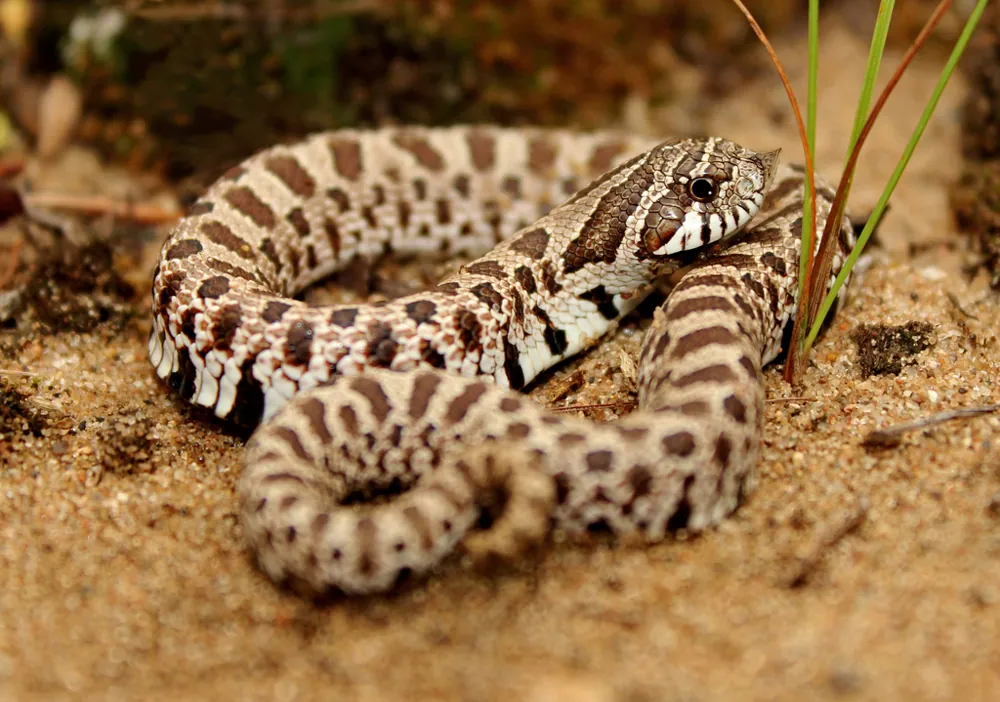
The western hognose snake is a small, stout-bodied snake with an upturned nose that looks a bit like a pig's snout. It lives across much of North America, from southern Canada to northern Mexico, in sandy and gravelly places such as prairies and grasslands. It is often mistaken for a rattlesnake, but its bite is not regarded as dangerous to people.1



 Mmene ungaizindikirire
- Relatively small and stout-bodied, with adults rarely exceeding 40–50 cm in total length, tail included.1
- A modified, upturned nose scale gives it a distinctive hog-like snout.1
- Colour and pattern vary a great deal between subspecies and individuals.1
- When threatened, it flattens its neck, hisses and may puff up its throat with air.1
Nthawi zambiri imasokonezedwa ndi: To an untrained eye, most individuals look much like rattlesnakes, which is thought to be a form of mimicry that makes predators wary. Its upturned snout and small, stout body are features to note.1
Mphamvu ya ululu
Ululu umatuluka kudzera m'mano ake ikaluma.
Ululu wake umachita chiyani?
The snake releases modified saliva from its Duvernoy's glands, which runs down a groove in its rear fang and helps break down the toxins of toads it eats. No deaths or whole-body (systemic) effects in people have been recorded from its bite. Bites may occasionally be medically significant.1
Ndi yoopsa bwanji kwa anthu?
Ngozi kwa anthu: YofatsaNgati kulasidwa ndi njuchi kapena pang'ono kuposa pamenepo. Pafupifupi yosavulaza anthu.The species is not dangerous to people and is not regarded as venomous. Its bites are extremely rare, and no deaths or systemic effects have been recorded. Bites may uncommonly be medically significant.1
Imachita chiyani ikachita mantha?
It flattens its neck, hisses and may make mock strikes with its mouth closed. If harassed further, it usually plays dead rather than biting.1
 Ikaluma
- Sambitsa polumidwapo, munthuyo akhale wodekha ndipo peza thandizo la dokotala. Mitundu ina (monga boomslang) ingathe kupha patapita maola.
Nthawi zonse yamba wayimbira nambala yadzidzidzi (112, 000, 911). Awa ndi malangizo wamba a chithandizo choyamba, osati malangizo a dokotala. Zoyambira za chithandizo choyamba
 Khala wotetezeka
- Usakhudze, kugwira kapena kuseweretsa nyama yakuthengo, ngakhale yaing'ono, ndipo ngakhale ikuoneka ngati yagona kapena yafa.
- Ipatse malo. Ukakumana nayo, khala chete, bwerera m'mbuyo pang'onopang'ono ndipo uilole ipite njira yake.
- Ikakuluma: khala chete, usasunthe, imbira nambala yadzidzidzi (112, 000, 911) kapena pita kuchipatala mwachangu. Kumbukira m'mene inkaonekera, chithunzi chimathandiza.
Sikufuna kukuvulaza. Imagwiritsa ntchito ululu wake kugwira chakudya kapena kudziteteza, ndipo imakonda kwambiri kubisala. Zambiri za kukhala wotetezeka
Kuti padziko lapansi?
Ndi yaikulu bwanji?
Ndi yaitali bwanji?
 yaitali ngati nthochi 3 zoyalidwa motsatizana
 yaitali ngati zidutswa zomangira zoseweretsa 16 pamzere
 ingathamange mamita 100 m'masekondi 77 (munthu wothamanga kwambiri amafunika 9.6)
Western hognose snake ndi yaikulu bwanji poyerekeza ndi IWE?
Ndi masamu chabe mu msakatuli wako. Palibe chomwe chimasungidwa kapena kutumizidwa kwina.
Imathamanga bwanji?


Mfundo
Captive breeders have produced more than 50 'designer' colour morphs of this snake.1
In captivity, many hognose snakes refuse food for about two to three and a half months, from January to mid March, because they instinctively brumate, or sleep, underground in winter.1
Males are considerably smaller than females.1
Hatchlings reach sexual maturity after about two years, based mostly on size rather than age.1
Kuthetsa nthano zabodza
Nthano yabodza: Because it looks like a rattlesnake, it must be dangerous or deadly.
Zoona: The western hognose snake is not dangerous to people. Its rare bites have not caused recorded deaths or whole-body effects, and it usually plays dead instead of biting.1
Za akatswiri a ululu
- Dzina la sayansi
- Heterodon nasicus
- Gulu
- Njoka za mano akumbuyo
- Banja
- Colubridae2
- Dongosolo
- Squamata
- Makontinenti
- Amereka ya Kumpoto
- Ana akhanda
- It lays eggs. Females lay 4–23 elongate, thin-shelled eggs between June and August, which hatch after about 60 days.1
- Mmene ilili kuthengo
- Least Concern (IUCN)1
- Ngozi kwa anthu
- 1 / 5: Yofatsa3
Kumene mfundo zimachokera
- Western hognose snake (Wikipedia (CC BY-SA 4.0))
- Heterodon nasicus (iNaturalist): mayina ndi magulu a sayansi.
- Venom Wiki: mlingo wa ngozi, kukula wamba ndi kuyerekeza kwa liwiro ndi zathu. Ona mmene timazipezera: Mmene timayezera ngozi.
Mfundo iliyonse patsamba lino ili ndi nambala yosonyeza kochokera. Ngati talakwitsa, pepani, ndife okonda nyama, osati magazini a sayansi. Tiuze pa [email protected] ndipo tikonza.
 Chinkhanira chili ndi njala! Venom Wiki ndi ntchito ya munthu mmodzi: yaulere, yopanda zotsatsa ndi zokutsatira. Mphatso yaing'ono imathandiza kuti ikhalebe pa intaneti.Dyetsa chinkhanira
Zina za gulu lomwelo: Njoka za mano akumbuyo
 Brown vine snake
 Eastern hognose snake
 Green vine snake
 Desert night snake
 Night snake
 Sonoran lyre snake
Imakhalanso ku: Amereka ya Kumpoto
 TerciopeloNjoka za pit viperYakupha
 Eastern coral snakeNjoka za coralIngathe kupha
 Eastern diamondback rattlesnakeNjoka za rattlesnakeIngathe kupha
 Eyelash viperNjoka za pit viperIngathe kupha
 Timber rattlesnakeNjoka za rattlesnakeIngathe kupha
 Western diamondback rattlesnakeNjoka za rattlesnakeIngathe kupha