
 Africa
 Asia
Asia Ulaya
Ulaya Amereka ya Kumwera
 Australia ndi Oceania
 Antarctica
 Nyanja ya Pacific
 Nyanja ya Atlantic
 Nyanja ya Indian
 Nyanja ya Arctic
 Nyanja ya Mediterranean
 Nyanja Yofiira
 Nyanja ya Caribbean
 Nyanja ya Coral
 Nyanja ya South China
 Nyanja ya Philippine
 Nyanja ya Andaman
 Nyanja ya Kumpoto (North Sea)
 Nyanja ya Timor ndi Arafura
 Nyanja ya Bengal
 Gulf ya California
Green vine snake
 Imaluma
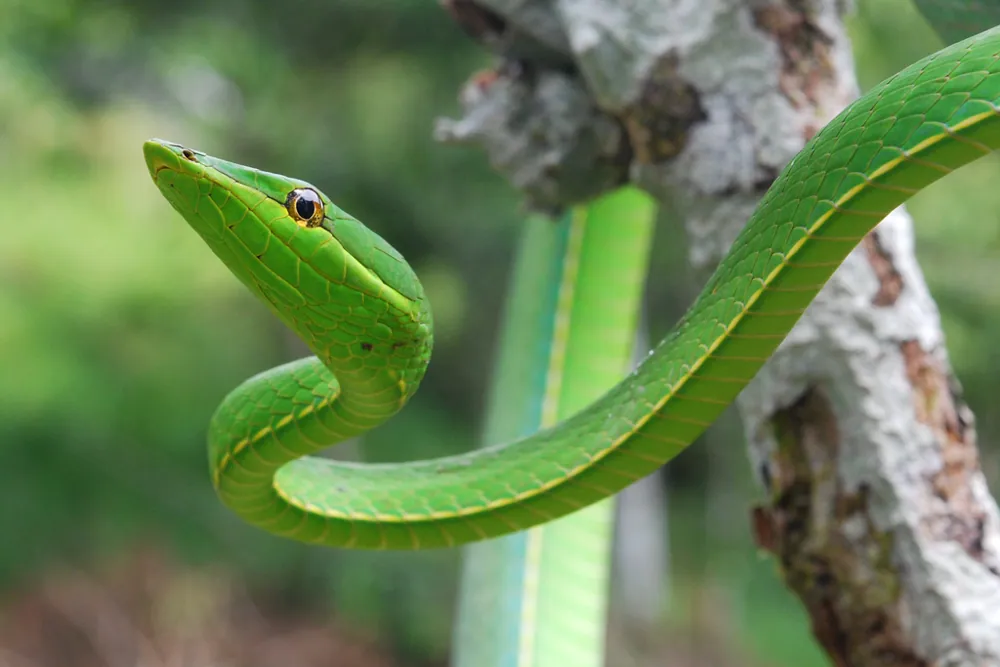
The green vine snake is a slender, bright green snake that lives high in the trees of Central and northern South America. It hunts small animals from the branches, and it is rear-fanged, which means its venom is delivered from the back of the mouth.1



 Mmene ungaizindikirire
- Bright green on its back, with yellowish green underneath and on the upper lip1
- A narrow yellowish-white stripe runs along each side of the belly and tail1
- Very slender body with a long, pointed head and a very large mouth that reaches almost the whole length of the head1
- Long green tongue, kept outside the mouth and moved up and down1
- Long, delicate tail, used to hold on while reaching for prey1
Mphamvu ya ululu
Ululu umatuluka kudzera m'mano ake ikaluma.
Ululu wake umachita chiyani?
Its saliva is toxic, and it works quickly on small animals, so they are stopped from fighting back. It has little to no effect on humans. In the rare reported bites, slight tingling or temporary numbness at the bite site has been reported.1
Ndi yoopsa bwanji kwa anthu?
Ngozi kwa anthu: YofatsaNgati kulasidwa ndi njuchi kapena pang'ono kuposa pamenepo. Pafupifupi yosavulaza anthu.Bites to people are rare, because the snake has to grab hold and chew its saliva into the skin, which most people will not allow. Serious allergic reactions are possible, as with any venomous animal, and most allergies are not known before a bite.1
 Ikaluma
- Sambitsa polumidwapo, munthuyo akhale wodekha ndipo peza thandizo la dokotala. Mitundu ina (monga boomslang) ingathe kupha patapita maola.
Nthawi zonse yamba wayimbira nambala yadzidzidzi (112, 000, 911). Awa ndi malangizo wamba a chithandizo choyamba, osati malangizo a dokotala. Zoyambira za chithandizo choyamba
 Khala wotetezeka
- Usakhudze, kugwira kapena kuseweretsa nyama yakuthengo, ngakhale yaing'ono, ndipo ngakhale ikuoneka ngati yagona kapena yafa.
- Ipatse malo. Ukakumana nayo, khala chete, bwerera m'mbuyo pang'onopang'ono ndipo uilole ipite njira yake.
- Ikakuluma: khala chete, usasunthe, imbira nambala yadzidzidzi (112, 000, 911) kapena pita kuchipatala mwachangu. Kumbukira m'mene inkaonekera, chithunzi chimathandiza.
Sikufuna kukuvulaza. Imagwiritsa ntchito ululu wake kugwira chakudya kapena kudziteteza, ndipo imakonda kwambiri kubisala. Zambiri za kukhala wotetezeka
Kuti padziko lapansi?
Ndi yaikulu bwanji?
Ndi yaitali bwanji?
 yaitali ngati amphaka apakhomo 4 mphuno ndi mchira motsatizana
 yaitali ngati nthochi 11 zoyalidwa motsatizana
 ingathamange mamita 100 m'masekondi 57 (munthu wothamanga kwambiri amafunika 9.6)
Green vine snake ndi yaikulu bwanji poyerekeza ndi IWE?
Ndi masamu chabe mu msakatuli wako. Palibe chomwe chimasungidwa kapena kutumizidwa kwina.
Imathamanga bwanji?


Mfundo
Its tongue is thought to work like a cat's whiskers, helping it sense its way through branches and brush as it moves quickly.1
After biting, it coils around its prey. It does not squeeze the prey the way a constrictor does, but the coil helps to hold it.1
It is rear-fanged, with two larger but blunted, peg-like teeth at the upper back of the mouth. These teeth have grooves on the sides that deliver its saliva.1
After swallowing a meal, it usually moves to the highest point of a tree to rest.1
In captivity it readily takes mice, and some are large enough to eat rats, which makes it a prized choice among reptile collectors.1
Kuthetsa nthano zabodza
Nthano yabodza: That the bite of this snake is dangerous to people.
Zoona: Its venom has little to no effect on humans. It is fast-acting on small animals, but bites to people are rare and usually cause only slight tingling or temporary numbness.1
Kumene mfundo zimachokera
- Oxybelis fulgidus (Wikipedia (CC BY-SA 4.0))
- Oxybelis fulgidus (iNaturalist): mayina ndi magulu a sayansi.
- Venom Wiki: mlingo wa ngozi, kukula wamba ndi kuyerekeza kwa liwiro ndi zathu. Ona mmene timazipezera: Mmene timayezera ngozi.
Mfundo iliyonse patsamba lino ili ndi nambala yosonyeza kochokera. Ngati talakwitsa, pepani, ndife okonda nyama, osati magazini a sayansi. Tiuze pa [email protected] ndipo tikonza.
 Chinkhanira chili ndi njala! Venom Wiki ndi ntchito ya munthu mmodzi: yaulere, yopanda zotsatsa ndi zokutsatira. Mphatso yaing'ono imathandiza kuti ikhalebe pa intaneti.Dyetsa chinkhanira
Zina za gulu lomwelo: Njoka za mano akumbuyo
 Western hognose snakeNjoka za mano akumbuyoYosavulaza
 Baron's green racerNjoka za mano akumbuyoImangopweteka
 False water cobraNjoka za mano akumbuyoImangopweteka
 Brown vine snakeNjoka za mano akumbuyoYosavulaza
 Eastern hognose snakeNjoka za mano akumbuyoYosavulaza
 Lichtenstein's green racerNjoka za mano akumbuyoIkufuna dokotala
Imakhalanso ku: Amereka ya Kumpoto
 TerciopeloNjoka za pit viperYakupha
 Eastern coral snakeNjoka za coralIngathe kupha
 Eastern diamondback rattlesnakeNjoka za rattlesnakeIngathe kupha
 Eyelash viperNjoka za pit viperIngathe kupha
 Timber rattlesnakeNjoka za rattlesnakeIngathe kupha
 Western diamondback rattlesnakeNjoka za rattlesnakeIngathe kupha